- Animals
- ›Arthropods
- ›Hexapods
- ›Insects
- ›Winged and Once-winged Insects
- ›Butterflies and Moths
- ›Curved-horn Moths
- ›Concealer Moths
- ›Trachypepla
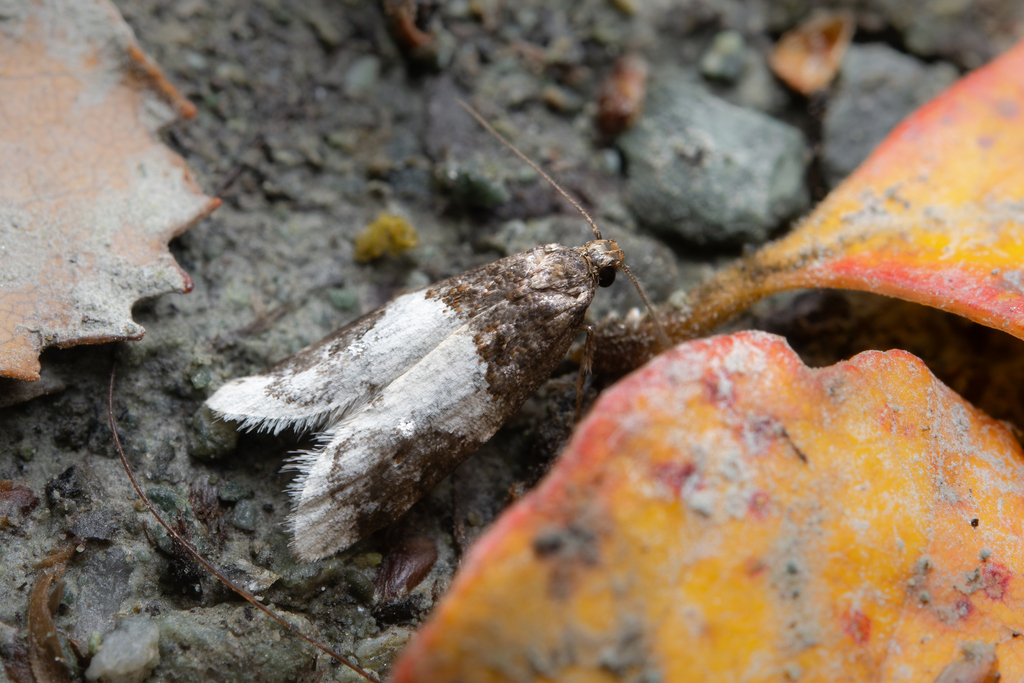
Trachypepla ingenua
Trachypepla ingenua is a moth of the family Oecophoridae first described by Edward Meyrick in 1911. It is endemic to New Zealand and has been collected in both the North and South Islands. This species is one of the larger in the genus Trachypepla and the colouration of the adults imitates bird droppings. The preferred habitat of T. ingenua is native forest and adults are on the wing from December to February.
From the article Trachypepla ingenua on Wikipedia (CC BY-SA), quoted section by section
Description
Meyrick described this species as follows:
♂. 18 mm. Head rather dark fuscous irrorated with whitish. Palpi dark fuscous, second joint sprinkled with white towards apex, terminal joint white with two bands of dark-fuscous irroration. Antennal ciliations 1+1⁄2. Thorax dark fuscous. Abdomen brownish finely irrorated with whitish, segmental margins whitish-grey. Forewings elongate, rather narrow, costa moderately arched, apex obtuse, termen very obliquely rounded; white; a dark purplish-fuscous basal patch occupying 2⁄5 of wing, outer edge straight, mixed with chestnut-brown towards edge from above middle to near dorsum; some scattered grey scales in disc beyond this; an irregular-triangular dark purplish-fuscous blotch on costa beyond middle, reaching more than half across wing, posterior edge excavated beneath costa, its lower portion mixed with chestnut-brown; a ring of dark-fuscous irroration preceding apex of this blotch in disc, and partly limited by it : a narrow transverse suffused grey patch in disc following this; a curved cloudy line of dark- fuscous irroration from 4⁄5 of costa to tornus, forming a triangular dark-fuscous spot on costa, and indented beneath this : cilia whitish, round apex tinged with grey and somewhat sprinkled with dark fuscous. …
Range & habitat
This species is endemic to New Zealand and has been found in both the North and the South Islands. As well as at the type locality, this species has also been collected at Mount Arthur at an altitude of approximately 1050 m, at Arthur's Pass, at Aoraki / Mount Cook, on the Milford Track, on the Clinton River and near the Homer tunnel.
Wikipedia: “Distribution”
What it does
Adults of this species are on the wing from December to February.
== References ==
Wikipedia: “Behaviour”
Listen
Looking for field recordings…
Where it lives
Recorded sightings
—
geo-referenced records in GBIF, from museums, herbaria and field observers.
Drag the globe to turn it. Dots are where records exist, not a range map; darker means more records.
In the stacks
Searching the stacks…
Every page naming Trachypepla ingenua in the Biodiversity Heritage Library →
This page is assembled live from iNaturalist, GBIF, Wikipedia, the Source Library and the Internet Archive. It is not yet part of the hand-edited codex. iNaturalist taxon 563965.