- Plants
- ›Vascular Plants
- ›flowering plants
- ›Dicots
- ›Legumes, Milkworts, and Allies
- ›Legumes
- ›Faboideae
- ›Robinieae
- ›Robinia
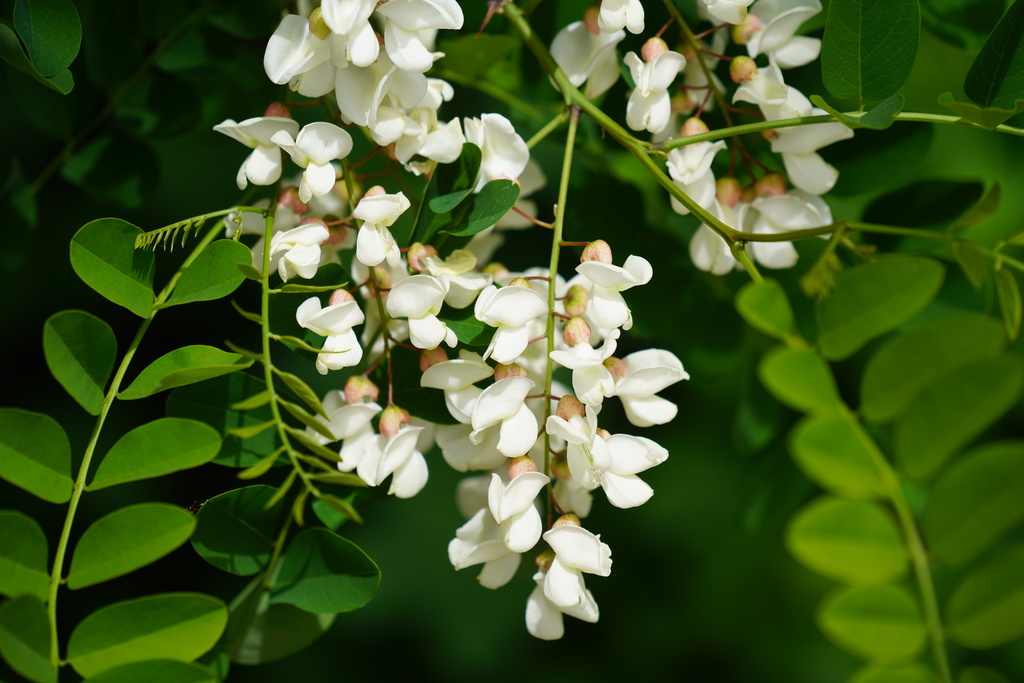
black locust
Robinia pseudoacacia
Robinia pseudoacacia, commonly known as black locust, is a medium-sized hardwood deciduous tree, belonging to the tribe Robinieae of the legume family. Another common name is false acacia, a literal translation of the specific name (pseudo [Greek ψευδο-] meaning 'fake' or 'false' and acacia referring to the genus of plants with the same name).
Although fossilized traces of the genus were found in Europe, the species itself is native to a few small areas of the United States, but has been widely planted and naturalized elsewhere, including temperate North America, Eurasia, and Africa. It is considered an invasive species in some regions.
From the article Robinia pseudoacacia on Wikipedia (CC BY-SA), quoted section by section
Description
The roots of black locust contain nodules that allow it to fix nitrogen, as is common within the pea family. Trees reach a typical height of 12–30 metres (40–100 feet) with a diameter of 0.6–1.2 m (2–4 ft). It is a very upright tree with a straight trunk and narrow crown that grows scraggly with age. The bark is a reddish black and gray and tinged with red or orange in the grooves; it is deeply furrowed into grooves and ridges which run up and down the trunk and often cross and form diamond shapes. The branches are typically zig-zaggy and may have ridges and grooves or may be round. When young, the branches are at first coated with white silvery down; this soon disappears, and they become pale green and afterward reddish or greenish brown. The dark blue-green leaves are lighter on the underside, and are compound, meaning that each leaf contains many smaller leaflike structures called leaflets, which are roughly paired on either side of the stem that runs through the leaf (rachis). There is typically one leaflet at the tip of the leaf (odd pinnate), and the leaves are alternately arranged on the stem. Each leaf is 15–36 cm (6–14 in) long and contains 9–19 leaflets, each being 2.5–5 cm (1–2 in) long and 0.6–2 cm (1⁄4–3⁄4 in) wide. The leaflets are rounded or slightly indented at the tip and typically rounded at the base. …
Range & habitat
The genus Robinia is native to North America, although traces of it are found in Eocene and Miocene rocks in Europe. The species itself is native to the eastern United States, but its exact native range is not accurately known as it has been cultivated and is now found in all 48 lower states, British Columbia, and eastern Canada. The native range is thought to be two separate populations, one centered about the Appalachian Mountains from Pennsylvania to northern Georgia, and a second westward focused around the Ozark Plateau and Ouachita Mountains of Arkansas, Oklahoma and Missouri. The tree has been naturalized in temperate North America, Eurasia, and Africa. Humans have distributed the tree for landscaping, with its range now including Canada, Southern South America, Europe, temperate regions in Asia (including China, India, and Pakistan), Northern and Southern Africa, Australia, and New Zealand.
Wikipedia: “Distribution”
What it does
Black locust is a shade-intolerant species and therefore is typical of young woodlands and disturbed areas where sunlight is plentiful and the soil is dry. In this sense, black locust can be considered a weed tree. It also spreads by underground shoots or suckers, which contributes to the weedy character of this species. When growing in sandy areas this plant can enrich the soil by means of its nitrogen-fixing nodules, allowing other species to move in. On sandy soils black locust may replace other vegetation which cannot fix nitrogen. Black locust is a typical early successional plant, a pioneer species. It grows best in bright sunlight and does not handle shade well. It specializes in colonizing disturbed areas and edges of woodlots before it is eventually replaced with taller or more shade-tolerant species. It prefers dry to moist limestone soils but will grow on most soils as long as they are not wet or poorly drained. This tree tolerates a soil pH range of 4.6 to 8.2. Within its native range it will grow on soils of Inceptisols, Ultisols, and Alfisols groups, but does not do well on compacted, clayey or eroded soils. Black locust is a part of the Appalachian mixed mesophytic forests. Black locust is host to up to 67 species of lepidoptera, and provides valuable cover when planted on previously open areas. …
Wikipedia: “Ecology”
At the table
Black locust can be easily propagated from roots, softwood, or hardwood. Cultivars may be grafted, ensuring that parent and daughter plants will be genetically identical. In Europe, it is often planted along streets and in parks, especially in large cities, because it tolerates pollution well.
Cultivars. Several cultivars exist, 'Frisia' being one of the most planted ones.
'Decaisneana' has been considered a cultivar but is more accurately a hybrid (R. pseudoacacia x R. viscosa). It has light rose-pink colored flowers and small or no prickles. 'Frisia', a selection with bright yellow-green leaves and red prickles, is occasionally planted as an ornamental tree. 'Purple robe' has dark rose-pink flowers and bronze red new growth. The flowers tend to last longer than on the wild tree. 'Tortuosa', a small tree with curved and distorted branches. 'Unifoliola', a plant with fewer leaflets, no prickles, and a shorter height. Black locust has been spread and used as a plant for erosion control as it is fast growing and generally a tough tree. The wood, considered the most durable wood in North America, has been very desirable and motivated people to move the tree to areas where it is not native so the wood can be farmed and used.
Honey. Black locust is a major honey plant in the eastern US, and has been planted in European countries. …
Wikipedia: “Cultivation and uses”
Toxicity
The bark, leaves, and wood are toxic to both humans and livestock. Important constituents of the plant are the toxalbumin robin, which loses its toxicity when heated, and robinin, a nontoxic glucoside. Horses that consume the plant show signs of anorexia, depression, incontinence, colic, weakness, and cardiac arrhythmia. Symptoms usually occur about 1 hour following consumption, and immediate veterinary attention is required. The sawdust and shavings from Robinia lumber can cause contact dermatitis in sensitive persons.
In human culture
The tree was identified in 1607 at Jamestown by British colonists, who used the timber to build houses. The tree was named for its resemblance to Ceratonia siliqua, known as the "Old World Locust".
Introduction in Europe. The genus is named after the royal French gardeners Jean Robin and his son Vespasien Robin. Today, The Jardin des Plantes botanical garden in Paris, France, says Jean Robin planted a black locust tree in France in his own garden located in L'île de la Cité, Paris, circa 1600 (previously said to be in 1601 or 1602), his son Vespasien later uprooting and transplanting the very same tree circa 1630 in the actual Jardin des Plantes botanical garden in Paris (previously thought to originate from an offshoot of the tree planted by the father, while the now revised official story states the original tree being uprooted had offshoots grow later from some of the roots which were still left in the soil in its initial location). Jean Robin is said to have obtained the seeds which served to plant the tree in question from his friend John Tradescant the Elder, an English naturalist. It was introduced into Britain in 1636.. The Jardin des Plantes also exhibits a hybrid black locust cultivar bearing pink colored flowers, coined Robinier de Descaines (Robinia x ambigua ‘Decaisneana’) which was developed in the 19th century in the city of Manosque by mr. …
Wikipedia: “History”
Where it lives
Recorded sightings
—
geo-referenced records in GBIF, from museums, herbaria and field observers.
Drag the globe to turn it. Dots are where records exist, not a range map; darker means more records.
In the old herbals & bestiaries

In the stacks
Searching the stacks…
Every page naming Robinia pseudoacacia in the Biodiversity Heritage Library →
This page is assembled live from iNaturalist, GBIF, Wikipedia, the Source Library and the Internet Archive. It is not yet part of the hand-edited codex. iNaturalist taxon 56088.