 NL·0709
Herbarium of the Nature Library
- Name
- Deilephila elpenor
- Family
- Sphingidae
- Native to
- Europe and temperate Asia to Japan
- Habitat
- Gardens, Woodland edge, Wasteland, Wetland edge
Elephant hawk-moth
Deilephila elpenor
Also calledMittlerer Weinschwärmer (German) · Grand sphinx de la vigne (French) · Esfinge (Spanish)
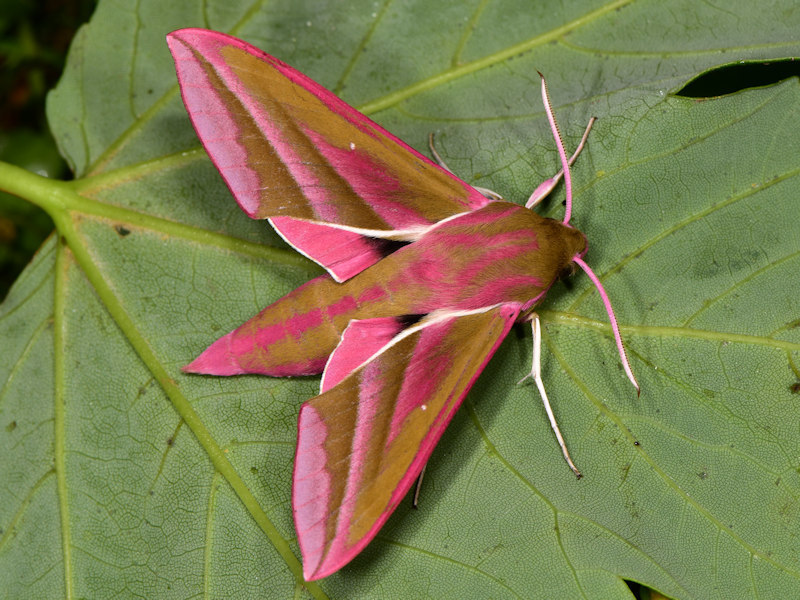
A pink-and-olive hawk-moth that hovers at flowers at dusk. It was the first animal shown to see colour in dim starlight, when humans see only grey.
Deilephila elpenor, the elephant hawk moth or large elephant hawk moth, is a moth in the family Sphingidae. Its common name is derived from the caterpillar's resemblance to an elephant's trunk. It is most common in Central Europe and is distributed throughout the Palearctic region. It has also been introduced in British Columbia, Canada. Its distinct olive and pink colouring makes it one of the most recognisable moths in its range, but confusing the elephant hawk moth with the small elephant hawk moth, a closely related species that also shares the characteristic colours, is quite common. Wikipedia
What it can do
- iColour vision under starlight using highly sensitive superposition eyes (Kelber et al. 2002)
- iiHovers while drinking nectar through a long proboscis
- iiiCaterpillar inflates its eyespots to mimic a small snake
In the field
Field marks
- aOlive-green and pink moth with a streamlined body
- bPink bands across the olive forewing and a pink body
- cCaterpillar grey-brown with two pairs of eyespots behind a trunk-like head
- dVisits flowers at dusk
- Not to be confused with
- Small elephant hawk-moth (Deilephila porcellus) is smaller and mainly pink and yellowish-brown, without the olive-green bands.
- Where to see it
- Gardens with honeysuckle, rough ground with rosebay willowherb, heaths and woodland edges across Europe
- When
- Adults May–Jul; caterpillars Jul–Sep on willowherbs, bedstraws and fuchsia
Listen
Looking for field recordings…
Life & habits
- Diet
- Larvae eat willowherb (Chamaenerion) and bedstraw (Galium); adults drink nectar from honeysuckle and similar flowers
- Habitat
- Gardens, rough ground, heaths and woodland edges
- Size
- Wingspan 45–60 mm
- Lifespan
- Adults a few weeks
When disturbed, the caterpillar pulls its head in and swells its front segments, flashing four eyespots like a snake.
Where it lives
Recorded sightings
—
geo-referenced records in GBIF, from museums, herbaria and field observers.
Native range
Europe and temperate Asia to Japan
Drag the globe to turn it. Dots are where records exist, not a range map; darker means more records.
In the stacks
Searching the stacks…
Every page naming Deilephila elpenor in the Biodiversity Heritage Library →
Marginalia
The common name refers to the trunk-like caterpillar. Linnaeus named it after Elpenor, Odysseus's companion who fell from Circe's roof.
Curiosity
It is a common garden visitor in Britain, yet its night colour vision was only discovered in 2002.
Kinship




Photographs: iNaturalist contributors under the licences shown. Records: GBIF.org. Historical plates: Source Library (CC BY-SA 4.0; originals public domain). Summary text: Nature Library editors and Wikipedia (CC BY-SA). Medicinal and edibility notes are historical and educational, not advice. iNaturalist taxon 55996.