- Plants
- ›Vascular Plants
- ›flowering plants
- ›Dicots
- ›Sunflowers, Bellflowers, Fanflowers, and Allies
- ›Sunflowers, Daisies, Asters, and Allies
- ›Asteroideae
- ›Chamomiles, yarrows, and allies
- ›Anthemidinae
- ›Tanacetum
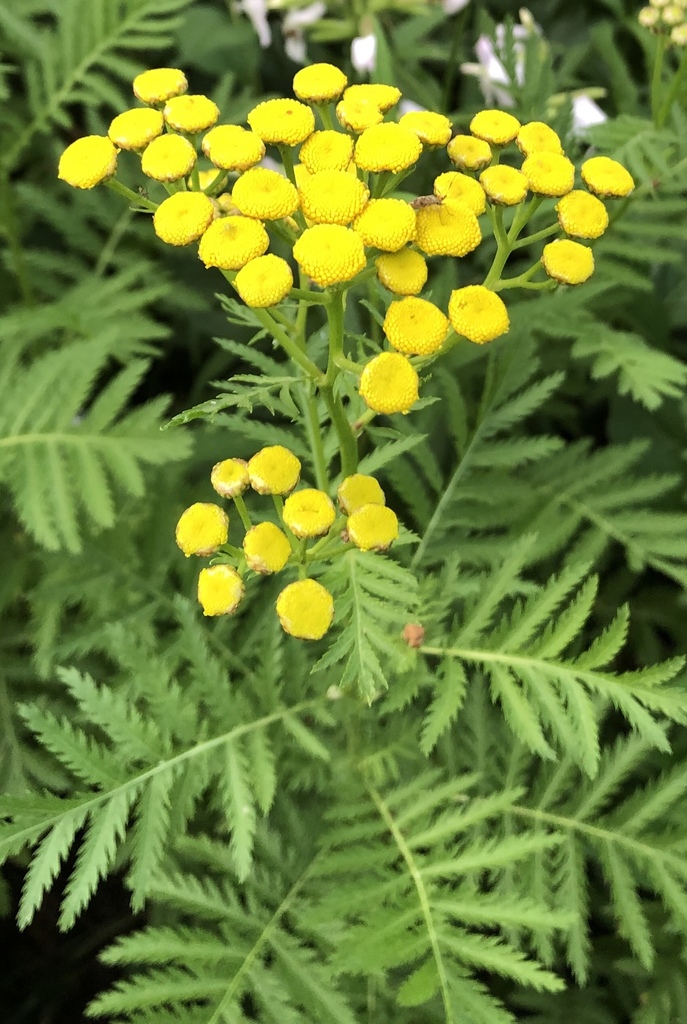
Common Tansy
Tanacetum vulgare
Tansy (Tanacetum vulgare) is a perennial, herbaceous flowering plant in the genus Tanacetum in the family Asteraceae, native to temperate Europe and Asia. It has been introduced to other parts of the world, including Australia and North and South America, and in some areas has become invasive. It is also known as common tansy, bitter buttons, cow bitter, or golden buttons. The Latin word vulgare means "common".
From the article Tansy on Wikipedia (CC BY-SA), quoted section by section
Description
Tansy is a flowering herbaceous clump-forming plant with finely divided compound leaves and yellow, button-like flowers. It has a stout, somewhat reddish, erect stem, usually smooth, 50–150 cm (20–59 in) tall, and branching near the top. The leaves are alternate, 10–15 cm (3.9–5.9 in) long and are pinnately lobed, divided almost to the midrib into about seven pairs of segments, or lobes, which are again divided into smaller lobes having saw-toothed edges, giving the leaf a somewhat fern-like appearance. The roundish, flat-topped, button-like, yellow flower heads are produced in terminal clusters from mid-to-late summer, typically July to September in Great Britain; each 'button' flowerhead 7–12 mm diameter. The scent is similar to that of camphor with hints of rosemary. The leaves and flowers are toxic if consumed in large quantities; the volatile oil contains toxic compounds including thujone, which can cause convulsions and liver and brain damage. Some insects, notably the tansy beetle Chrysolina graminis, have resistance to the toxins and subsist almost exclusively on the plant.
Range & habitat
Tansy is native to Eurasia; it is native in almost all parts of Europe, including Great Britain, though introduced in Iceland, Ireland, and Portugal. It is absent from Siberia and from some of the Mediterranean islands; in Asia, it is native south to Turkey, Kazakhstan, northern China, Korea, and Japan, but absent further south.
Wikipedia: “Distribution”
At the table
Tansy was formerly used as a flavouring for puddings and omelettes, but is now almost unknown, except in Cork, where it is used in a sauce to accompany drisheens. The herbalist John Gerard (c. 1545–1612) noted that tansy was well known as "pleasant in taste", and he recommends tansy sweetmeats as "an especial thing against the gout, if every day for a certain space a reasonable quantitie thereof be eaten fasting." In Yorkshire, tansy and caraway seeds were traditionally used in biscuits served at funerals. During the Stuart Restoration in the late 1600s, a "tansy" was a sweet omelette flavoured with tansy juice. In the BBC documentary "The Supersizers go ... Restoration", Allegra McEvedy described the flavour as "fruity, sharpness to it and then there's a sort of explosion of cool heat a bit like peppermint." However, Sue Perkins, the programme's presenter, experienced tansy toxicity. According to liquor historian A. J. Baime, in the 19th century Tennessee whiskey magnate Jack Daniel enjoyed drinking his own whiskey with sugar and crushed tansy leaf.
In the Belgian coastal province of West Flanders small quantities of crushed dried tansy leaf were traditionally used as culinary herb to spice up pancakes and omelettes. There tansy is colloquially known as pannenkoekenkruid ("pancake herb"). It can also be used as a substitute for sage.
Wikipedia: “Culinary uses”
In medicine
For many years, tansy has been used as a medicinal herb despite its toxicity. 19th-century Irish folklore suggests bathing in a solution of tansy and salt as a cure for joint pain. A bitter tea made with tansy flowers has been used for centuries as an anthelmintic to treat parasitic worm infestations, and tansy cakes were traditionally eaten during Lent because it was believed that eating fish during Lent caused intestinal worms. Various Tanacetum species are used ethnomedically to treat migraine, neuralgia and rheumatism and as anthelmintics. Traditionally, tansy was often used for its emmenagogue effects to bring on menstruation or end an unwanted pregnancy, and pregnant women are advised to not use this herb.
Among Native Americans. The Cherokee use an infusion of the plant for backache, use the plant as a tonic, and wear it around the waist and in shoes to prevent miscarriages. The Cheyenne use an infusion of the pulverised leaves and blossoms for dizziness and weakness.
Wikipedia: “Ethnomedical use”
Toxicity
Many tansy species contain a volatile oil which can cause contact dermatitis in sensitive individuals. If taken internally, toxic metabolites are produced as the oil is broken down in the liver and digestive tract. It is highly toxic to internal parasites, and for centuries tansy tea has been prescribed by herbalists to expel worms. Tansy is an effective insecticide and is highly toxic to arthropods. Because it contains thujone, the U.S. FDA limits the use of tansy to alcoholic beverages, and the final product must be thujone-free. Blue tansy (Vogtia annua, syn. Tanacetum annuum) is often confused with common tansy (Tanacetum vulgare) but the former produces an essential oil that is completely different chemically as it contains no thujone and high amounts of chamazulene making the oil dark blue in colour, giving rise to its common name of Blue Tansy Oil. Despite claims by some unethical resellers of essential oils who adulterate the very expensive blue tansy oil with the much cheaper oil from Tanacetum vulgare, the oil from Tanacetum vulgare is never blue in colour as it contains no chamazulene. …
How it is grown
The ancient Greeks may have been the first to cultivate it as a medicinal herb. In the sixteenth century it was considered to be "necessary for a garden" in England.
History of use. Tansy has a long history of use. The first historical records of its cultivation for medicinal purposes involved the ancient Greeks. In the 8th century AD it was grown in the herb gardens of Charlemagne and by Benedictine monks of the Swiss monastery of Saint Gall. Tansy was used to treat intestinal worms, rheumatism, digestive problems, fevers, sores, and to bring out measles. During the Middle Ages and later, high doses were used to induce abortions. On the other hand, tansy was also used to help women conceive and to prevent miscarriages. In the 15th century, Christians began serving tansy with Lenten meals to commemorate the Passover bitter herbs eaten by the Israelites. Tansy was thought to have the added Lenten benefits of controlling flatulence brought on by days of eating fish and pulses and of preventing the intestinal worms believed to be caused by eating fish during Lent. Tansy was used as a face wash and was reported to lighten and purify the skin. In the 19th century, Irish folklore suggested that bathing in a solution of tansy and salts would cure joint pain.
Wikipedia: “Cultivation and use”
Where it lives
Recorded sightings
—
geo-referenced records in GBIF, from museums, herbaria and field observers.
Drag the globe to turn it. Dots are where records exist, not a range map; darker means more records.
In the old herbals & bestiaries


In the stacks
Searching the stacks…
Every page naming Tanacetum vulgare in the Biodiversity Heritage Library →
This page is assembled live from iNaturalist, GBIF, Wikipedia, the Source Library and the Internet Archive. It is not yet part of the hand-edited codex. iNaturalist taxon 55971.