- Plants
- ›Vascular Plants
- ›flowering plants
- ›Dicots
- ›Mints, Plantains, Olives, and Allies
- ›Mint Family
- ›Lamioideae
- ›Galeopsis
- ›Galeopsis
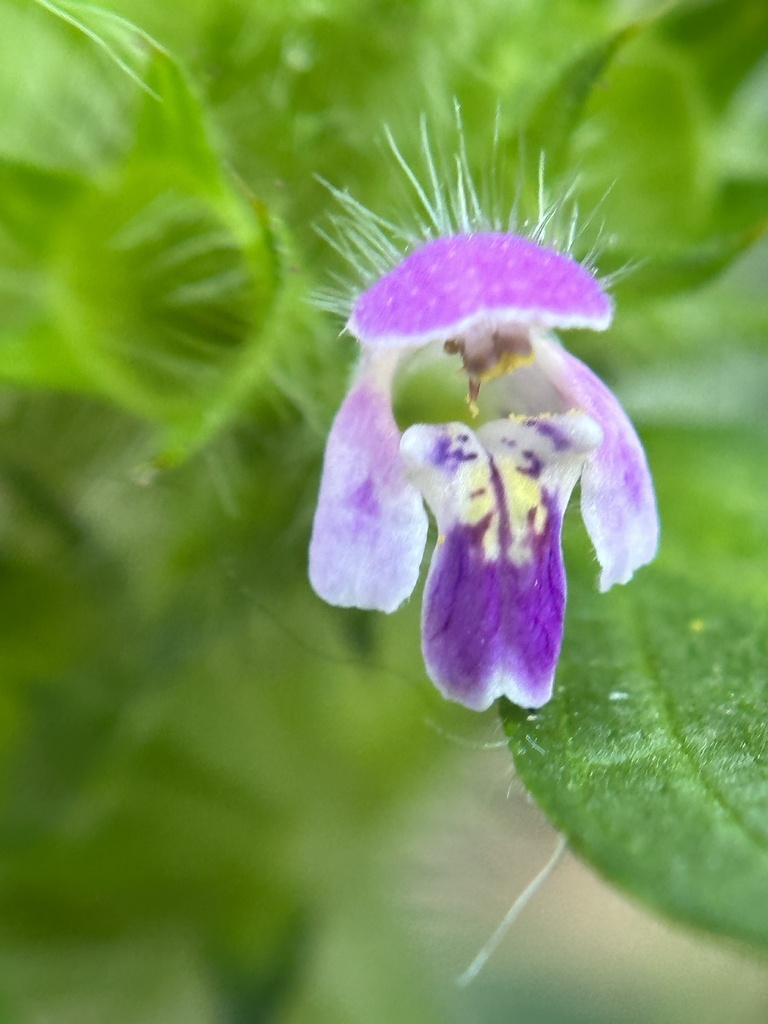
Bifid Hemp-nettle
Galeopsis bifida
Galeopsis bifida is an annual plant native to Europe and Asia but now found in Canada and the northeastern, midwestern parts of the United States. It has many common names such as bifid hemp-nettle, split-lip hemp-nettle, common hemp-nettle, and large-flowered hemp-nettle. The genus name means weasel-like, referring to the corolla of the flower. It is often confused with other species of Lamiaceae such as Mentha arvensis, Dracocephalum parviflorum and Stachys pilosa.
From the article Galeopsis bifida on Wikipedia (CC BY-SA), quoted section by section
Description
Hempnettle could grow up to 1 meter high. Its leaves and flowers are hairy. Leaves are simple, 1 to 5 inches long, opposite, margins are serrate and ovate in shape, pubescent on both sides. The stem is swollen below the leaf nodes. Its flowers can be purple, white or pink and are terminal in axillary clusters.
Wikipedia: “Morphology”
Range & habitat
Galeopsis bifida is native to Europe and Asia. In the British Isles it is mainly found in Wales and Scotland. It occurs throughout Canada, the northeastern and midwestern parts of the United States, and has been introduced to Alaska. It was also introduced in some parts of New Zealand and the Canary Islands.
Wikipedia: “Distribution”
What it does
Hempnettle mostly grow in disturbed sites, roadsides, gardens, agricultural lands, wet heaths and sometimes in woods. It creates a dense mid-forb layer dominating the regular grass and low forbs. It utilizes limited nutrients and requires moist soil, usually prefers moderate levels of acid and basic soils.
Wikipedia: “Habitat and ecology”
At the table
The seeds of this plant are edible and have been found in large quantities in European archeological sites. A study done on the seeds show no toxicity in mice and high potential for bioavailable antioxidants to humans. According to Samuel Thayer, many people have eaten the leaves mistaking them for stinging nettle; they are not toxic but unpalatable.
== References ==
Wikipedia: “Edibility”
Where it lives
Recorded sightings
—
geo-referenced records in GBIF, from museums, herbaria and field observers.
Drag the globe to turn it. Dots are where records exist, not a range map; darker means more records.
In the stacks
Searching the stacks…
Every page naming Galeopsis bifida in the Biodiversity Heritage Library →
This page is assembled live from iNaturalist, GBIF, Wikipedia, the Source Library and the Internet Archive. It is not yet part of the hand-edited codex. iNaturalist taxon 55967.