- Plants
- ›Vascular Plants
- ›flowering plants
- ›Dicots
- ›Mints, Plantains, Olives, and Allies
- ›Mint Family
- ›Lamioideae
- ›Lamieae
- ›Lamium
- ›Lamium
- ›Lamiotypus
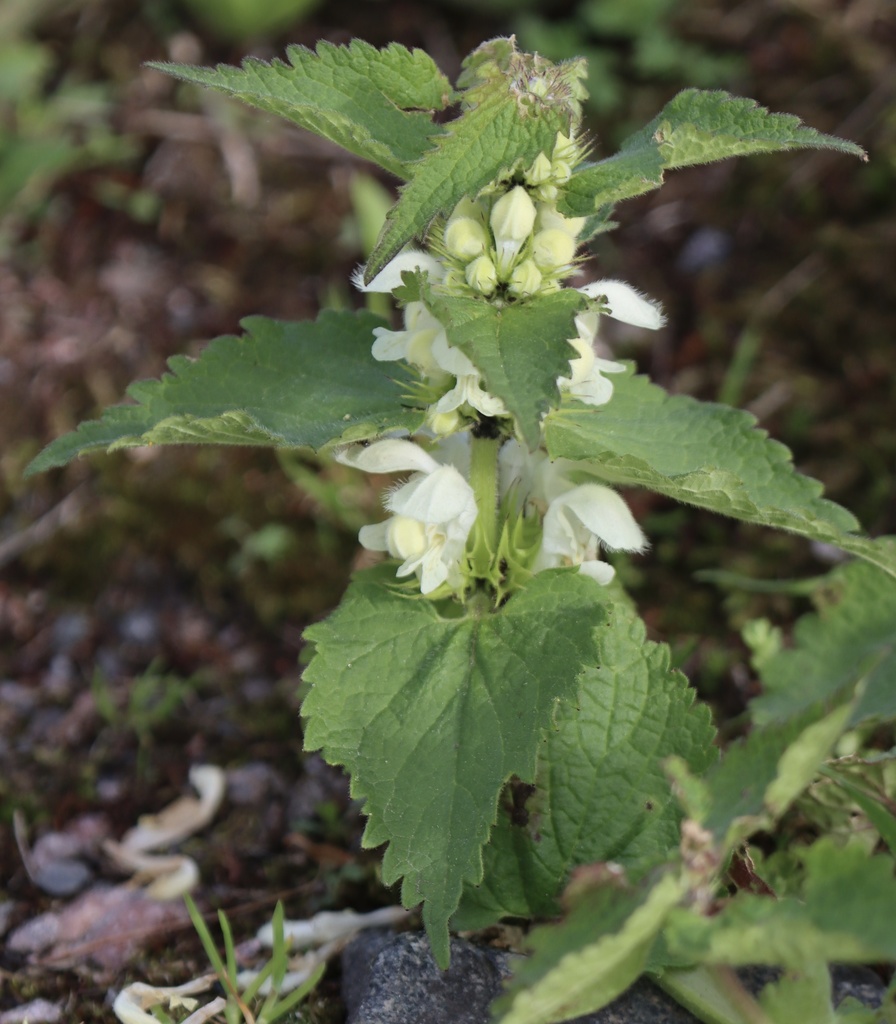
White deadnettle
Lamium album
Lamium album, commonly called white nettle or white dead-nettle, is a flowering plant in the family Lamiaceae, native throughout Europe and Asia, growing in a variety of habitats from open grassland to woodland, generally on moist, fertile soils.
From the article Lamium album on Wikipedia (CC BY-SA), quoted section by section
Description
Lamium album is a rhizomatous herbaceous perennial plant growing to 70 cm (28 in) tall, with green, four-angled stems. The leaves are 3–8 cm (1–3 in) long and 2–5 cm (3⁄4–2 in) broad, triangular with a rounded base, softly hairy, and with a serrated margin and a petiole up to 5 cm (2 in) long; like many other members of the Lamiaceae, they appear superficially similar to those of the stinging nettle Urtica dioica but do not sting, hence the common name "dead-nettle". The flowers are white, produced in whorls ('verticillasters') on the upper part of the stem, the individual flowers 1.5–2.5 cm (5⁄8–1 in) long.
Phytochemistry. Various polyphenolic glycosides such as Lamalboside and Verbascoside, Tiliroside and 5-caffeoylquinic acid along with Rutoside and quercetin 3-O-glucoside and kaempferol 3-O-glucoside can be isolated from the flowers of L. album. The plant also contains the iridoid glycosides lamalbid, alboside A and B, and caryoptoside as well as the hemiterpene glucoside hemialboside. L.album was a source of chlorophyll and other plant pigments for Mikhail Tsvet, the inventor of adsorption chromatography.
Range & habitat
L. album is native to Eurasia, from Ireland in the west to Japan in the east. It has three subspecies, subsp. album in the western part of the range, subsp. crinitum in the southern part in southwest Asia (Turkey to Nepal), and subsp. barbatum in the far east of mainland Asia and in Japan. It is common in England, rare in the west and northern Scotland, and introduced to eastern Ireland. It is abundant in the British Isles, where it is found on roadsides, around hedges, and in abandoned places. L. album was introduced to North America, where it is widely naturalised.
Wikipedia: “Distribution and habitat”
What it does
The flowers are visited by many types of insects, but mostly by long-tongued insects, like bees. Bumblebees are especially attracted to the flowers, which are a good source of early nectar and pollen, hence the plant is sometimes called the bee nettle.
Wikipedia: “Ecology”
In human culture
A distillation of the flowers is reputed "to make the heart merry, to make a good colour in the face, and to make the vital spirits more fresh and lively."
Wikipedia: “Cultural significance”
Where it lives
Recorded sightings
—
geo-referenced records in GBIF, from museums, herbaria and field observers.
Drag the globe to turn it. Dots are where records exist, not a range map; darker means more records.
In the old herbals & bestiaries


In the stacks
Searching the stacks…
Every page naming Lamium album in the Biodiversity Heritage Library →
This page is assembled live from iNaturalist, GBIF, Wikipedia, the Source Library and the Internet Archive. It is not yet part of the hand-edited codex. iNaturalist taxon 55876.