On eBird ↗
Slaty-backed Hemispingus
Live sightings near you, the range map, bar charts of when it is seen, and Macaulay Library photos and recordings.
Slaty-backed Hemispingus
Poospiza goeringi
The slaty-backed hemispingus (Poospiza goeringi) is a Near Threatened species of bird in the family Thraupidae, the tanagers and allies. It is endemic to Venezuela.
From the article Slaty-backed hemispingus on Wikipedia (CC BY-SA), quoted section by section
Description
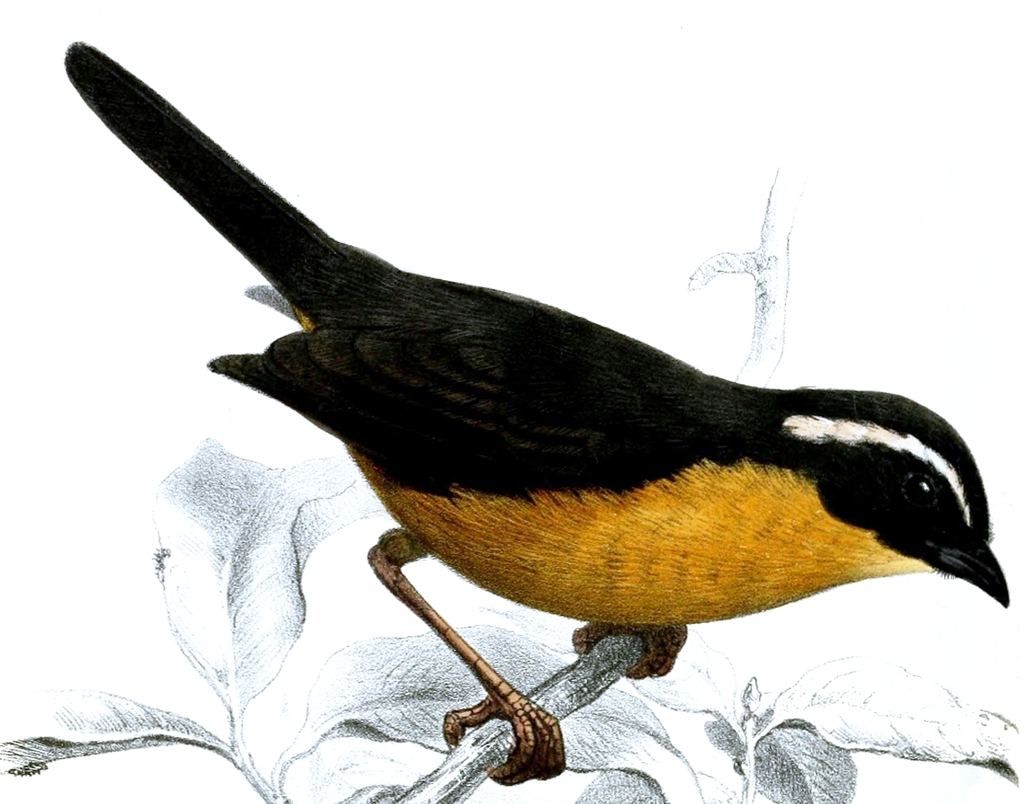
The slaty-backed hemispingus is 14 to 15 cm (5.5 to 5.9 in) long. The sexes have the same plumage. Adults have a mostly black head with a wide white supercilium that extends to the nape. Their mantle is slaty. The rest of their upperparts and their tail and wings are dark gray. Their underparts are rich tawny-rufous with an olive-brown tinge on the flanks. They have a dark brown iris, a small slender bill with a black maxilla and gray mandible, and long, heavy, pinkish gray to dark horn-gray legs.
Range & habitat
The slaty-backed hemispingus is found in the Venezuelan Andes from northern Táchira north to central Mérida. It inhabits higher levels of wet montane forest and elfin forest, and has been recorded in dense shrubbery around more open fields. It is often associated with bamboo and might require it. In elevation it ranges between 2,600 and 3,200 m (8,500 and 10,500 ft) with one sight record at 2,300 m (7,500 ft).
Wikipedia: “Distribution and habitat”
What it does
The slaty-backed hemispingus feeds primarily on arthropods but also includes small fruits in its diet. It mostly forages in pairs, though sometimes singly or in small family groups, and often joins mixed-species feeding flocks. It forages in dense vegetation, from the ground up to about 5 m (15 ft) above it. It takes prey while perched and sometimes with a short upward leap to the underside of a leaf.
Wikipedia: “Feeding”
Listen
Looking for field recordings…
Where it lives
Recorded sightings
—
geo-referenced records in GBIF, from museums, herbaria and field observers.
Drag the globe to turn it. Dots are where records exist, not a range map; darker means more records.
In the stacks
Searching the stacks…
Every page naming Poospiza goeringi in the Biodiversity Heritage Library →
This page is assembled live from iNaturalist, GBIF, Wikipedia, the Source Library and the Internet Archive. It is not yet part of the hand-edited codex. iNaturalist taxon 558581.