On eBird ↗
Drab Hemispingus
Live sightings near you, the range map, bar charts of when it is seen, and Macaulay Library photos and recordings.
Drab Hemispingus
Pseudospingus xanthophthalmus
The drab hemispingus (Pseudospingus xanthophthalmus) is a species of bird in the family Thraupidae, the tanagers and allies. It is found in Bolivia and Peru.
From the article Drab hemispingus on Wikipedia (CC BY-SA), quoted section by section
Description
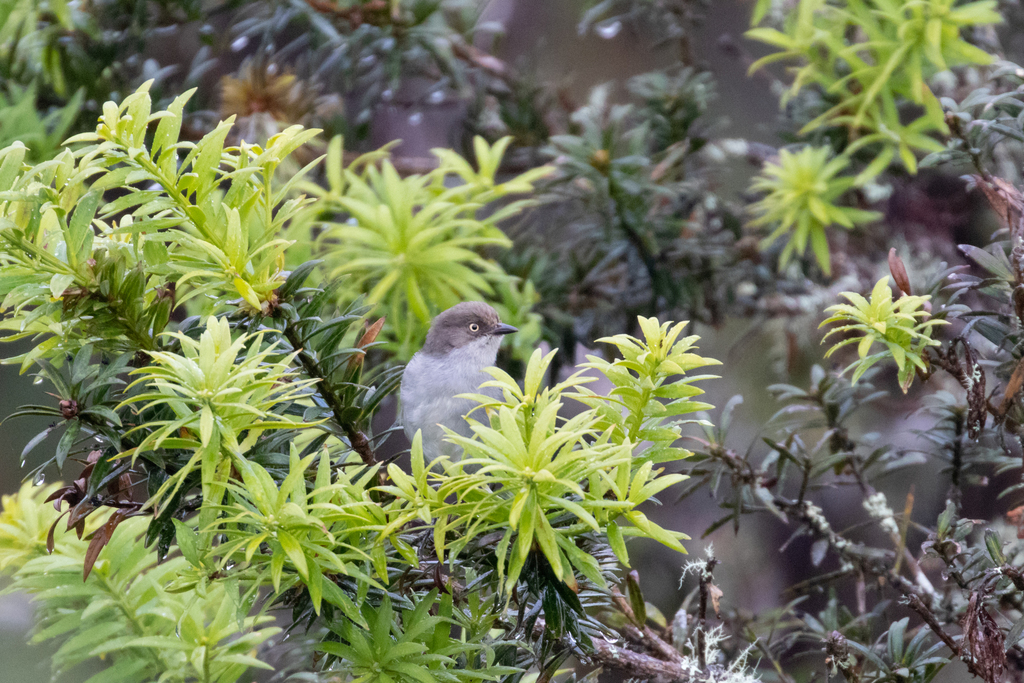
The drab hemispingus is 13 to 14 cm (5.1 to 5.5 in) long and weighs 10 to 15 g (0.35 to 0.53 oz). Adults have a brownish gray head, nape, upperparts, wings, and tail. Their throat and belly are whitish, their breast grayish white, their flanks tinged grayish, and their undertail coverts tinged buff. They have a white to pale yellow iris, a thin blackish bill, and blackish legs.
Range & habitat
The drab hemispingus is found along the eastern slope of the Andes from the Marañón River in northern Peru south into western Bolivia's La Paz Department. It inhabits humid montane and elfin forest to the tree line. In elevation it ranges between 2,200 and 3,350 m (7,200 and 11,000 ft) in Peru and between 2,900 and 3,050 m (9,500 and 10,000 ft) in Bolivia.
Wikipedia: “Distribution and habitat”
What it does
The drab hemispingus feeds primarily on insects. It typically forages in pairs and small groups and regularly joins mixed-species feeding flocks. It feeds mostly in the canopy, walking and hopping across leaves and branches and gleaning prey from them. It also occasionally takes prey in mid-air with a short flutter-flight.
Wikipedia: “Feeding”
Listen
Looking for field recordings…
Where it lives
Recorded sightings
—
geo-referenced records in GBIF, from museums, herbaria and field observers.
Drag the globe to turn it. Dots are where records exist, not a range map; darker means more records.
In the stacks
This page is assembled live from iNaturalist, GBIF, Wikipedia, the Source Library and the Internet Archive. It is not yet part of the hand-edited codex. iNaturalist taxon 558579.