On eBird ↗
Spot-winged Antbird
Live sightings near you, the range map, bar charts of when it is seen, and Macaulay Library photos and recordings.
Spot-winged Antbird
Myrmelastes leucostigma
The spot-winged antbird (Myrmelastes leucostigma) is a species of bird in subfamily Thamnophilinae of family Thamnophilidae, the "typical antbirds". It is found in Brazil, Colombia, Ecuador, French Guiana, Guyana, Peru, Suriname, and Venezuela.
From the article Spot-winged antbird on Wikipedia (CC BY-SA), quoted section by section
Description
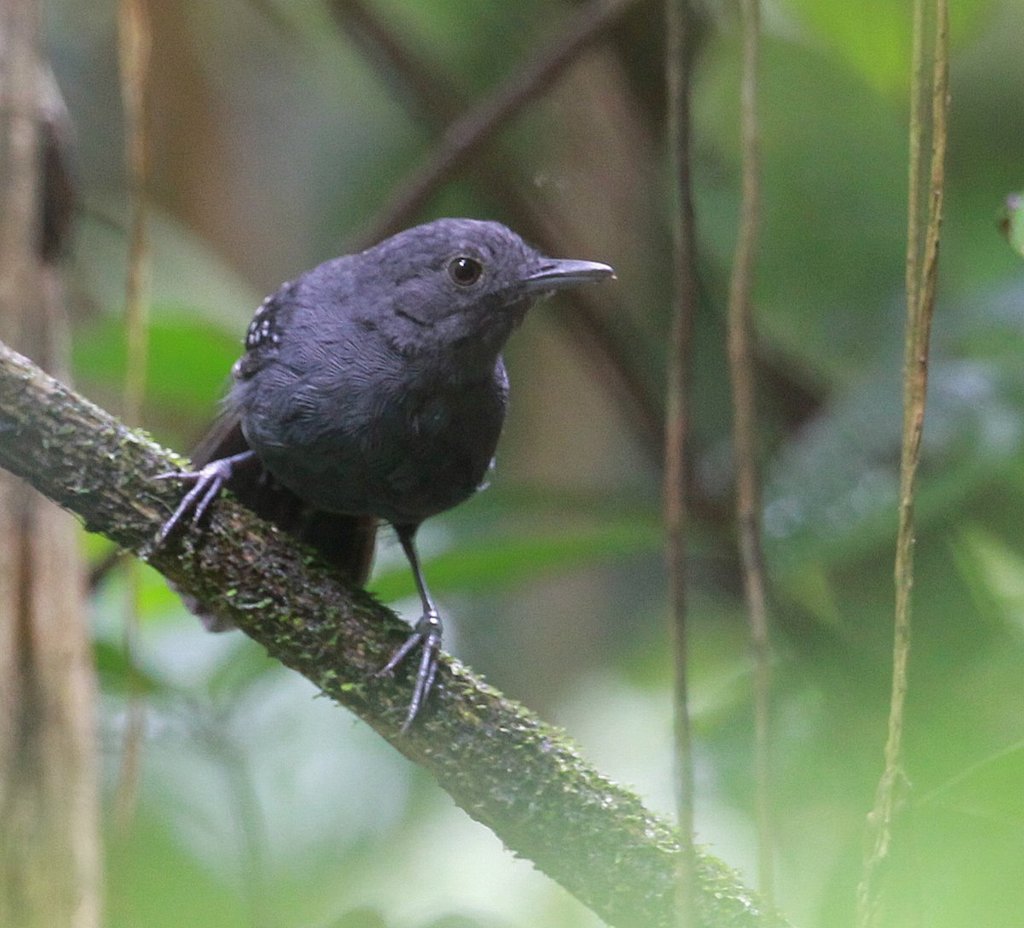
The spot-winged antbird is 14 to 16 cm (5.5 to 6.3 in) long and weighs 20 to 28.5 g (0.71 to 1.0 oz). Males of the nominate subspecies M. l. leucostigma have dark gray upperparts. Their wings and tail are blackish gray with wide white tips on the wing coverts. Their face, throat, and underparts are pale gray to gray; their sides and belly are the darker parts. Females have a dark gray crown and dark cinnamon-brown upperparts. Their wings and tail are blackish brown with pale cinnamon-rufous tips on the wing coverts. Their face is gray. Their throat and belly are pale tawny and their flanks and undertail coverts olive-brown. Both sexes have pinkish legs and feet. Males of subspecies M. l. subplumbeus have underparts almost as dark as their upperparts and smaller white tips on their wing coverts than the nominate. Females' throat and underparts are rufous-brown. Both sexes have bluish gray legs and feet. Males of M. l. intensus are similar to subplumbeus males but overall darker. Females have a blackish crown and deep brown upperparts. Males of M. l. infuscatus is similar to the nominate but with smaller spots on the wing coverts. Females have a brownish olive face. Both sexes have bluish gray legs and feet.
Range & habitat
The subspecies of the spot-winged antbird are found thus:
M. l. subplumbeus: southwestern Táchira state in extreme western Venezuela south along the eastern base of the Andes through Colombia and Ecuador into northeastern Peru as far as southern Department of Loreto and east just into western Brazil's Amazonas and Acre states M. l. leucostigma: from extreme eastern Bolívar state in eastern Venezuela east through the Guianas and northeastern Brazil to the Atlantic in Amapá state M. l. intensus: central Peru's Huánuco, Pasco, Junín, and Ucayali departments M. l. infuscatus: southwestern Amazonas state in southern Venezuela, eastern Colombia, and northwestern Brazil north of the upper Amazon Some sources add extreme northwestern Bolivia to the range of intensus but the South American Classification Committee of the American Ornithological Society has no records from that country. The spot-winged antbird primarily inhabits the floor and understorey of terra firme evergreen forest. Especially at lower elevations, within the forest it favors poorly drained areas and areas along small watercourses. In elevation it reaches 700 m (2,300 ft) in Brazil, 400 m (1,300 ft) in Venezuela, 1,100 m (3,600 ft) in Colombia, and 1,650 m (5,400 ft) in Peru. In Ecuador it mostly occurs below 600 m (2,000 ft) but locally reaches 1,100 m (3,600 ft).
Wikipedia: “Distribution and habitat”
What it does
The spot-winged antbird's diet has not been detailed but is known to be mostly insects and arachnids and also include small lizards. It forages as individuals, pairs, and small family groups and mostly within about 1 m (3 ft) of the ground and only rarely with mixed-species feeding flocks. It hops along the ground and among low branches, and takes prey mostly by picking from leaf litter and by reaching to leaves and twigs from the ground or a low perch. It regularly attends army ant swarms to capture prey disturbed by the ants, though more often forages away from ants.
Wikipedia: “Feeding”
Listen
Looking for field recordings…
Where it lives
Recorded sightings
—
geo-referenced records in GBIF, from museums, herbaria and field observers.
Drag the globe to turn it. Dots are where records exist, not a range map; darker means more records.
In the stacks
Searching the stacks…
Every page naming Myrmelastes leucostigma in the Biodiversity Heritage Library →
This page is assembled live from iNaturalist, GBIF, Wikipedia, the Source Library and the Internet Archive. It is not yet part of the hand-edited codex. iNaturalist taxon 558496.