On eBird ↗
Willis's Antbird
Live sightings near you, the range map, bar charts of when it is seen, and Macaulay Library photos and recordings.
Willis's Antbird
Cercomacroides laeta
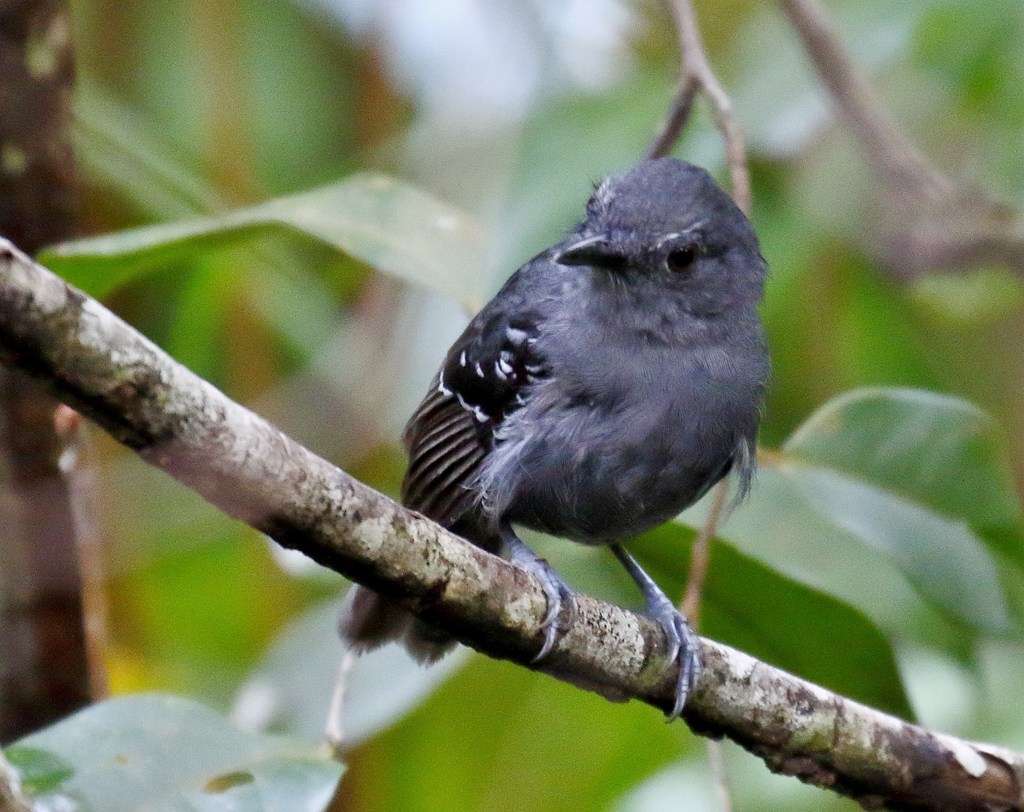
Willis's antbird (Cercomacroides laeta), also known as the laeta antbird, is a species of bird in subfamily Thamnophilinae of family Thamnophilidae, the "typical antbirds". It is found in Brazil and Guyana.
From the article Willis's antbird on Wikipedia (CC BY-SA), quoted section by section
Description
Willis's antbird is 13.5 to 14.5 cm (5.3 to 5.7 in) long and weighs 15 to 17 g (0.53 to 0.60 oz). Males of the nominate subspecies are almost entirely gray, with somewhat lighter underparts than upperparts. They have a white patch between their scapulars and narrow white tips on their wing coverts and outer tail feathers. Females have olive-gray upperparts and ear coverts, browner wings and tail, and cinnamon edges on their wing coverts. They have a very small white interscapular patch. Their throat and underparts are tawny-buff with an olive tinge to their flanks. Males of subspecies C. l. waimiri are a darker gray than the nominate and do not have white tips on the tail feathers. Females have orange-cinnamon ear coverts and dark gray wing coverts with wide cinnamon-brown edges. Males of subspecies C. l. sabinoi are like nominate males; females have pale cinnamon underparts.
Range & habitat
Willis's antbird has a disjunct distribution; the subspecies' ranges are significantly separated from each other. Subspecies C. l. waimiri is the westernmost. It is found in north-central Amazonian Brazil where eastern Roraima, northeastern Amazonas, and northwestern Pará meet and also into southern Guyana. The nominate subspecies is found in southeastern Amazonian Brazil, in eastern Pará and western Maranhão. Subspecies C. l. sabinoi is found in the coastal eastern Brazilian states of Pernambuco and Alagoas. In general, Willis's antbird inhabits the understorey at the edges of evergreen forest and also mature secondary forest, usually near water. The nominate subspecies favors the edges of várzea and forest along small streams. Subspecies C. l. waimiri favors campina woodlands on white sand soil, especially along streams and in swampy areas. C. l. sabinoi favors the edges of secondary forest and densely vegetated openings in the forest interior such as those made by fallen trees. It is less tied to water features than the other two subspecies. In elevation C. l. sabinoi reaches 600 m (2,000 ft); the other two subspecies reach only 300 m (1,000 ft).
Wikipedia: “Distribution and habitat”
What it does
The diet of Willis's antbird has not been detailed but is known to include a variety of insects and spiders. Single birds, pairs, and family groups usually forage on the ground or within about 3 m (10 ft) of it. It typically hops through dense vegetation, taking prey from vegetation by gleaning, reaching, lunging, and making short fluttery flights from a perch. It seldom joins mixed-species feeding flocks, and occasionally attends army ant swarms but spends little time with them.
Wikipedia: “Feeding”
Listen
Looking for field recordings…
Where it lives
Recorded sightings
—
geo-referenced records in GBIF, from museums, herbaria and field observers.
Drag the globe to turn it. Dots are where records exist, not a range map; darker means more records.
In the stacks
Searching the stacks…
Every page naming Cercomacroides laeta in the Biodiversity Heritage Library →
This page is assembled live from iNaturalist, GBIF, Wikipedia, the Source Library and the Internet Archive. It is not yet part of the hand-edited codex. iNaturalist taxon 558488.