On eBird ↗
Blue-winged Teal
Live sightings near you, the range map, bar charts of when it is seen, and Macaulay Library photos and recordings.
Blue-winged Teal
Spatula discors
The blue-winged teal (Spatula discors) is a species of bird in the duck, goose, and swan family Anatidae. One of the smaller members of the dabbling duck group, it occurs in North America, where it breeds from southern Alaska to Nova Scotia, and south to northern Texas. It winters along the Pacific and Atlantic coasts and south into the Caribbean islands and Central America.
From the article Blue-winged teal on Wikipedia (CC BY-SA), quoted section by section
Description
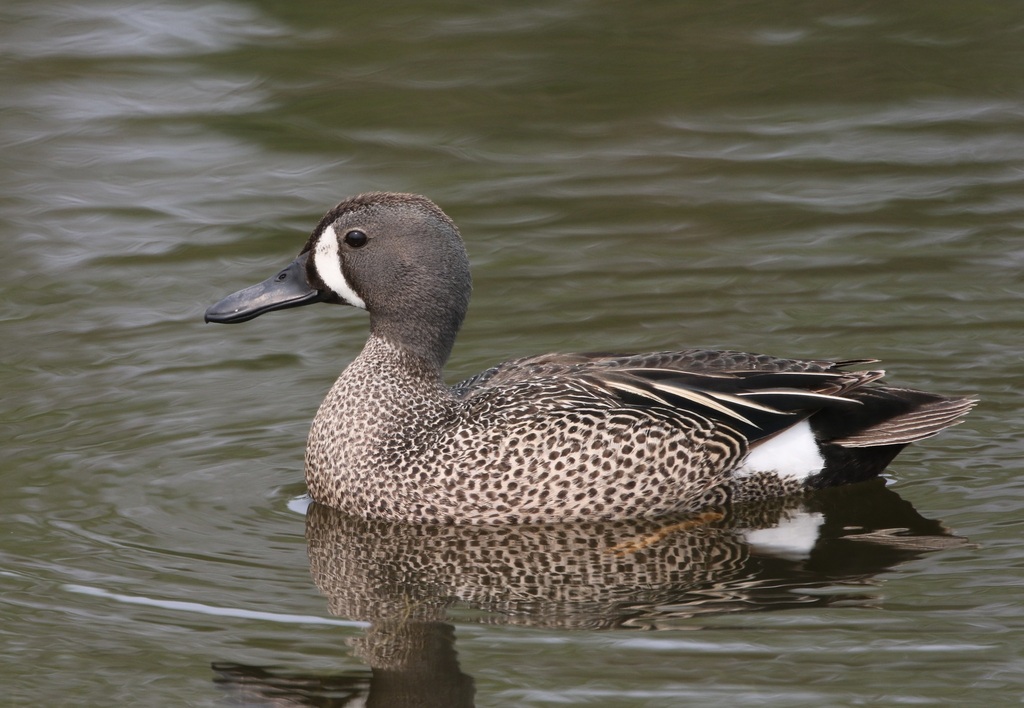
The blue-winged teal is 40 cm (16 in) long, with a wingspan of 58 cm (23 in), and a weight of 370 g (13 oz). The adult male has a greyish blue head with a white facial crescent, a light brown body with a white patch near the rear and a black tail. The adult female is mottled brown, and has a whitish area at base of bill. Both sexes have sky-blue wing coverts, a green speculum, and yellow legs. They have two molts per year and a third molt in their first year. The call of the male is a short whistle; the female's call is a soft quack.
Range & habitat
The range is all of North America except western and northern Alaska, northern Yukon Territory, northern Northwest Territories and the northeastern area of Canada. Blue-winged teal are rare in the desert southwest, and the west coast. The breeding habitat of the blue-winged teal is marshes and ponds. The breeding range extends from east-central Alaska and southern Mackenzie District east to southern Quebec and southwestern Newfoundland. In the contiguous United States it breeds from northeast California east to central Louisiana, central Tennessee, and the Atlantic Coast. The western blue-winged teal inhabits that part of the breeding range west of the Appalachian Mountains. Some populations of blue-winged teals nest along the Atlantic Coast from New Brunswick to Pea Island, North Carolina. They migrate in flocks to winter in to the south of its breeding range. During migration, some birds may fly long distances over open ocean. They are occasional vagrants to Europe, where their yellow legs are a distinction from other small ducks like the common teal and garganey, and in recent years have been annual vagrants in Britain and Ireland. The blue-winged teal winters from southern California to western and southern Texas, the Gulf Coast to the Atlantic Coast, the Caribbean, and south to Central and South America. It is often seen wintering as far south as Brazil and central Chile.
Wikipedia: “Distribution”
What it does
These birds feed by dabbling in shallow water at the edge of marshes or open water. They mainly eat plants; their diet may include molluscs and aquatic insects. Blue-winged teal are generally the first ducks south in the fall and the last ones north in the spring. Adult drakes depart the breeding grounds well before adult hens and immatures. Most blue-winged teal flocks seen after mid-September are composed largely of adult hens and immatures. The northern regions experience a steady decline in blue-winged teal populations from early September until early November. Blue-winged teal in central migration areas tend to remain through September, then diminish rapidly during October, with small numbers remaining until December. Large numbers of blue-winged teal appear on wintering grounds in Florida, Louisiana, and Texas in September.
Reproduction. The onset of courtship among immature blue-winged teal often starts in late January or early February. In areas south of the breeding grounds, blue-winged teal are more active in courtship during the spring migration than are most other ducks. Blue-winged teal are among the last dabbling ducks to nest, generally nesting between April 15 and May 15. Few nests are started after mid-July. Chronology of nesting can vary from year to year as a result of weather conditions. …
Wikipedia: “Behavior”
Listen
Looking for field recordings…
Where it lives
Recorded sightings
—
geo-referenced records in GBIF, from museums, herbaria and field observers.
Drag the globe to turn it. Dots are where records exist, not a range map; darker means more records.
In the old herbals & bestiaries


In the stacks
Searching the stacks…
Every page naming Spatula discors in the Biodiversity Heritage Library →
This page is assembled live from iNaturalist, GBIF, Wikipedia, the Source Library and the Internet Archive. It is not yet part of the hand-edited codex. iNaturalist taxon 558433.