On eBird ↗
Puna Teal
Live sightings near you, the range map, bar charts of when it is seen, and Macaulay Library photos and recordings.
Puna Teal
Spatula puna
The Puna teal (Spatula puna) is a species of dabbling duck in the family Anatidae. It was at one time regarded as a subspecies of the silver teal (Spatula versicolor).
The Puna teal is resident in the Andes of Peru, western Bolivia, northern Chile, and extreme northwestern Argentina. It is found on the larger lakes and pools in the altiplano.
From the article Puna teal on Wikipedia (CC BY-SA), quoted section by section
Description
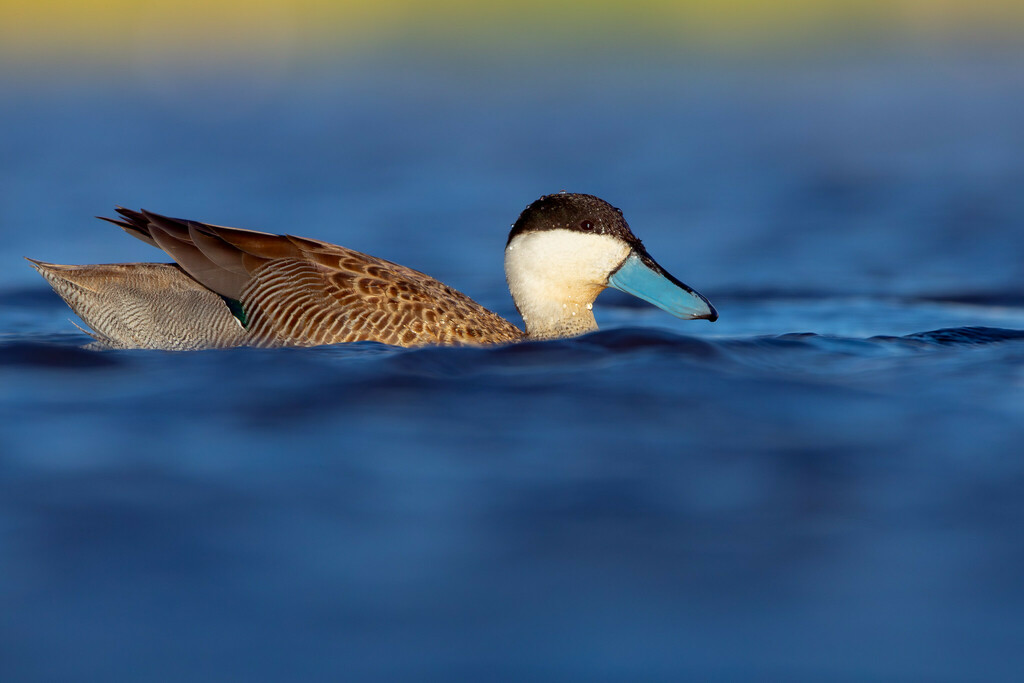
The Puna teal is larger than its closely related species, the silver teal (Spatula versicolor). It measures about 48 cm (19 in) long, similar in size to a wood duck. Males typically weigh between 546 to 560 g and have a wingspan of 215-235 mm. Their bill is 47-53 mm long, compared to 37-41 mm in S. versicolor. Puna teal is easily recognized by its distinctive head and bill patterns. Adult males have a blackish-brown cap that extends below the eyes. They have a creamy white lower face and neck, a coffee-colored back, chest, and flank, and a dark brown rear flank. Their neck and chest are covered in small, dark brown spots that turn into bars on the back, chest, and flanks. Their rump and upper tail coverts appear gray. Their upper wing coverts are a dull blue color, greater secondary coverts are white-tipped, and they have an iridescent green speculum with posterior black and white bars. Their underwings are banded with gray. Their legs and feet are gray, and they have brown eyes and a distinctive light blue bill with a black nail and culmen. Females are typically duller in color than males and have less distinct barring patterns on their flanks. Juveniles are also duller, with a less iridescent speculum and less contrasting head. Chicks have brown upper down and grayish-white lower down, with pairs of white dorsal spots along their wings and sides. …
Wikipedia: “Appearance”
Range & habitat
The Puna teal is a non-migratory bird native to the Neotropical realm of South America. Its range is confined to the Puna zone of the Andes Mountains, extending from central Peru (around the Junín region) southward through western Bolivia, northern Chile (as far south as Antofagasta), and into the extreme northwest of Argentina (Jujuy Province). This species is restricted to high-altitude environments, typically found at elevations up to 4,600 m (15,100 ft). It inhabits various freshwater wetland types, favoring weakly alkaline lakes, swamps, and bogs with abundant floating vegetation, particularly the aquatic plant genus Chara.
Wikipedia: “Habitat and Distribution”
What it does
Puna teal mostly feed on plants and seeds, but also often eat invertebrates. As dabbling ducks, they typically feed in the water by tipping forward till they are upside down, to get food from the bottom of water bodies, such as ponds. Their bills are specialized for removing food from the water using plates called lamellae, which are aligned along the edges of the bill and vary in length and distance between one another.
Wikipedia: “Diet and Feeding”
Listen
Looking for field recordings…
Where it lives
Recorded sightings
—
geo-referenced records in GBIF, from museums, herbaria and field observers.
Drag the globe to turn it. Dots are where records exist, not a range map; darker means more records.
In the stacks
Searching the stacks…
Every page naming Spatula puna in the Biodiversity Heritage Library →
This page is assembled live from iNaturalist, GBIF, Wikipedia, the Source Library and the Internet Archive. It is not yet part of the hand-edited codex. iNaturalist taxon 558432.