On eBird ↗
Ross's Goose
Live sightings near you, the range map, bar charts of when it is seen, and Macaulay Library photos and recordings.
Ross's Goose
Anser rossii
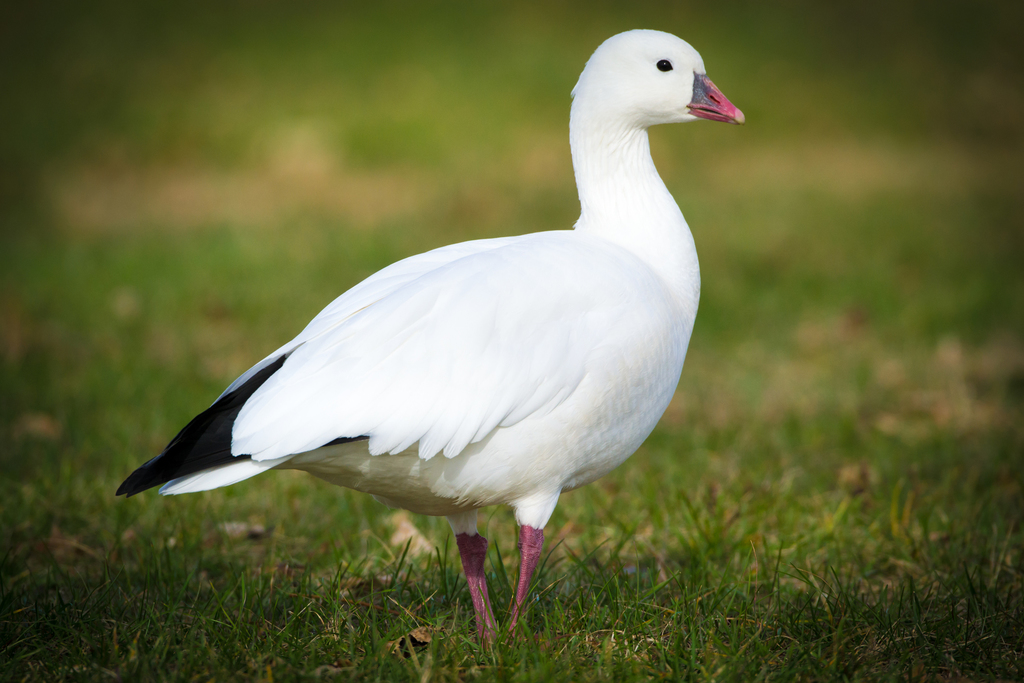
Ross's goose (Anser rossii) is a white goose with black wingtips and a relatively short neck. It is the smallest of the three white geese that breed in North America. It is similar in appearance to a white-phase snow goose, but about 40% smaller. Other differences from the snow goose are that the bill is smaller in proportion to its body and lacks "black lips". Like snow geese, Ross's geese may exhibit a darker "blue" phase or morph, though this is extremely rare (<0.01% of adult birds).
Before the early 1900s, this goose was considered a rare species, possibly as a consequence of open hunting, but numbers have increased dramatically as a result of conservation measures. It is now listed as a species of Least Concern by the IUCN, and is protected by the Migratory Bird Treaty Act.
From the article Ross's goose on Wikipedia (CC BY-SA), quoted section by section
Description
Ross's goose has a rounded head above a short neck. The bill is short and triangular and has a bluish base with warty structures that increase in prominence with age. Adults are identified by all-white secondary feathers, while juveniles' are dark centered. Females average 6% smaller than males. Legs begin as olive gray on goslings and turn deep red as they mature.No geographic variation or identified subspecies is known. Related species include other Anser geese, particularly the lesser snow goose, where the two mtDNA lineages imply frequent hybridization. Two hypotheses about the evolution of Ross's goose are that they arose from a population of snow geese that were isolated by glacial advance or in a refugium that remained ice free. Measurements:
Male Length: 23.2–25.2 in (59–64 cm) Weight: 42.3–55.3 oz (1198–1567 g) Wingspan: 44.5-45.7 in (113–116 cm) Female Length: 22.6–24.4 in (57.3–62 cm) Weight: 37.6–51.3 oz (1066–1454 g)
Range & habitat
Landscape in the central Arctic is dominated by flat plains with some rock outcrops and drumlins, wet meadows, and marshy tundra. Vegetation includes patches of dwarf birch, willow, grasses, sedges, and low-growing vascular plants including crowberry, lapland rosebay, and lousewort.
Wikipedia: “Habitat”
What it does
These birds migrate from their Canadian nesting grounds by mid-October, probably in response to limited food before freezing temperatures set in, and begin their return in mid-April to May. Like most geese, they are grazers that feed on grasses, sedges, and small grains. They often forage in large, mixed flocks with snow geese. Large colonies of nesting birds can cause extensive damage to plants by overgrazing.
Reproduction. Ross's geese form large nesting colonies on islands in shallow lakes and adjacent mainland, building nests on the ground made of twigs, leaves, grass, moss, and down. Females lay an average of four eggs per clutch and incubate the nest for 21–23 days. The eggs measure 6.54–8.02 cm (2.6–3.2 in) in length and 4.43–5.14 cm (1.7–2 in) in length. A study of ground-based sampling along the McConnell River on the west coast of Hudson Bay reported a population of about 81,000 nesting Ross's geese.
Wikipedia: “Behavior”
Listen
Looking for field recordings…
Where it lives
Recorded sightings
—
geo-referenced records in GBIF, from museums, herbaria and field observers.
Drag the globe to turn it. Dots are where records exist, not a range map; darker means more records.
In the stacks
Searching the stacks…
Every page naming Anser rossii in the Biodiversity Heritage Library →
This page is assembled live from iNaturalist, GBIF, Wikipedia, the Source Library and the Internet Archive. It is not yet part of the hand-edited codex. iNaturalist taxon 558427.