On eBird ↗
Snow Goose
Live sightings near you, the range map, bar charts of when it is seen, and Macaulay Library photos and recordings.
Snow Goose
Anser caerulescens
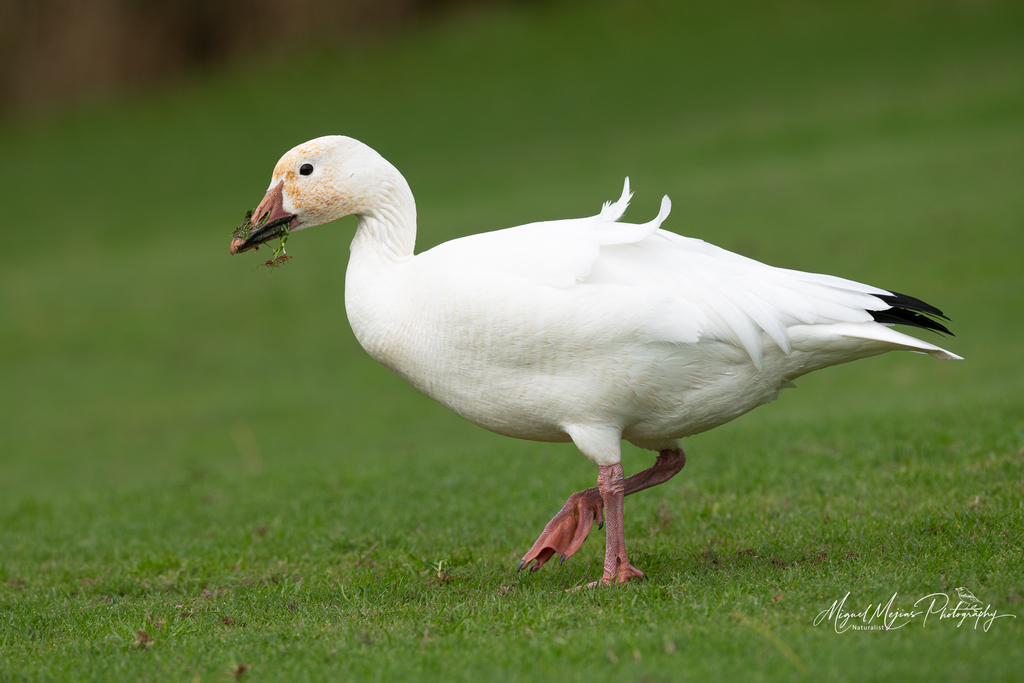
The snow goose (Anser caerulescens) is a species of goose native to North America. Both white and dark morphs exist, the latter often known as blue goose. Its name derives from the typically white plumage. The species was previously placed in the genus Chen, but is now typically included in the "gray goose" genus Anser.
Snow geese breed north of the timberline in Greenland, Canada, Alaska, and the northeastern tip of Siberia, and spend winters in warm parts of North America from southwestern British Columbia through parts of the United States to Mexico.
From the article Snow goose on Wikipedia (CC BY-SA), quoted section by section
Description
The snow goose has two color plumage morphs, white (snow) or gray/blue (blue), thus the common description as "snows" and "blues". White-morph birds are white except for black wing tips, but blue-morph geese have bluish-gray plumage replacing the white except on the head, neck, and tail tip. The immature blue phase is drab or slate-gray with little to no white on the head, neck, or belly. Both snow and blue phases have rose-red feet and legs and pink bills with black tomia ("cutting edges"), giving them a black "grin patch". These colors distinguish the species from white domesticated geese. The colors are not as bright on the feet, legs, and bill of immature birds. The head can be stained rusty brown from minerals in the soil where they feed. They are very vocal and can often be heard from more than a mile away. White- and blue-morph birds interbreed, and the offspring may be of either morph. These two colors of geese were once thought to be separate species; since they interbreed and are found together throughout their ranges, they are now considered two color phases of the same species. The color phases are genetically controlled. The dark phase results from a single dominant gene, and the white phase is homozygous recessive. When choosing a mate, young birds most often select a mate that resembles their parents' coloring. …
What it does
Outside of the nesting season, they usually feed in flocks. In winter, snow geese feed on left-over grain in fields. They migrate in large flocks, often visiting traditional stopover habitats in spectacular numbers. Snow geese frequently travel and feed alongside greater white-fronted geese; in contrast, the two tend to avoid travelling and feeding alongside Canada geese, which are often heavier birds. The population of greater snow geese was in decline at the beginning of the 20th century, but has now recovered to sustainable levels. Snow geese in North America have increased to the point where the tundra breeding areas in the Arctic and the saltmarsh wintering grounds are both becoming severely degraded, and this affects other species using the same habitat. Major nest predators include Arctic foxes and skuas. The biggest threat occurs during the first few weeks after the eggs are laid and then after hatching. The eggs and young chicks are vulnerable to these predators, but adults are generally safe. They have been seen nesting near snowy owl nests, which is likely a solution to predation. Their nesting success was much lower when snowy owls were absent, leading scientists to believe that the owls, since they are predatory, were capable of keeping competing predators away from the nests. …
Wikipedia: “Ecology”
Listen
Looking for field recordings…
Where it lives
Recorded sightings
—
geo-referenced records in GBIF, from museums, herbaria and field observers.
Drag the globe to turn it. Dots are where records exist, not a range map; darker means more records.
In the stacks
Searching the stacks…
Every page naming Anser caerulescens in the Biodiversity Heritage Library →
This page is assembled live from iNaturalist, GBIF, Wikipedia, the Source Library and the Internet Archive. It is not yet part of the hand-edited codex. iNaturalist taxon 558426.