On eBird ↗
Emperor Goose
Live sightings near you, the range map, bar charts of when it is seen, and Macaulay Library photos and recordings.
Emperor Goose
Anser canagicus
The emperor goose (Anser canagicus), also known as the beach goose or the painted goose, is a waterfowl species in the family Anatidae, which contains the ducks, geese, and swans. In summer, the emperor goose is found in remote coastal areas near the Bering Sea in arctic and sub-arctic Alaska and the Russian Far East, where it breeds in monogamous pairs. It migrates south to winter in ice-free mudflats and coasts in Alaska, mostly the Aleutian Islands, and Canada's British Columbia, rarely reaching the contiguous United States. Listed as near threatened by the International Union for Conservation of Nature, the species' population is declining due to threats such as pollution, hunting, and climate change.
From the article Emperor goose on Wikipedia (CC BY-SA), quoted section by section
Description
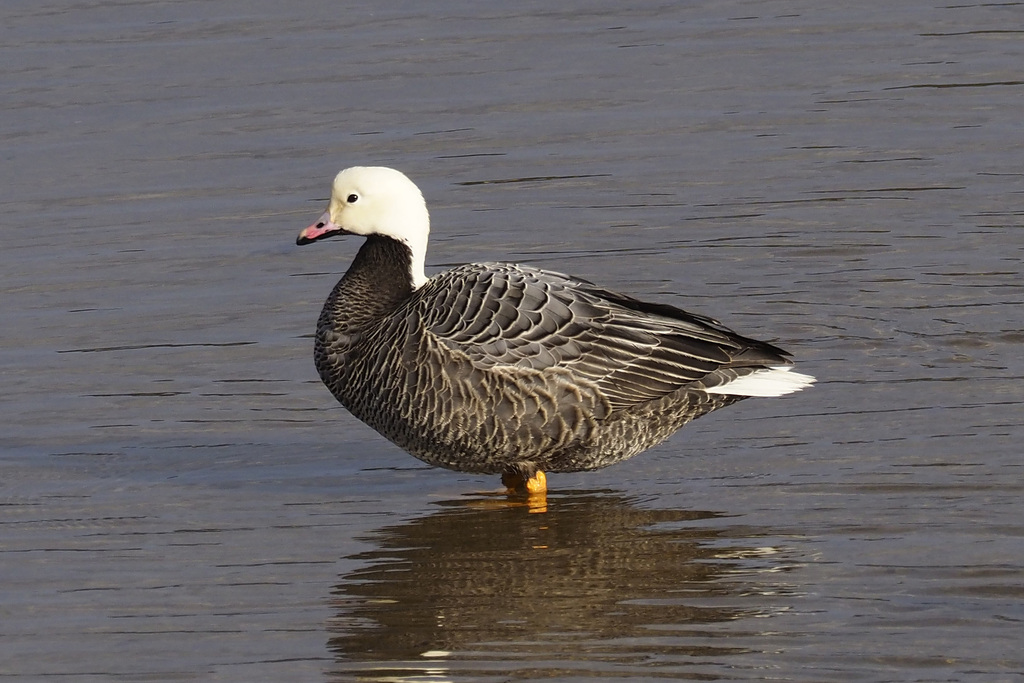
The emperor goose has a stout blue-gray body, with spots of black and white, which cause it to have a "scaled appearance". Its head and the back of its neck are white and tinged with amber-yellow; unlike the snow goose, the white does not extend to the front of the neck. The goose is also characterized by a black chin and throat, a white tail, a pink bill, which is tipped with white, and yellow-orange legs and feet. The underside of the emperor goose's wings is gray, unlike the snow goose, which has black and white on the underside of its wings. The head of adults frequently turns to a reddish-brown color in summer, due to its feeding in tidal pools with iron oxide. Goslings (i.e. young shortly after hatching) are grayish-white colored; unlike adults, their bill is black. Goslings are also distinguished from adults by having gray, brown, or black feet and an area of white surrounding the bill for the first three weeks after hatching. Juveniles (i.e. immature specimens older than goslings) are mostly gray colored, with a small amount of white on their feathers. Younger juveniles have a dark head and neck, with their head being dusty-colored with patches of white. However, after October, their head and upper neck turn to mostly white, although they still have scattered darker feathers. …
Range & habitat
During the summer, the emperor goose lives in Arctic and subarctic climates in the Bering Sea, around Alaska and a small part of northeast Russia. Its habitats in this season include freshwater pools, inland lakes, and coastal lagoons. 90% of specimens nest on the Yukon-Kuskokwim Delta. In the winter, after its southerly migration, it lives primarily among the Aleutian Islands, as well as on the Alaska Peninsula and the Kodiak Island. It sometimes spends winters in Canada and rarely as far south as northwestern California. Some areas in California the species has been found living in, as of 1918, include Humboldt Bay, Gridley, Davis, Rio Vista, Colusa County, Ingomar, Modesto, and Dixon. Its habitats are mudflats and rocky shores in the winter, in areas free of ice, and tundra wetlands in the summer. Its extent of occurrence is estimated to be 775,000 square kilometres (299,000 sq mi).
Wikipedia: “Habitat and distribution”
What it does
The emperor goose is migratory, traveling north in the summer to breed and south for the winter. Unlike many goose species, which migrate thousands of miles, the emperor goose travels a few hundred miles for migration, usually about 370 miles (600 km) to 470 miles (760 km). Breeding birds molt near the breeding colonies, but geese unsuccessful with breeding move to either St. Lawrence Island or the Chukchi Peninsula to molt prior to the main southerly migration for winter.
Breeding. The breeding season starts in late June in Russia, but begins a few weeks earlier in Alaska, generally between 20 May and 3 June. Only individuals three years or older will mate. A monogamous species, female emperor geese have a single mate throughout their life and only mate with any other male if their mate dies. The species molts from late July to early August and leaves its breeding grounds later than any other species. The emperor goose breeds on tundra, building its nests in areas 10 miles (16 km) or closer to the coast. The nests are typically constructed in marshes. They are built as holes in the ground without containing nesting material, but are later built up with vegetation, such as leaves, and feathers, which the female plucks from herself. The species usually lays 4–6 eggs, but it can lay anywhere from 2 to 8; eggs are often laid in the nests of other emperor geese families. …
Wikipedia: “Behavior”
Listen
Looking for field recordings…
Where it lives
Recorded sightings
—
geo-referenced records in GBIF, from museums, herbaria and field observers.
Drag the globe to turn it. Dots are where records exist, not a range map; darker means more records.
In the stacks
Searching the stacks…
Every page naming Anser canagicus in the Biodiversity Heritage Library →
This page is assembled live from iNaturalist, GBIF, Wikipedia, the Source Library and the Internet Archive. It is not yet part of the hand-edited codex. iNaturalist taxon 558425.