- Plants
- ›Vascular Plants
- ›flowering plants
- ›Dicots
- ›Legumes, Milkworts, and Allies
- ›Legumes
- ›Faboideae
- ›Trifolieae
- ›Trifolium
- ›Trifolium
- ›Trifoliastrum
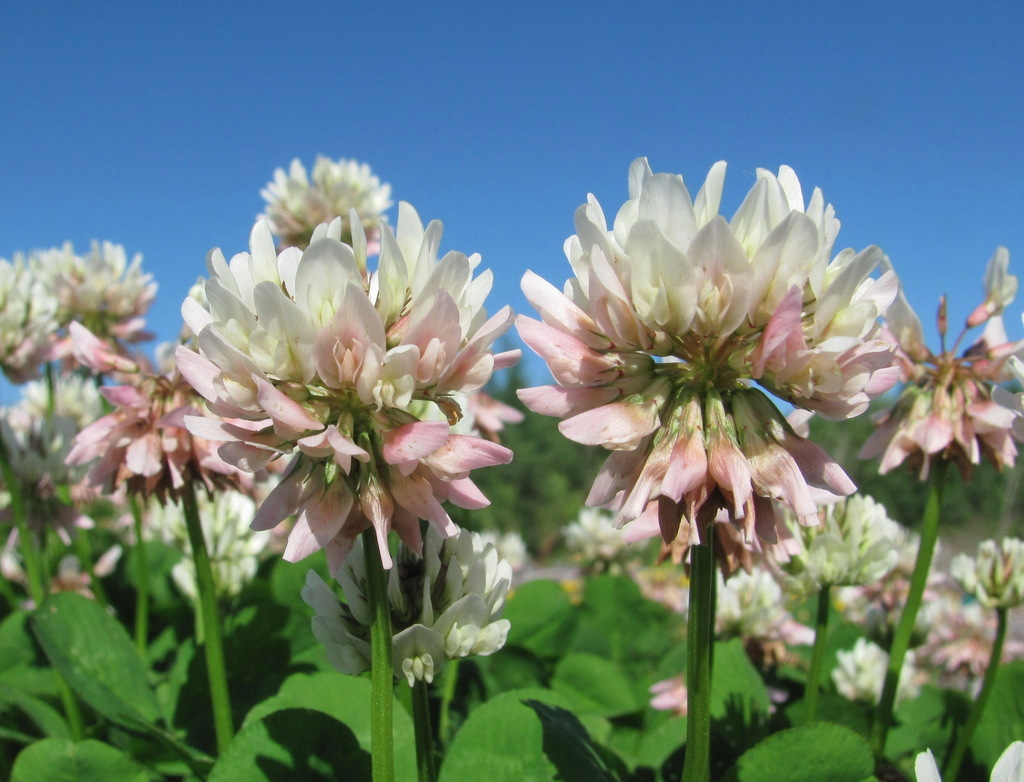
white clover
Trifolium repens
Trifolium repens, the white clover (also known as Dutch clover, Ladino clover, or Ladino), is a herbaceous perennial plant in the bean family Fabaceae (Previously referred to as Leguminosae). It is native to Europe and central Asia. One of the most widely cultivated types of clover, it has been widely introduced worldwide as a forage crop, and is now also common in most grassy areas (lawns and gardens) of North America and New Zealand. The species...
From the article Trifolium repens on Wikipedia (CC BY-SA), quoted section by section
Description
It is a low-growing herbaceous, perennial plant. The leaves are trifoliolate, smooth, elliptic to egg-shaped, long-petioled, and usually with light or dark markings. The stems function as stolons, so white clover often forms mats, with the stems creeping as much as 18 centimetres (7 in) a year, and rooting at the nodes. The leaves form the symbol known as shamrock. Almost always, a white clover will be trifoliolate (have three leaflets). However, one can, but only sometimes, possess four or more leaflets. The species includes varieties often classed as small, intermediate and large, according to height, which reflects petiole length. It produces flowering heads of whitish florets, often with a tinge of pink or cream that may come on with the aging of the plant. The heads are generally 1.5–2 cm (1⁄2–3⁄4 in) wide, and are at the end of 7 cm (2+3⁄4 in) peduncles or inflorescence stalks. The flowers are mostly visited by bumblebees and often by honey bees. White clover spreads vegetatively through creeping above-ground stems known as stolons, which form adventitious roots at their nodes. Patches of clover can potentially double in diameter during a growing season.
Range & habitat
It is native in Europe and Central Asia, ubiquitous throughout the British Isles, introduced in North America, South Africa, Australia, New Zealand, Japan and elsewhere, and globally cultivated as a forage crop. It is common in most grassy areas (lawns and gardens) of North and South America, Australia and New Zealand.
Wikipedia: “Distribution and habitat”
What it does
White clover has been used as a model organism for global research into ecology and urban evolution. As part of the Global Urban Evolution Project, scientists from 26 countries examined the production of cyanide by over 110,000 clover plants from 160 cities. Cyanide can be useful to clover plants as a deterrent to herbivores. Analyzing urban-rural differences, scientists found that cyanide production tended to increase with distance from the center of cities, suggesting that clover populations were adapting to factors commonly found in urban centers worldwide. Possible factors could include temperature (freezing is related to cyanide content), herbivory pressures, and drought stress. As clover habitats, the downtowns of cities may more closely resemble other far-flung cities than nearby rural areas.
Wikipedia: “Ecology”
At the table
Besides making an excellent forage crop for livestock, its leaves and flowers are a valuable survival food: they are high in proteins, and are widespread and abundant. The fresh plants have been used for centuries as additives to salads and other meals consisting of leafy vegetables. They are not easy for humans to digest raw, however this is easily fixed by boiling the harvested plants for 5–10 minutes. Native Americans ate some species raw. Dried white clover flowers may also be smoked as a herbal alternative to tobacco; they should not be eaten too long after picking, however, due to formation of cyanides.
Wikipedia: “Culinary uses”
In medicine
In India, T. repens is considered a folk medicine against intestinal helminthic worms, and an experimental in-vivo study validated that the aerial shoots of T. repens bear significant anticestodal (anti-tapeworm) properties.
Wikipedia: “Medicinal uses”
In human culture
The genus name, Trifolium, derives from the Latin tres, "three", and folium, "leaf", so called from the characteristic form of the leaf, which almost always has three leaflets. The species name, repens, is Latin for "creeping". The term 'white clover' is applied to the species in general, 'Dutch clover' is often applied to intermediate varieties (but sometimes to smaller varieties), and 'ladino clover' is applied to large varieties.
Wikipedia: “Etymology”
Where it lives
Recorded sightings
—
geo-referenced records in GBIF, from museums, herbaria and field observers.
Drag the globe to turn it. Dots are where records exist, not a range map; darker means more records.
In the old herbals & bestiaries


In the stacks
Searching the stacks…
Every page naming Trifolium repens in the Biodiversity Heritage Library →
This page is assembled live from iNaturalist, GBIF, Wikipedia, the Source Library and the Internet Archive. It is not yet part of the hand-edited codex. iNaturalist taxon 55745.