- Animals
- ›Arthropods
- ›Hexapods
- ›Insects
- ›Winged and Once-winged Insects
- ›Butterflies and Moths
- ›Pyralid and Crambid Snout Moths
- ›Crambid Snout Moths
- ›Pyraustinae
- ›Pyraustini
- ›Pyrausta
- ›Pyrausta aurata
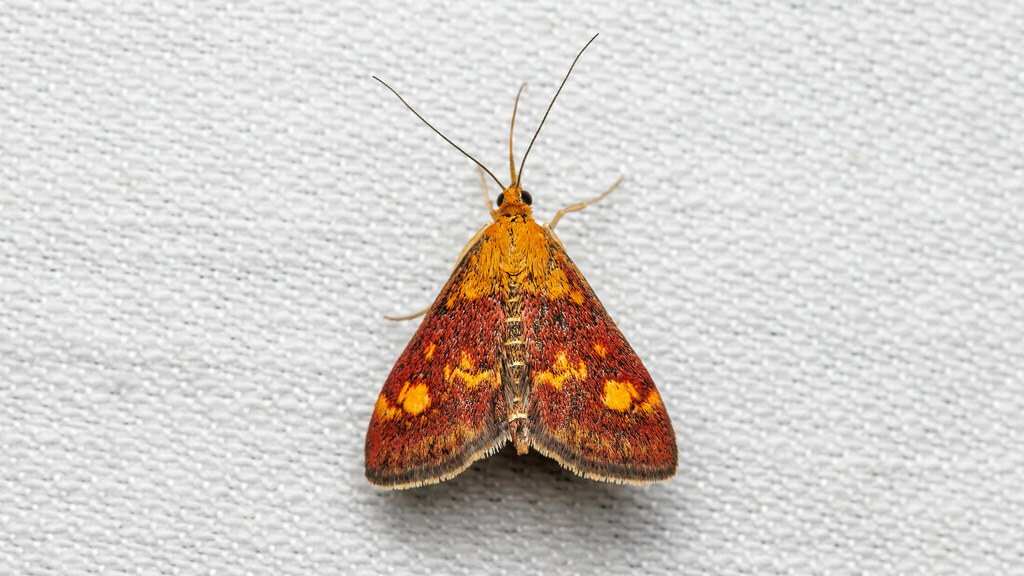
Mint Moth
Pyrausta aurata
The mint moth (Pyrausta aurata) is a small moth from the family Crambidae, also known by the common name Small Purple and Gold.
From the article Mint moth on Wikipedia (CC BY-SA), quoted section by section
Description
Pyrausta aurata has a wingspan of 18–20 millimetres (0.7–0.8 in). The forewings are purplish-brown with golden yellow markings. The number and intensity of these markings is quite variable. Usually in the forewings there is a single postmedian round golden spot near the costa, often with some other minor golden spots. The yellow spots can also be greatly reduced up to complete absence. Sometimes there is an almost indistinct wavy golden postmedian line between the dorsum and the main golden spot. The hindwings are dark brown or also black with a broad yellow transverse band approximately in the wing center and without additional spot closer to the basal area. The moth is very similar to the related Pyrausta purpuralis, a slightly larger moth with a broad postmedian continuous band, usually divided into at least three yellow spots. The caterpillar can reach a length of 13 mm. It may be light green, dark green, light brown, black, grey, or reddish, with a darker back line. The head is brownish black. The pupa is quite slender, red-brown to black-brown.
Range & habitat
This species can be found in most of Europe and it is also widespread in North Africa and North Asia. In the east it is present from Siberia to North China, Korea and Japan, in the south, it covers Asia Minor, the Middle East, Iran, Afghanistan, Middle Asia and Mongolia.
Wikipedia: “Distribution”
Listen
Looking for field recordings…
Where it lives
Recorded sightings
—
geo-referenced records in GBIF, from museums, herbaria and field observers.
Drag the globe to turn it. Dots are where records exist, not a range map; darker means more records.
In the stacks
Searching the stacks…
Every page naming Pyrausta aurata in the Biodiversity Heritage Library →
This page is assembled live from iNaturalist, GBIF, Wikipedia, the Source Library and the Internet Archive. It is not yet part of the hand-edited codex. iNaturalist taxon 55658.