- Animals
- ›Arthropods
- ›Hexapods
- ›Insects
- ›Winged and Once-winged Insects
- ›Butterflies and Moths
- ›Butterflies
- ›Whites, Yellows, and Sulphurs
- ›Whites
- ›Pierini
- ›Pierina
- ›Pieris
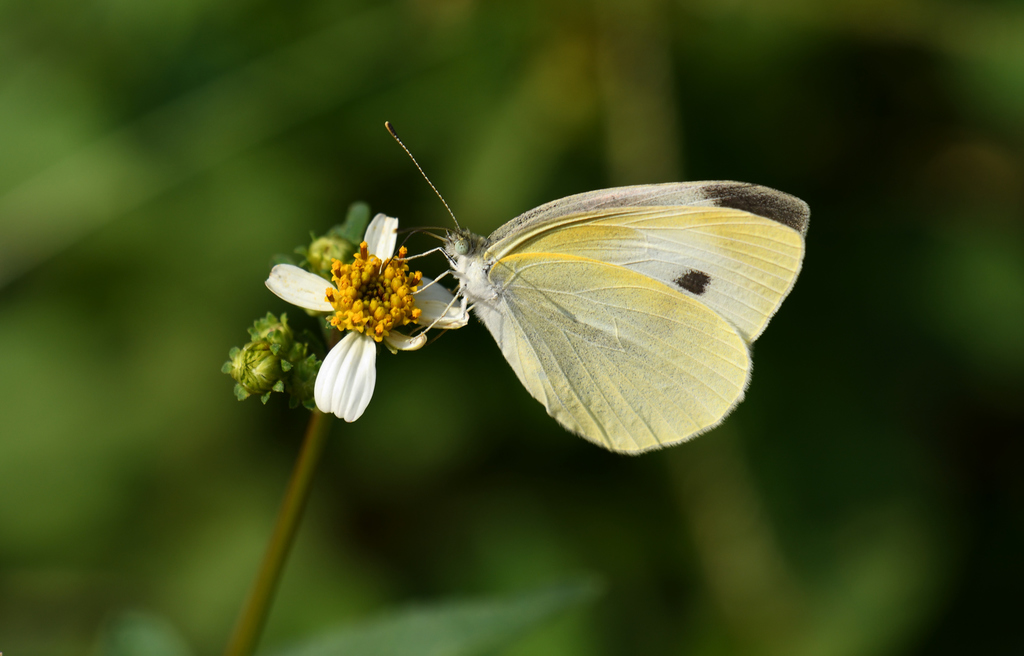
Small White
Pieris rapae
Pieris rapae is a small-to-medium-sized butterfly species of the whites-and-yellows family Pieridae. It is known in Europe as the small white, in North America and the United Kingdom as the cabbage white or cabbage butterfly, on several continents as the small cabbage white, and in New Zealand as the white butterfly. The butterfly is recognizable by its white color with small black dots on its wings, and it can be distinguished from P. brassicae by the latter's larger size and black band at the tip of the forewings.
The caterpillar of this species, often referred to as the "imported cabbageworm", is a pest to crucifer crops such as cabbage, kale, bok choy and broccoli. Pieris rapae is widespread in Europe and Asia; it is believed to have originated in the Eastern Mediterranean region of Europe and to have spread across Eurasia thanks to the diversification of brassicaceous crops and the development of human trade routes. Over the past two centuries, it spread to North Africa (about 1800), North America (1860s), Hawaii (1897), New Zealand (1930), and Australia (1937), as a result of accidental introductions.
From the article Pieris rapae on Wikipedia (CC BY-SA), quoted section by section
Description
In appearance it looks like a smaller version of the large white (Pieris brassicae). The upperside is creamy white with black tips on the forewings. Females also have two black spots in the center of the forewings. Its underwings are yellowish with black speckles. It is sometimes mistaken for a moth due to its plain appearance. The wingspan of adults is roughly 32–47 mm (1.3–1.9 in). Pieris rapae has a wingbeat frequency averaging 12.8 flaps per second.
Range & habitat
The species has a natural range across Europe, Asia, and North Africa. It was accidentally introduced to Quebec, Canada, around 1860 and spread rapidly throughout North America. The species has spread to all North American life zones from Lower Austral/Lower Sonoran to Canada. Estimates show that a single female of this species might be the progenitor in a few generations of millions. It is absent or scarce in desert and semidesert regions (except for irrigated areas). It is not found north of Canadian life zone, nor on Channel Islands off the coast of southern California. By 1898, the small white had spread to Hawaii; by 1929, it had reached New Zealand and the area around Melbourne, Australia, and found its way to Perth as early as 1943. It does not seem to have made it to South America. In Britain, it has two flight periods, April–May and July–August, but is continuously brooded in North America, being one of the first butterflies to emerge from the chrysalis in the spring and flying until hard freeze in the fall. The species can be found in any open area with diverse plant association. It can be seen usually in towns, but also in natural habitats, mostly in valley bottoms. Although an affinity towards open areas is shown, the small white is found to have entered even small forest clearings in recent years. The nominate subspecies P. r. …
Wikipedia: “Distribution and habitat”
What it does
The small white will readily lay eggs on both cultivated and wild members of the cabbage family, such as charlock (Sinapis arvensis) and hedge mustard (Sisymbrium officinale). P. rapae is known to lay eggs singularly on the host plant. The egg is characterized by a yellowish color and 12 longitudinal ridges. The egg production peaks about a week after adulthood in lab and the female can live up to 3 weeks. Females tend to lay fewer eggs on plants in clumps than on isolated plants. It has been suggested that isothiocyanate compounds in the family Brassicaceae may have been evolved to reduce herbivory by caterpillars of the small white. However, this suggestion is not generally accepted because the small white has later been shown to be immune to the isothiocyanate forming reaction due to a specific biochemical adaptation. In contrast, the small white and relatives seem to have evolved as a consequence of this biochemical adaptation to the isothiocyanate-forming glucosinolates.
Traditionally known in the United States as the imported cabbage worm, now more commonly the cabbage white, the caterpillars are bluish-green, with tiny black spots, a black ring around the spiracles, and a lateral row of yellow dashes, and a yellow middorsal line. Caterpillars rest on the undersides of the leaves, making them less visible to predators. …
Wikipedia: “Life cycle”
Listen
Looking for field recordings…
Where it lives
Recorded sightings
—
geo-referenced records in GBIF, from museums, herbaria and field observers.
Drag the globe to turn it. Dots are where records exist, not a range map; darker means more records.
In the old herbals & bestiaries

François Bouchard — Recueil de cent-trente-trois oiseaux des plus belles especes (1775)
François Bouchard · 1775 · p.151

Herbarius
1485 · p.150

Mark Catesby — Piscium, serpentum, insectorum (pt. 2) (1777)
Mark Catesby · 1777 · p.42

Latin Herbal
1484 · p.281

Herbarius
1485 · p.212

Garden of Health
Jacob Meydenbach · 1491 · p.229

Ortus sanitatis
1491 · p.279

Garden of Health
Jacob Meydenbach · 1491 · p.69

The Great Herbary with all the figures of the herbs
1532 · p.196

The Great Herbary with all the figures of the herbs
1532 · p.261

Book of Herbs
Hieronymus Bock (Tragus) · 1546 · p.670

Historia naturalis Brasiliae
Willem Piso / Georg Marcgraf · 1648 · p.159
In the stacks
Searching the stacks…
Every page naming Pieris rapae in the Biodiversity Heritage Library →
This page is assembled live from iNaturalist, GBIF, Wikipedia, the Source Library and the Internet Archive. It is not yet part of the hand-edited codex. iNaturalist taxon 55626.