- Animals
- ›Arthropods
- ›Hexapods
- ›Insects
- ›Winged and Once-winged Insects
- ›Butterflies and Moths
- ›Owlet Moths and Allies
- ›Cutworm Moths and Allies
- ›Acronictinae
- ›Acronicta
- ›Simyra
- ›Acronicta menyanthidis
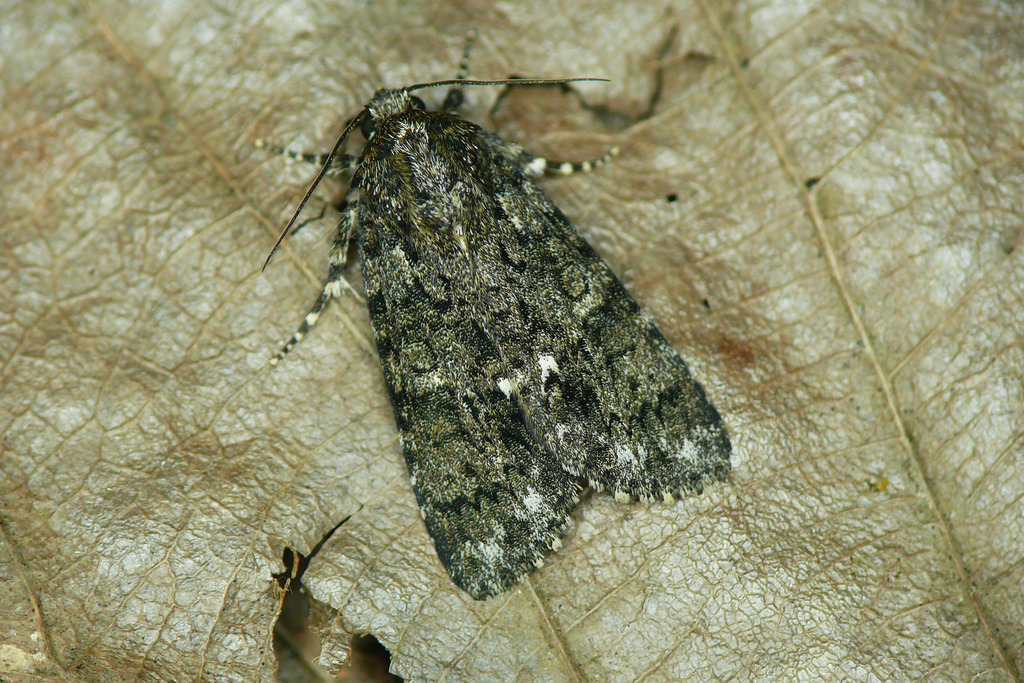
Knot Grass Moth
Acronicta rumicis
Acronicta rumicis, the knot grass moth, is a species of moth which is part of the genus Acronicta and family Noctuidae. It was first described by Carl Linnaeus in his 1758 10th edition of Systema Naturae. It is found in the Palearctic region. A. rumicis lives and feeds on plants located in wide-open areas. At its larval stage, as a caterpillar, it causes such a large impact as a crop pest that it has received much attention and research. A. rumicis feeds on maize, strawberries and other herbaceous plants.
The moth's evolution has been affected by the industrial melanism that occurred in Europe during the late 19th and early 20th centuries, causing a dramatic increase in two aberrations (salicin and lugubris), which have darker grey wings. Today, A. rumicis is important to conservation efforts in the United Kingdom, because, like many other species, it is in decline. However, as it is part of a UK Priority Biodiversity Action Plan and receiving greater awareness and conservation, the species may become more abundant.
From the article Acronicta rumicis on Wikipedia (CC BY-SA), quoted section by section
Description
A. rumicis has a wingspan of 34–44 mm. The forewings are blotched with a mixture of dark and light-grey shades, while the hindwings are dark brown. A white spot is seen midway down the trailing edge of the forewing providing a distinct marker for A. rumicis not seen in other Acronicta moths. Chinese and Japanese moths tend to be larger than their European counterparts. The Asian moths also have lower forewings that have darker shades of grey.
Wikipedia: “Description and identification”
Range & habitat
A. rumicis is distributed throughout the Palearctic. It is common in northwestern China, the Korean Peninsula, and Japan, although it has also been found in other parts of Eurasia, including Russia. A. rumicis is found in almost all parts of Europe, though it is absent in some areas of north-western Scandinavia. There has been much research about the species in England and Scotland. These moths tend to spend their lives in plants located in wide-open areas like meadows, woodland clearings, gardens, and hedgerows, generally in non-humid areas.
Wikipedia: “Distribution and habitat”
In human culture
A. rumicis species generally have two broods: the first generation flies in May and June, while the second flies in August and September. However, the number of generations can differ based on location; in southern Europe, it tends to have three broods, while in the north, it has only one, most likely due to diapause. The number of broods may be determined by the duration of light and temperature ranges. The larvae tend to feed from the summer onwards until winter, during which A. rumicis spend its time in the pupae stage in cocoons.
Egg. Eggs are laid in clusters, in almost regular, overlapping rows on host plants. The egg stage lasts about 5 to 10 days. The eggs have a round flattened shape like a sand dollar and has a micropylar area that has 20 long ridges that radiate from the center, almost like a child's drawing of a sun and its rays. The flattened structure allows for stability while resting on the host plant.
Caterpillar. When larvae hatch, they tend to nibble out the round opening of the egg. Usually, A. rumicis larvae are ready to pupate after 30 days. They tend to be about 40 mm long, having dark brown bodies, with white spots along both sides of the body and red spots along the centre of the back. Body hairs grow in tufts, arranged in rows: two rows along each side of the body and one row along the centre of the back.
Pupa. …
Wikipedia: “Life history”
Listen
Looking for field recordings…
Where it lives
Recorded sightings
—
geo-referenced records in GBIF, from museums, herbaria and field observers.
Drag the globe to turn it. Dots are where records exist, not a range map; darker means more records.
In the stacks
Searching the stacks…
Every page naming Acronicta rumicis in the Biodiversity Heritage Library →
This page is assembled live from iNaturalist, GBIF, Wikipedia, the Source Library and the Internet Archive. It is not yet part of the hand-edited codex. iNaturalist taxon 55623.