- Animals
- ›Arthropods
- ›Hexapods
- ›Insects
- ›Winged and Once-winged Insects
- ›Beetles
- ›Water, Rove, Scarab, Long-horned, Leaf, and Snout Beetles
- ›Cucujiform Beetles
- ›Leaf Beetles and Allies
- ›Leaf Beetles
- ›Skeletonizing Leaf and Flea Beetles
- ›Luperini
- ›Diabroticina
- ›Diabrotica
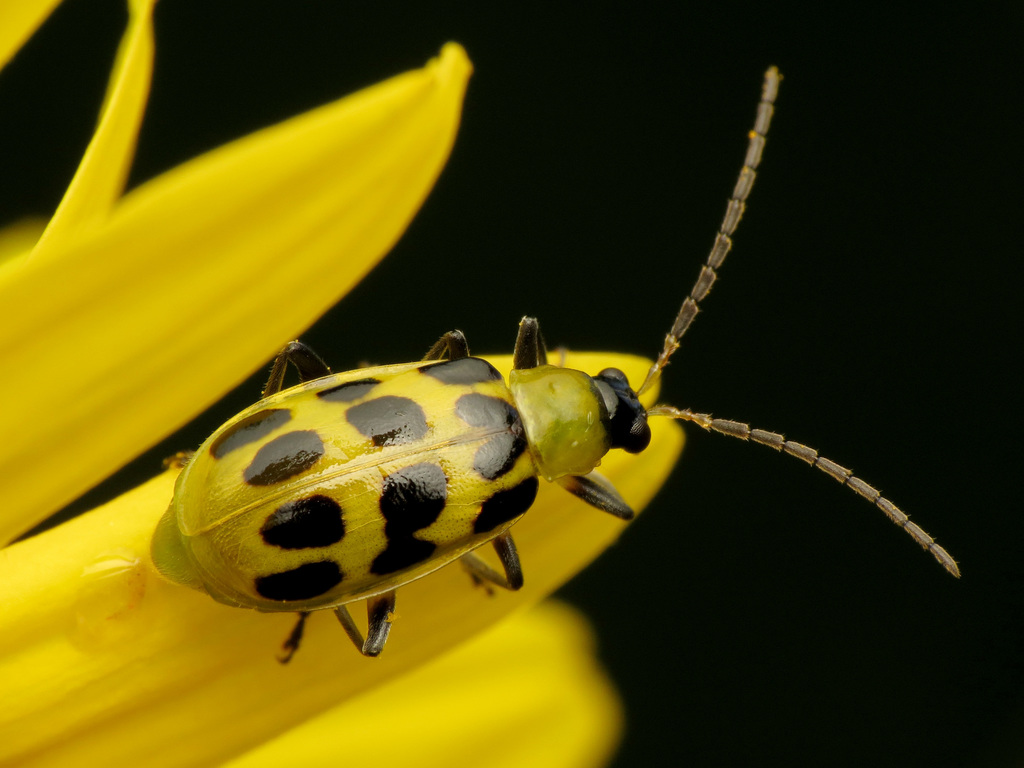
Spotted Cucumber Beetle
Diabrotica undecimpunctata
Diabrotica undecimpunctata, the spotted cucumber beetle or southern corn rootworm, is a species of cucumber beetle that is native to North America. The species can be a major agricultural pest insect in North America. Spotted cucumber beetles cause damage to crops in the larval and adult stages of their life cycle. Larvae feed on the roots of the emerging plants, which causes the most damage since the young plants are more vulnerable. In the adult stage the beetles cause damage by eating the flowers, leaves, stems, and fruits of the plant. The beetles can also spread diseases such as bacterial wilt and mosaic virus.
From the article Diabrotica undecimpunctata on Wikipedia (CC BY-SA), quoted section by section
Description
The three primary types of cucumber beetles are the spotted cucumber beetle, the banded cucumber beetle (Diabrotica balteata), and the striped cucumber beetle (Acalymma vittatum). In North America, the spotted and striped cucumber beetles are the most commonly encountered varieties. The spotted cucumber beetle has three subspecies, each with a different common name:
Diabrotica undecimpunctata howardi – spotted cucumber beetle or southern corn rootworm Diabrotica undecimpunctata tenella – western cucumber beetle Diabrotica undecimpunctata undecimpunctata – western spotted cucumber beetle In the adult form, it eats leaves of many crops, including squash, cucumbers, soybeans, cotton, beans, and corn. Adult beetles lay eggs in the soil near a cucurbit plant. In a lifetime, females can lay between 150 and 400 eggs. However, there have been cases in which females have surpassed this quota, with some laying a total of 1,200 eggs. The eggs hatch around mid-spring and take 6–9 days to hatch under favorable conditions. In some cases, specifically when the climate is at a lower temperature, eggs can take 30 days to hatch. The ideal soil for egg survival is moist. The larval stage lasts around 2–3 weeks and the larvae are yellowish and wormlike. After the larval stage insects become pupae, this stage lasts for 6–10 days. …
Range & habitat
This species is found throughout southern Canada, the continental United States, and the central highlands of Mexico, but is particularly widespread throughout the southern states.
Wikipedia: “Distribution”
What it does
Adult spotted cucumber beetles consume over fifty different types of crops and wild plants, including corn, peanuts, beans, apples, cherries, clovers, lettuce, potatoes, and more. Spotted cucumber beetles are classified as generalist feeders, which means they consume a wide variety of foods; however, they often prefer cucurbits (plants belonging to the gourd family).
Wikipedia: “Diet”
Listen
Looking for field recordings…
Where it lives
Recorded sightings
—
geo-referenced records in GBIF, from museums, herbaria and field observers.
Drag the globe to turn it. Dots are where records exist, not a range map; darker means more records.
In the stacks
Searching the stacks…
Every page naming Diabrotica undecimpunctata in the Biodiversity Heritage Library →
This page is assembled live from iNaturalist, GBIF, Wikipedia, the Source Library and the Internet Archive. It is not yet part of the hand-edited codex. iNaturalist taxon 55487.