- Animals
- ›Arthropods
- ›Hexapods
- ›Insects
- ›Winged and Once-winged Insects
- ›Butterflies and Moths
- ›Geometrid and Swallowtail Moths
- ›Geometer Moths
- ›Ennominae
- ›Ennomini
- ›Sabulodes
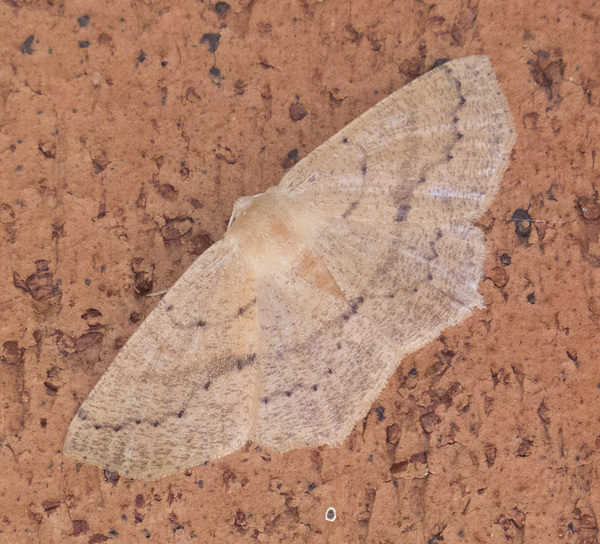
Omnivorous Looper
Sabulodes aegrotata
Sabulodes aegrotata, the Omnivorous Looper, is a moth of the family Geometridae. It is found in Western North America, from British Columbia to California. The larvae eat a wide variety of flowering trees and plants including some agricultural crops. Its distinguishing feature is that the medial and postmedial lines intersect near the trailing edge of the wing.
From the article Sabulodes aegrotata on Wikipedia (CC BY-SA), quoted section by section
Range & habitat
This moth is common in damp coastal forests along the west coast of North America from British Columbia to California.
Wikipedia: “Range and Habitat”
What it does
This species has three generations per year in coastal areas and four or five generations in inland locations. Depending on temperature, egg-to-adult development takes 2 to 5 months. Eggs are barrel-shaped, light green to reddish brown with a ring of tiny projections. Eggs are laid in clusters on leaves of the host plants and hatch after 8 or 9 days. When mature caterpillars are ready to pupate, they make pearly white to brown cocoons, hidden in between leaves. Pupation lasts 1 to 4 weeks. The larva make shelters from silk and folded leaves where they shelter during the day and come out at night to feed. The University of California IPM Program gives a description of the caterpillar: “Young omnivorous looper larvae are pale yellow caterpillars. Older larvae grow to about 2 inches long and are yellow to pale green or pink, with dark brown, black, or green lines along the sides and a gold-colored head. In addition to the three pairs of legs behind the head, omnivorous loopers have two pairs of prolegs (leglike appendages) near the rear on abdominal segments 6 and 10.”
Wikipedia: “Life Cycle”
Listen
Looking for field recordings…
Where it lives
Recorded sightings
—
geo-referenced records in GBIF, from museums, herbaria and field observers.
Drag the globe to turn it. Dots are where records exist, not a range map; darker means more records.
In the stacks
Searching the stacks…
Every page naming Sabulodes aegrotata in the Biodiversity Heritage Library →
This page is assembled live from iNaturalist, GBIF, Wikipedia, the Source Library and the Internet Archive. It is not yet part of the hand-edited codex. iNaturalist taxon 55467.