On eBird ↗
Plumbeous Antbird
Live sightings near you, the range map, bar charts of when it is seen, and Macaulay Library photos and recordings.
Plumbeous Antbird
Myrmelastes hyperythrus
The plumbeous antbird (Myrmelastes hyperythrus) is a species of bird in subfamily Thamnophilinae of family Thamnophilidae, the "typical antbirds". It is found in Bolivia, Brazil, Colombia, Ecuador, and Peru.
From the article Plumbeous antbird on Wikipedia (CC BY-SA), quoted section by section
Description
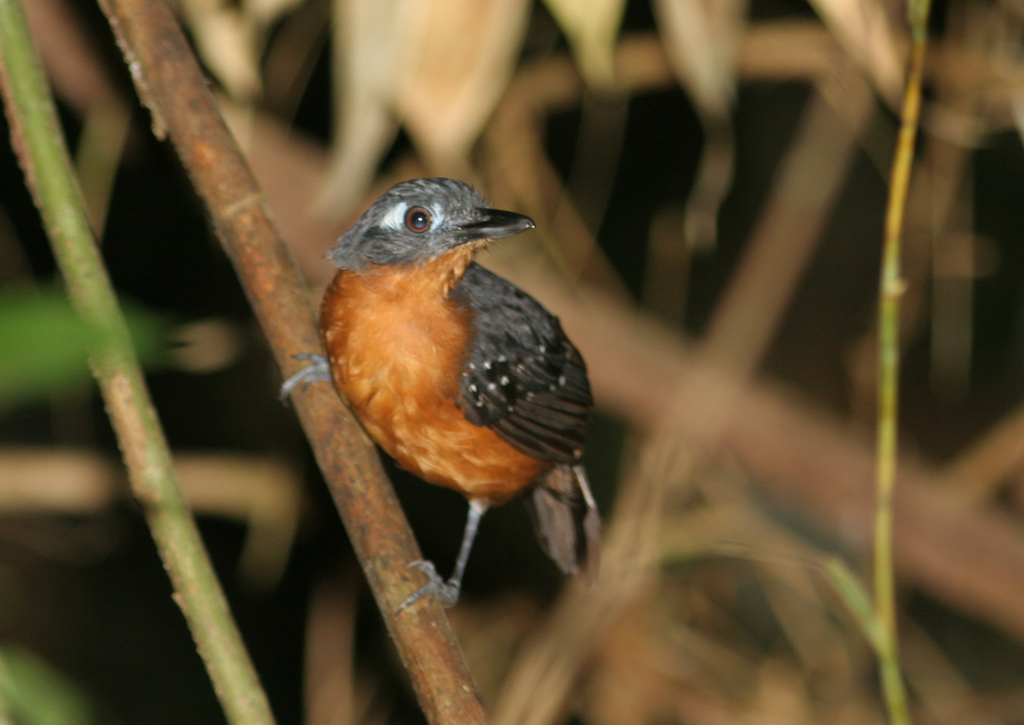
The plumbeous antbird is 17 to 18 cm (6.7 to 7.1 in) long and weighs 38 to 44 g (1.3 to 1.6 oz). Males are mostly dark slaty gray. Their wings and tail are blackish gray with white spots at the tips of the wing coverts. They have a large area of bare light blue skin around their eye. Females have dark slaty gray upperparts, wings, and tail like males. Their underparts are bright rufous with a brown tinge on their flanks and crissum.
Range & habitat
The plumbeous antbird is found in the western Amazon Basin. It ranges from Caquetá Department in southern Colombia and Sucumbíos and Orellana provinces in northeastern Ecuador south through eastern Peru into northwestern Bolivia and east in Brazil to the basin of the Purus River. It inhabits the floor and understorey of evergreen forest. It favors the interior of várzea where tree falls create openings, but also occurs in transitional forest and along small watercourses and oxbow lakes. In elevation it reaches 500 m (1,600 ft) in Colombia and 300 m (1,000 ft) in Ecuador. It Peru it mostly occurs below 500 m (1,600 ft) but locally is found as high as 800 m (2,600 ft).
Wikipedia: “Distribution and habitat”
What it does
The plumbeous antbird's diet has not been detailed but is known to include insects, other arthropods, and snails. It forages as individuals, pairs, and small family groups and mostly within about 3 m (10 ft) of the ground and usually not with mixed-species feeding flocks. They hop along the ground and among low branches, and take prey mostly by picking from leaf litter and by reaching to leaves and twigs from the ground or a low perch. They occasionally attend army ant swarms to capture prey disturbed by the ants.
Wikipedia: “Feeding”
Listen
Looking for field recordings…
Where it lives
Recorded sightings
—
geo-referenced records in GBIF, from museums, herbaria and field observers.
Drag the globe to turn it. Dots are where records exist, not a range map; darker means more records.
In the stacks
Searching the stacks…
Every page naming Myrmelastes hyperythrus in the Biodiversity Heritage Library →
This page is assembled live from iNaturalist, GBIF, Wikipedia, the Source Library and the Internet Archive. It is not yet part of the hand-edited codex. iNaturalist taxon 554135.