On eBird ↗
Gray-bellied Antbird
Live sightings near you, the range map, bar charts of when it is seen, and Macaulay Library photos and recordings.
Gray-bellied Antbird
Ammonastes pelzelni
The grey-bellied antbird (Ammonastes pelzelni) is a species of passerine bird in subfamily Thamnophilinae of family Thamnophilidae, the "typical antbirds". It is found Brazil, Colombia, and Venezuela.
From the article Grey-bellied antbird on Wikipedia (CC BY-SA), quoted section by section
Description
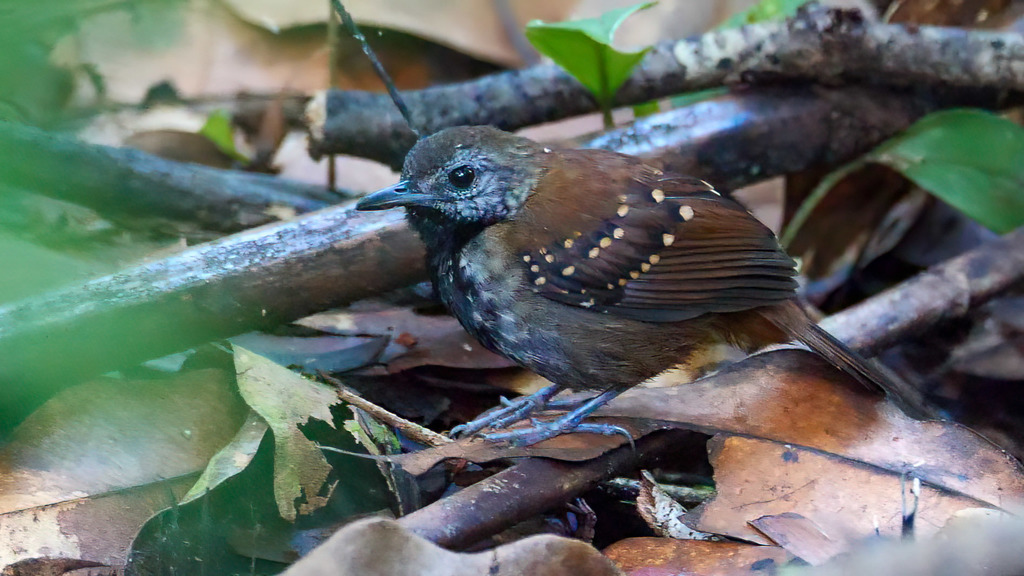
The grey-bellied antbird is 12.5 to 14 cm (4.9 to 5.5 in) long and weighs 17 to 18.5 g (0.60 to 0.65 oz). Adult males have a mottled whitish and gray face. Their crown is dark grayish brown and their back and rump are yellowish red-brown. Their wings and tail are dark reddish brown and their wing coverts blackish with large pale buff tips. Their throat and breast are black with a gray border that becomes reddish yellow-brown on the rest of the underparts. Adult females have upperparts like the male's but with larger white spots on the wing coverts. Their throat, breast, and belly are mostly white with a blackish scaly appearance on the upper breast. Both sexes have a black bill and pale brown legs.
Range & habitat
The grey-bellied antbird has a disjunct distribution. It is found in Colombia in the south-central Caquetá Department and the far eastern Guainía and Vaupés departments. In Venezuela it occurs in southwestern Amazonas state, and in Brazil in extreme northwestern Amazonas state along the upper reaches of the Rio Negro. It primarily inhabits Amazonian caatinga forest growing on white-sand soils, a biome characterized by tall trees and a sparse understorey. It also occurs in denser forest with concentrations of bromeliads on white sand and in the ecotone between the caatinga and igapó (seasonally flooded) forest. In elevation it is found only as high as 400 m (1,300 ft) above sea level.
Wikipedia: “Distribution and habitat”
What it does
The grey-bellied antbird feeds on arthropods, especially insects and spiders. It typically forages singly, in pairs, or in family groups and does not join mixed-species feeding flocks. It forages almost exclusively on the ground though it will ascend about 0.3 m (1 ft) up fallen logs and branches. It mostly gleans prey from the surface of leaf litter or within curled dead leaves, without often flipping them about. It also takes prey from clumps of moss and sometimes by reaching or jumping to glean from leaves near the ground.
Wikipedia: “Feeding”
Listen
Looking for field recordings…
Where it lives
Recorded sightings
—
geo-referenced records in GBIF, from museums, herbaria and field observers.
Drag the globe to turn it. Dots are where records exist, not a range map; darker means more records.
In the stacks
Searching the stacks…
Every page naming Ammonastes pelzelni in the Biodiversity Heritage Library →
This page is assembled live from iNaturalist, GBIF, Wikipedia, the Source Library and the Internet Archive. It is not yet part of the hand-edited codex. iNaturalist taxon 554131.