On eBird ↗
White-bibbed Antbird
Live sightings near you, the range map, bar charts of when it is seen, and Macaulay Library photos and recordings.
White-bibbed Antbird
Myrmoderus loricatus
The white-bibbed antbird (Myrmoderus loricatus) is a species of passerine bird in subfamily Thamnophilinae of family Thamnophilidae, the "typical antbirds". It is endemic to Brazil.
From the article White-bibbed antbird on Wikipedia (CC BY-SA), quoted section by section
Description
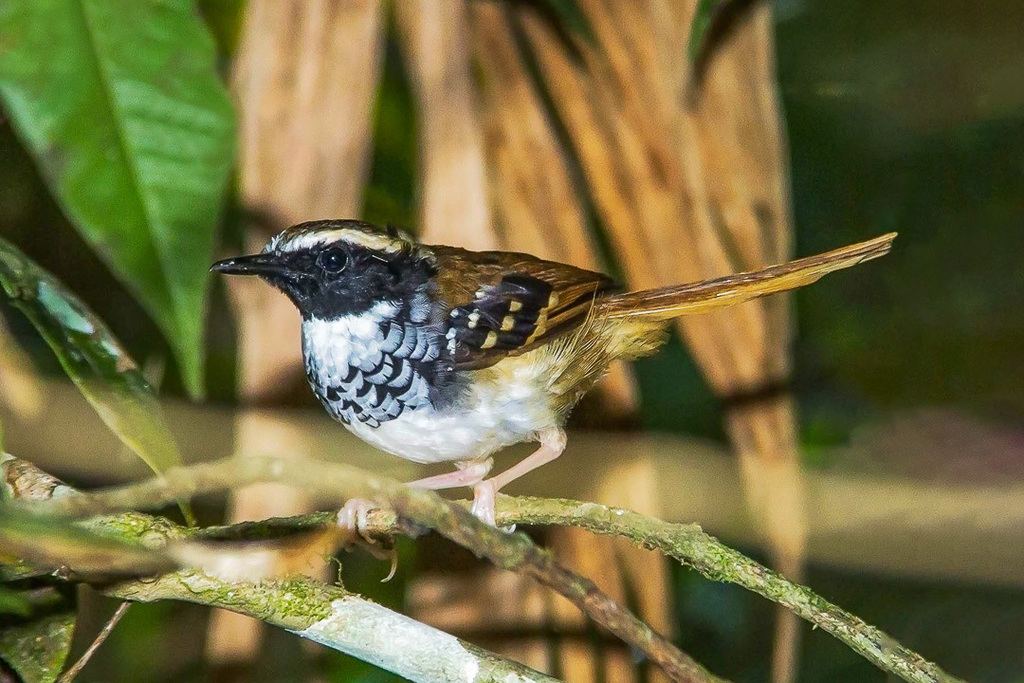
The white-bibbed antbird is 14 to 15 cm (5.5 to 5.9 in) long. Adult males have a black crown with wide rufous-chestnut edges to the feathers. They have a long white supercilium on an otherwise mostly black face. Their upperparts and tail are mostly rufous-chestnut with a white patch between their scapulars. Their flight feathers are rufous-chestnut and their wing coverts black with wide white tips. Their chin is black. Their throat and underparts to the crissum are white with black scallops on the breast; their crissum is light ochre-brown. Adult females are similar to males but with a dark reddish yellow-brown crown, a pale buff supercilium, mostly plain white underparts, and pale buff flanks and crissum.
Range & habitat
The white-bibbed antbird is found in eastern Brazil from central and southeastern Bahia south into northeastern São Paulo state. It inhabits the floor of evergreen forest and nearby mature secondary forest, where it favors areas with many saplings and a dense herbaceous understorey. In elevation it ranges between 700 and 1,300 m (2,300 and 4,300 ft).
Wikipedia: “Distribution and habitat”
What it does
The white-bibbed antbird's diet has not been detailed but is known to include insects and probably also spiders. Individuals, pairs, and family groups forage mostly on the ground though also in vegetation up to about 1 m (3 ft) above it. They actively hop on the ground and through vine tangles and brush. They probe leaf litter (seldom flipping leaves) and glean from low-hanging leaves by reaching and jumping. They do not join mixed-species feeding flocks and only occasionally, and briefly, attend army ant swarms.
Wikipedia: “Feeding”
Listen
Looking for field recordings…
Where it lives
Recorded sightings
—
geo-referenced records in GBIF, from museums, herbaria and field observers.
Drag the globe to turn it. Dots are where records exist, not a range map; darker means more records.
In the stacks
Searching the stacks…
Every page naming Myrmoderus loricatus in the Biodiversity Heritage Library →
This page is assembled live from iNaturalist, GBIF, Wikipedia, the Source Library and the Internet Archive. It is not yet part of the hand-edited codex. iNaturalist taxon 554109.