On eBird ↗
Ferruginous-backed Antbird
Live sightings near you, the range map, bar charts of when it is seen, and Macaulay Library photos and recordings.
Ferruginous-backed Antbird
Myrmoderus ferrugineus
The ferruginous-backed antbird (Myrmoderus ferrugineus) is a species of passerine bird in the family Thamnophilidae. It inhabits the Guyanas and the northern Amazon Basin. Its natural habitat is subtropical or tropical moist lowland forests.
From the article Ferruginous-backed antbird on Wikipedia (CC BY-SA), quoted section by section
Description
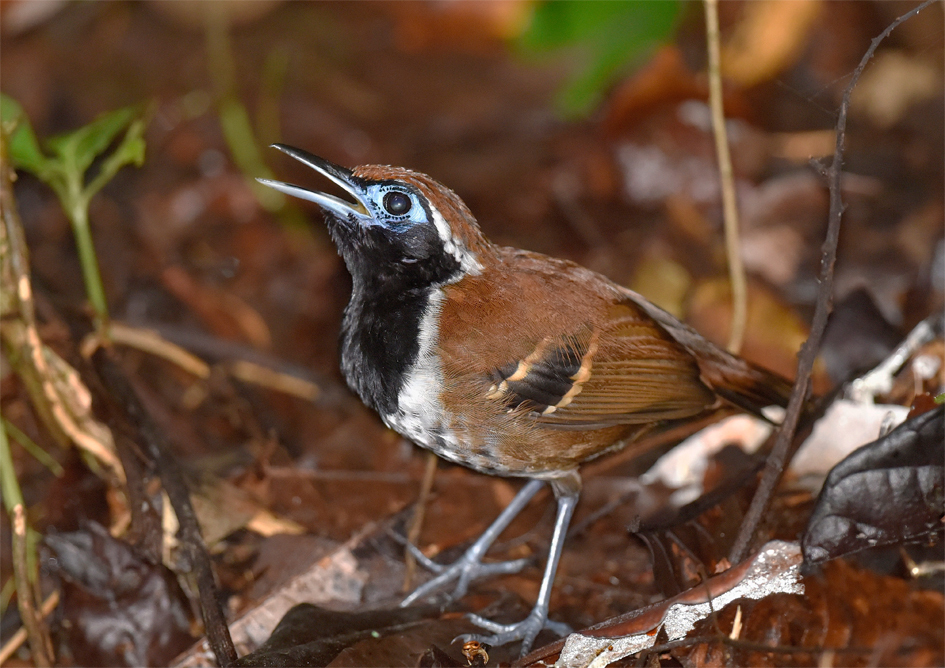
The ferruginous-backed antbird is 14 to 15 cm (5.5 to 5.9 in) long and weighs 24 to 29 g (0.85 to 1.0 oz). Adult males of the nominate subspecies have a bright chestnut crown, upperparts, and flight feathers. Their wing coverts are black with wide pale cinnamon-buff tips. Their tail is rufous-brown. Their eye is surrounded by bare blue skin. Their face, throat, breast, and upper belly are black with a white line separating them from the chestnut of the upperparts. The center of their belly is gray and their flanks, lower belly, and crissum are reddish yellow-brown. Adult females are similar but with a white chin and throat, a light gray (not black) belly, and a paler crissum. Both sexes of subspecies M. f. elutus have paler lower underparts than the nominate and females have a whiter belly.
Range & habitat
The nominate subspecies of the ferruginous-backed antbird is found from the Caroní River in far eastern Venezuela east through the Guianas. Its range extends into northeastern Amazonian Brazil north of the Amazon between the Branco River and Negro River. Subspecies M. f. elutus is found in Brazil south of the Amazon between the Madeira and Tapajós rivers and south to the Roosevelt and upper Dos Marmelos rivers. The species primarily inhabits terra firme evergreen forest and nearby mature secondary forest, but also savanna woodland on sandy soils.
Wikipedia: “Distribution and habitat”
What it does
The ferruginous-backed antbird's diet has not been detailed but is known to include insects and spiders. Primarily pairs, but also individuals and family groups, forage almost entirely on the ground and rarely up to about 1.5 m (5 ft) above it. They usually walk, and sometimes hop, on the ground, along fallen logs, and among the branches of fallen trees. They capture most prey by gleaning from leaf litter, stems and branches, and the underside of live leaves; they also regularly jump to take prey from higher surfaces. They often follow army ant swarms, usually for only a short time.
Wikipedia: “Feeding”
Listen
Looking for field recordings…
Where it lives
Recorded sightings
—
geo-referenced records in GBIF, from museums, herbaria and field observers.
Drag the globe to turn it. Dots are where records exist, not a range map; darker means more records.
In the stacks
Searching the stacks…
Every page naming Myrmoderus ferrugineus in the Biodiversity Heritage Library →
This page is assembled live from iNaturalist, GBIF, Wikipedia, the Source Library and the Internet Archive. It is not yet part of the hand-edited codex. iNaturalist taxon 554106.