- Animals
- ›Chordates
- ›Vertebrates
- ›Ray-finned Fishes
- ›Spiny-rayed fishes
- ›Jacks, Flounders, Barracudas, and Allies
- ›Flatfishes
- ›True Soles
- ›Solea
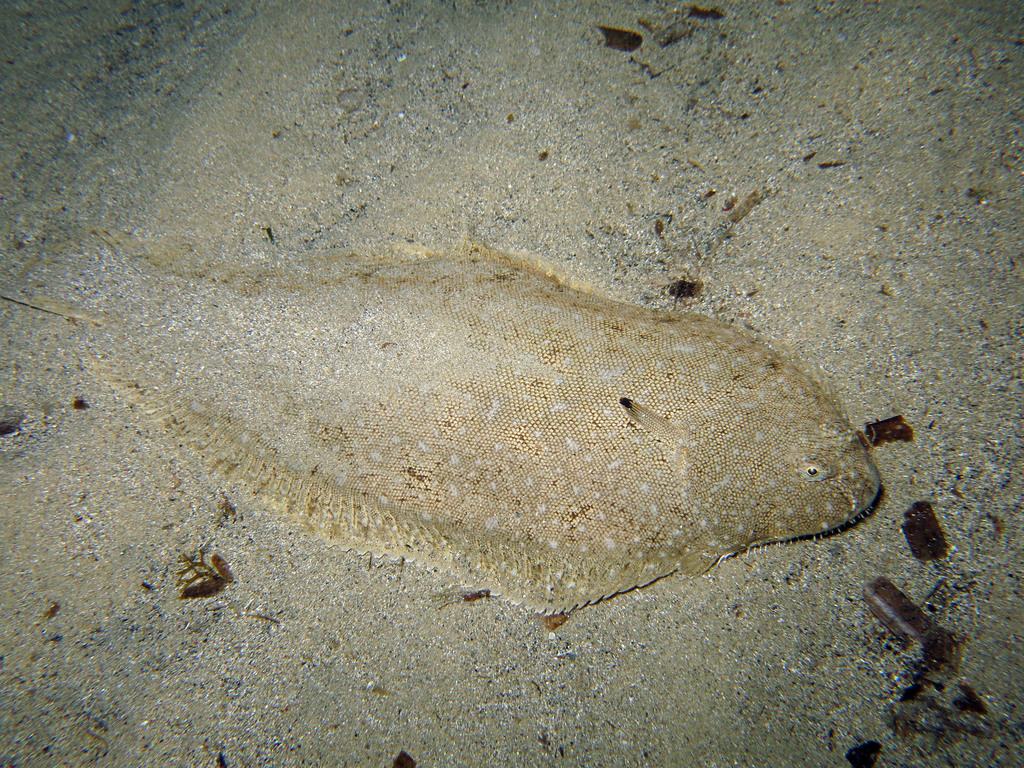
Common Sole
Solea solea
The common sole, Dover sole, or black sole (Solea solea) is a species of flatfish in the family Soleidae. It is one of the largest fish in the Solea genus. It lives on the sandy or muddy seabed of the northern Atlantic and the Mediterranean Sea where it often partially immerses itself in the substrate. The upper side is greyish-brown while the underside is white. It grows to a maximum length of about 70 cm (28 in). The species is prized as a food fish, being caught mostly by bottom trawling on the seabed.
The name "Dover" comes from Dover, the English fishing port landing the most sole in the 19th century.
From the article Common sole on Wikipedia (CC BY-SA), quoted section by section
Description
The small eyes are close to each other on the right side of the body. This gives the fish the possibility of lurking half-buried in the sand for passing prey. The common sole, just like all other flatfishes, hatches as an "ordinary" fish with one eye on each side of the body. The young metamorphose to flatfish begins when they are about one centimeter long. The upper side is greyish-brown and the underside is white. The common sole approaches a maximum length of 70 cm (28 in). In the UK, a small sole is commercially called a "slip".
Range & habitat
It has a preference for relatively shallow water (10–60 m) with sand or mud covering the bottom. They can be found at depths up to 200 m. Their preferred temperature range is from 8–24 °C. It is found in the Eastern Atlantic Ocean, from the south of Norway to Senegal, and in almost all of the Mediterranean Sea. In the winter, it withdraws to the somewhat warmer waters of the southern North Sea.
Wikipedia: “Distribution and habitat”
What it does
The Dover sole feeds at night. Its diet consists of worms, molluscs and crustaceans.
Wikipedia: “Diet”
At the table
Chefs prize Dover sole for its mild, buttery, sweet flavour and versatility, and for its ease of filleting. The fish yields fillets that hold together well in a variety of recipes.
Wikipedia: “Cuisine”
Where it lives
Recorded sightings
—
geo-referenced records in GBIF, from museums, herbaria and field observers.
Drag the globe to turn it. Dots are where records exist, not a range map; darker means more records.
In the stacks
Searching the stacks…
Every page naming Solea solea in the Biodiversity Heritage Library →
This page is assembled live from iNaturalist, GBIF, Wikipedia, the Source Library and the Internet Archive. It is not yet part of the hand-edited codex. iNaturalist taxon 55396.