- Plants
- ›Vascular Plants
- ›flowering plants
- ›Dicots
- ›Sunflowers, Bellflowers, Fanflowers, and Allies
- ›Sunflowers, Daisies, Asters, and Allies
- ›Asteroideae
- ›asters and allies
- ›Celmisiinae
- ›Olearia
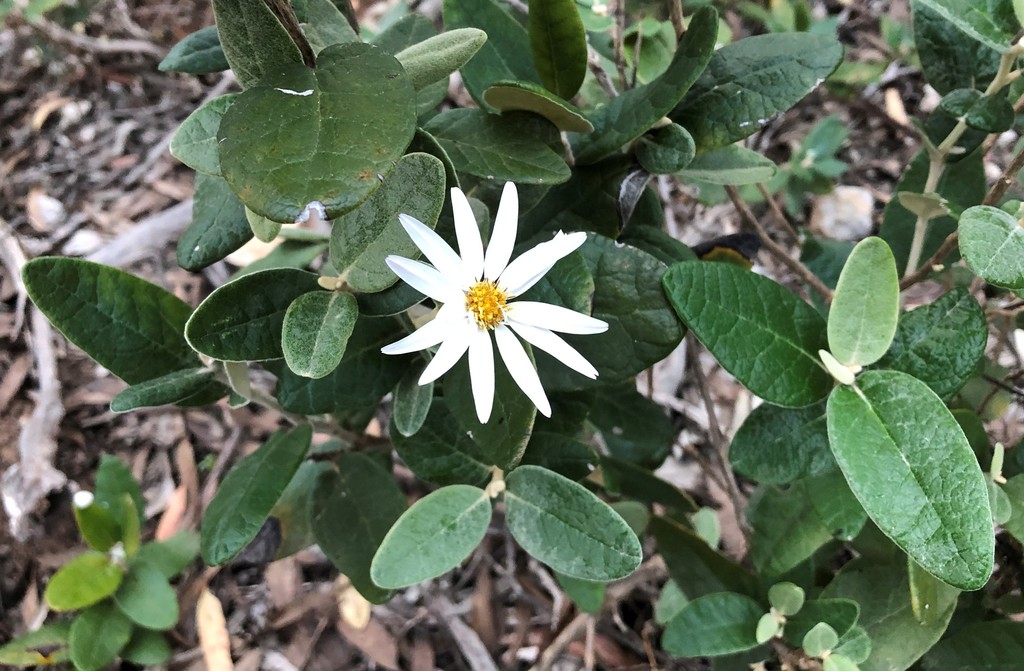
silver daisy-bush
Olearia pannosa
Olearia pannosa, commonly known as silver-leaved daisy or velvet daisy-bush, is a species of flowering plant in the family Asteraceae and is endemic to south-eastern continental Australia. It is a spreading undershrub or shrub with egg-shaped or heart-shaped leaves, and white and yellow daisy flowers.
From the article Olearia pannosa on Wikipedia (CC BY-SA), quoted section by section
Description
Olearia pannosa is a spreading undershrub or shrub that typically grows to a height of up to 1 m (3 ft 3 in) and forms a root suckers. The branchlets are covered with woolly, Y-shaped hairs. The leaves are arranged alternately, egg-shaped or heart-shaped, 30–120 mm (1.2–4.7 in) long and 18–65 mm (0.71–2.56 in) wide on a petiole up to 22 mm (0.87 in) long, the upper surface becoming glabrous and the lower surface covered with hairs similar to those on the branchlets. The heads or daisy-like "flowers" are arranged singly on the ends of branches and are 35–75 mm (1.4–3.0 in) wide on a peduncle 5–25 mm (0.20–0.98 in) long, the involucre hemispherical and woolly-hairy. Each flower has 8 to 24 white ray florets and 18 to 50 yellow disc florets. Flowering occurs from September to November and the achenes are 5–8 mm (0.20–0.31 in) long, the pappus 8–10 mm (0.31–0.39 in) long.
Range & habitat
Both subspecies of O. pannosa occur in the south-east of South Australia, but only subspecies cardiophylla occurs in Victoria, where it grows in dry forest on rocky sites in scattered locations.
Wikipedia: “Distribution and habitat”
Where it lives
Recorded sightings
—
geo-referenced records in GBIF, from museums, herbaria and field observers.
Drag the globe to turn it. Dots are where records exist, not a range map; darker means more records.
In the stacks
Searching the stacks…
Every page naming Olearia pannosa in the Biodiversity Heritage Library →
This page is assembled live from iNaturalist, GBIF, Wikipedia, the Source Library and the Internet Archive. It is not yet part of the hand-edited codex. iNaturalist taxon 553609.