Luluhot
Gymnosporia thompsonii
Gymnosporia thompsonii (CHamorro: luluhot) is a species of plant in the bittersweet family Celastraceae. It is endemic to the Mariana and Caroline Islands where it grows as a many-stemmed understory shrub or small tree in karst forests.
Some authorities refer to the species as Maytenus thompsonii.
From the article Gymnosporia thompsonii on Wikipedia (CC BY-SA), quoted section by section
Description
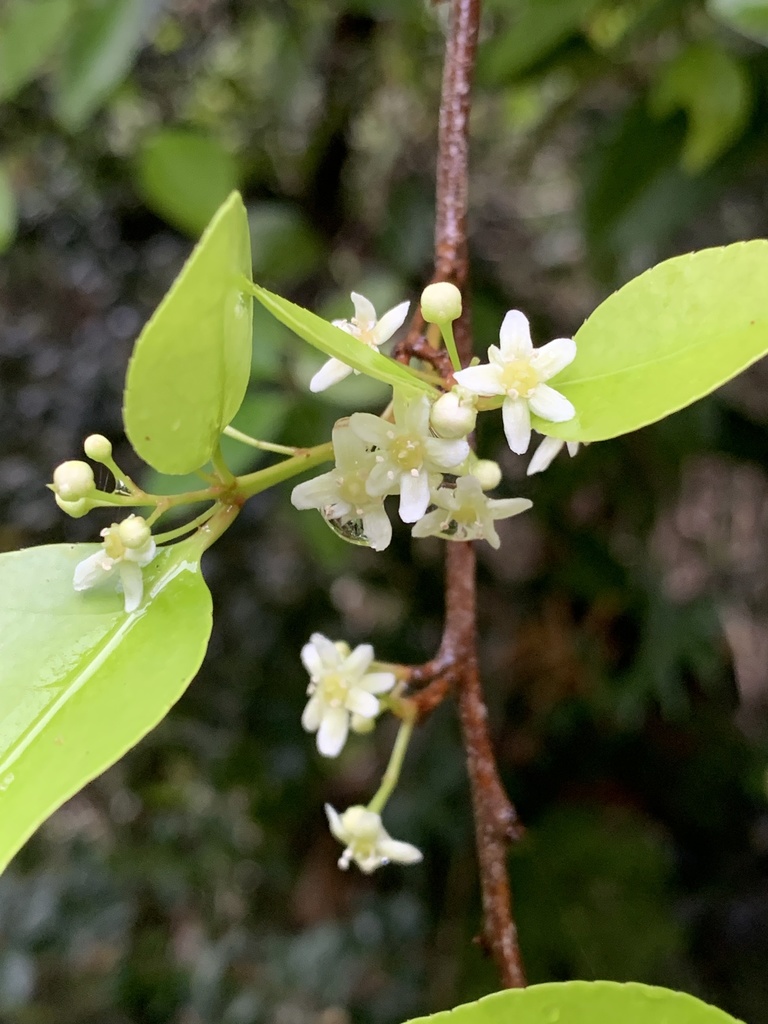
Gymnosporia thompsonii leaves are shiny with wavy margins and have a distinctive red petiole. Flowers are small, white or cream-colored, occurring in clusters at the base of leaves. The fruits turn from green to red, and after drying to a brown color they dehisce to expose 3 seeds. Gymnosporia thompsonii can grow up to 13 feet tall and form impenetrable thickets.
What it does
Gymnosporia thompsonii was thought to have served as the larval host plant to the endangered Mariana wandering butterfly (Vagrans egistina), since it had been observed on the plant on both Guam and Rota. However, the butterfly has not been observed on Guam since 1979, nor on Rota since 1995.
Wikipedia: “Ecology”
At the table
The plant has been used by Chamorro healers (yo’åmte) as a treatment for urinary tract infections and sore throats. Its wood is used for fuel.
Wikipedia: “Uses”
Where it lives
Recorded sightings
—
geo-referenced records in GBIF, from museums, herbaria and field observers.
Drag the globe to turn it. Dots are where records exist, not a range map; darker means more records.
In the stacks
Searching the stacks…
Every page naming Gymnosporia thompsonii in the Biodiversity Heritage Library →
This page is assembled live from iNaturalist, GBIF, Wikipedia, the Source Library and the Internet Archive. It is not yet part of the hand-edited codex. iNaturalist taxon 552387.