- Animals
- ›Chordates
- ›Vertebrates
- ›Reptiles
- ›Snakes and Lizards
- ›Lizards
- ›Skinks and allies
- ›Skinks
- ›Eugongyline skinks
- ›Carinascincus
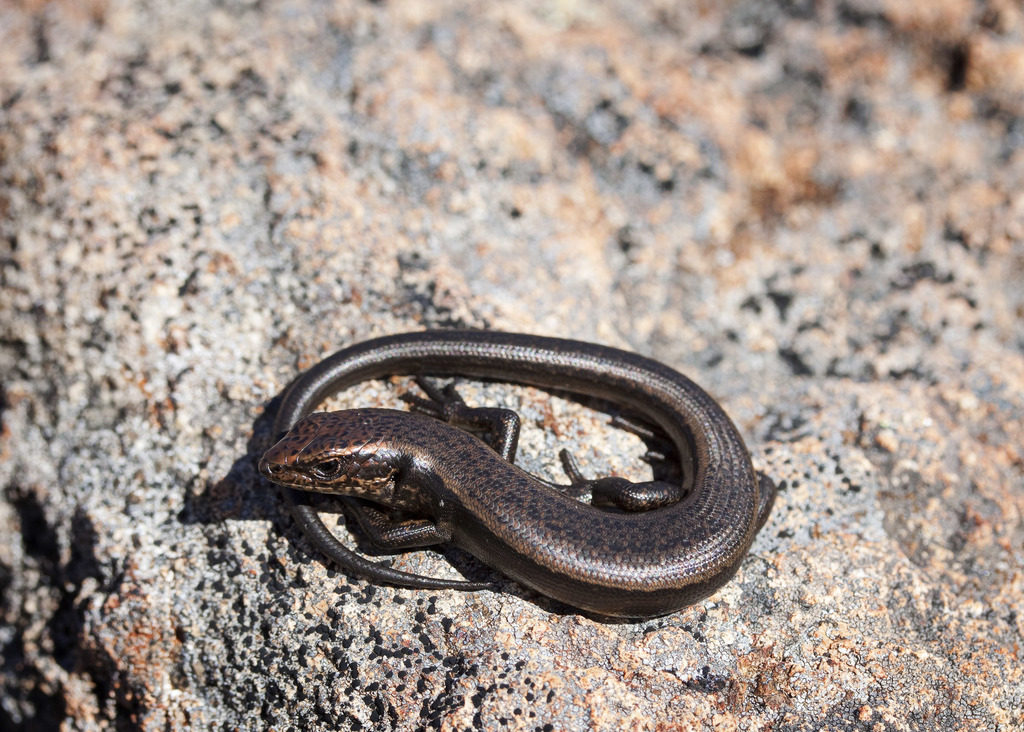
Boulder Coolskink
Carinascincus microlepidotus
Carinascincus microlepidotus, commonly known as the boulder cool-skink or southern snow skink, is a member of the family Scincidae. Endemic to Tasmania, Australia, this diurnal species basks on the exposed rock faces of the alpine boulder fields they inhabit.
From the article Carinascincus microlepidotus on Wikipedia (CC BY-SA), quoted section by section
Description
Carinascincus microlepidotus is grey or olive-brown in colour, with dark, narrow stripes running along either side of the body. Their backs are flecked dark brown or black. They have small scales, hence the name microlepidotus, with 'micro' meaning 'small' and 'lepidotus' meaning 'scaled' in Greek. C. microlepidotus can be distinguished from other species of Carinascincus by the absence of both a black vertebral stripe and pale stripes along the sides of the body. The maximum length and weight of C. microlepidotus is 6.9 centimetres, and 5 grams. The species lives up to 13 years.
Range & habitat
Carinascincus microlepidotus is an alpine species, found in the Highlands of central and Southern Tasmania at an elevation of 800-1270 metres. The species is numerous upon kunanyi/Mount Wellington but is found as far north as Cradle Mountain. Within these regions, their preferred microhabitat is dolerite boulder fields, where they bask on exposed rocks. During winter, individuals seek shelter under rock crevices and within vegetation to avoid extreme cold.
Where they co-occur with Carinascincus greeni, C. microlepidotus instead occupies heathland and basks on top of cushion plants. This is because C. greeni competitively excludes C. microlepidotus from the optimal boulder field habitat. Heathland is a sub-optimal microhabitat as it provides fewer ideal basking areas, therefore skinks occupying these areas have a smaller than average body size. Territory competition also occurs within-species. C. microlepidotus males have overlapping territories, as they move through one another's home ranges in search of prey and mates. Encounters between males result in conflict over territory.
Wikipedia: “Habitat and Distribution”
What it does
Carinascincus microlepidotus is predominately an insectivorous species, however they feed on Richea scoparia (Honey Bush) plants during the flowering season of December to March. This interaction is mutually beneficial to both species. The skinks tear off and chew on the fused petals (calyptrum) of the flower (inflorescence) to feed on the nectar. Tearing the calyptrum exposes the reproductive organs of the inflorescence which assists with successful cross pollination. As high skink activity coincides with mild weather, removal of the calyptra typically occurs during favourable conditions for pollination. Further, seed release is increased by 87%. Other species which feed on R. scoparia are not similarly beneficial. For example, the introduced bumblebee Bombus terrestris feeds on the calyptrum without fully removing it, hence providing no benefit to the reproductive cycle of the plant. Therefore, the relationship with C. microlepidotus is key to the reproduction of R. scoparia in the unpredictable environmental conditions of alpine Tasmania.
Wikipedia: “Diet”
Where it lives
Recorded sightings
—
geo-referenced records in GBIF, from museums, herbaria and field observers.
Drag the globe to turn it. Dots are where records exist, not a range map; darker means more records.
In the stacks
This page is assembled live from iNaturalist, GBIF, Wikipedia, the Source Library and the Internet Archive. It is not yet part of the hand-edited codex. iNaturalist taxon 552268.