- Animals
- ›Arthropods
- ›Hexapods
- ›Insects
- ›Winged and Once-winged Insects
- ›Beetles
- ›Water, Rove, Scarab, Long-horned, Leaf, and Snout Beetles
- ›Elateriform Beetles
- ›Click, Firefly, and Soldier Beetles
- ›Fireflies
- ›typical fireflies
- ›Photinini
- ›Pyropyga
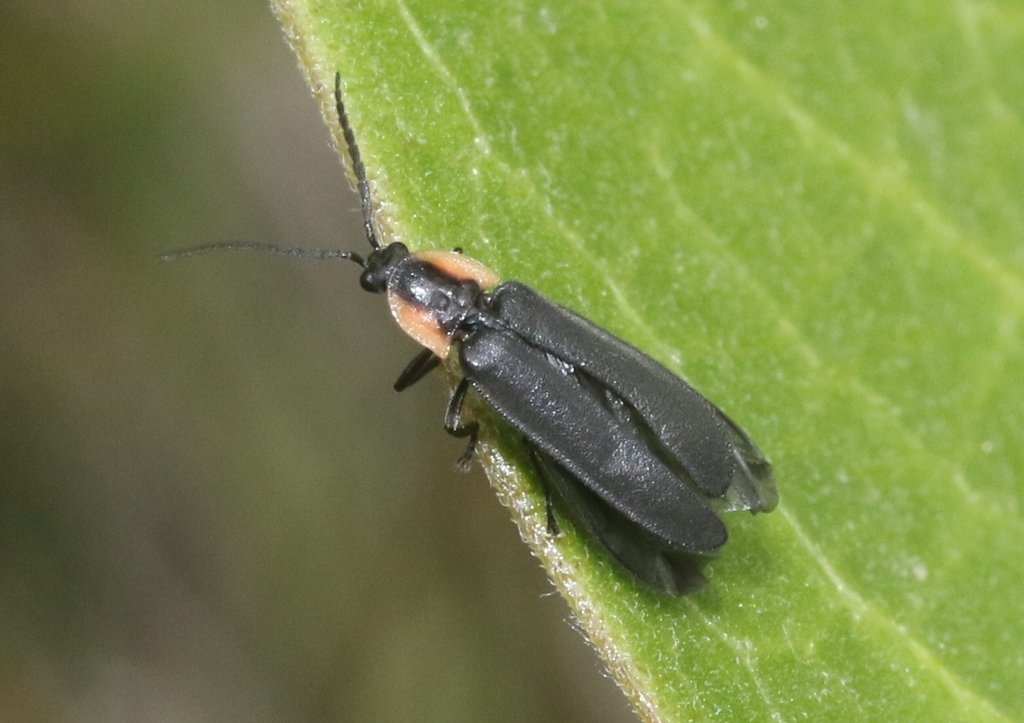
Flower Elf
Pyropyga minuta
Pyropyga minuta is a species of firefly in the family of beetles known as Lampyridae. It is found in Central America, North America, and South America.
From the article Pyropyga minuta on Wikipedia (CC BY-SA), quoted section by section
Description
P. minuta is a tiny beetle, with adults measuring 3–7 mm (0.1–0.3 in) long. Its wing covers, or elytra, and its body are solid black. The head shield, or pronotum, is pale yellow with a narrow, dark rectangular bar in the center, reaching from the top of the pronotum to the base. The bar flares wider towards the bottom and is bounded on the sides by red. Like the other fireflies in the Pyropyga genus, P. minuta does not have working lanterns on its abdomen.
Range & habitat
Adults are seen during the day in gardens, yards, open woodlands, fencerows, and open areas, often on leaves or on flowers.
Wikipedia: “Habitat”
What it does
Beetles such as P. minuta go through four life stages: egg, larva, pupa, and adult. Although the adults don't have lanterns and therefore do not flash, the larvae of P. minuta are bioluminescent, like all fireflies. Larvae are believed to be subterranean, living under the soil.
Wikipedia: “Life Cycle”
In human culture
The genus name Pyropyga is from Greek, combining "pyro", meaning "fire", and "pyga", meaning "rump" or "tail". The specific epithet, minuta, refers to the firefly's very small size.
Wikipedia: “Etymology”
Listen
Looking for field recordings…
Where it lives
Recorded sightings
—
geo-referenced records in GBIF, from museums, herbaria and field observers.
Drag the globe to turn it. Dots are where records exist, not a range map; darker means more records.
In the stacks
Searching the stacks…
Every page naming Pyropyga minuta in the Biodiversity Heritage Library →
This page is assembled live from iNaturalist, GBIF, Wikipedia, the Source Library and the Internet Archive. It is not yet part of the hand-edited codex. iNaturalist taxon 552002.