- Animals
- ›Chordates
- ›Vertebrates
- ›Ray-finned Fishes
- ›Carps, Characins, Catfishes and Allies
- ›Catfishes
- ›Loricarioidei
- ›Armored Catfishes
- ›Suckermouth Catfishes
- ›Hypancistrus
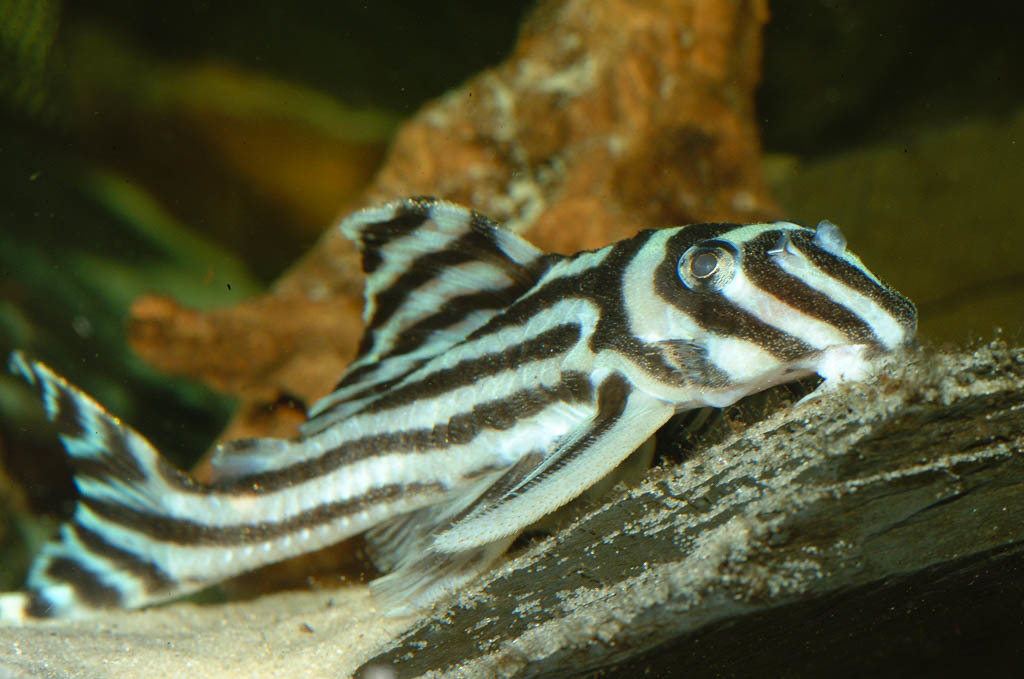
Zebra Pleco
Hypancistrus zebra
The zebra pleco (Hypancistrus zebra) is a species of freshwater ray-finned fish belonging to the family Loricariidae, the suckermouth armoured catfishes, and the subfamily Hypostominae, the suckermouth catfishes. This catfish is endemic to a small section of the Rio Xingu in Brazil. It occurs in the big bend area of the river, downstream from the town of Altamira, Para. It was first described in 1991. It gets its name from its black and white stripes, resembling the colouration of a zebra. This species grows to a length of 6.4 centimetres (2.5 in) SL. This species was exported from Brazil in 1987 for sale as aquarium fish. However, currently, the Brazilian government bans the export of certain fish species, including H. zebra.
H. zebra is threatened by the Belo Monte Dam in the Xingu river which has caused a severe reduction of the water flow of the entire known distribution range of the species. Due to this, the species has been classified as critically endangered and may soon become extinct in the wild. It is subject to several captive breeding programs. It is commercially bred in captivity for the aquarium trade.
From the article Zebra pleco on Wikipedia (CC BY-SA), quoted section by section
What it does
Similarly to other Hypancistrus species, the male will trap the female in a cave where she will lay her eggs for the male to fertilise. This is usually done at around a pH of 6.5-7.2 and a water tempurature of 27 °C. This process can take between 1 and 5 days depending on the experience the female has in motherhood. The male will often bite the female to keep her in the cave, which is a natural behaviour for the species. Once the eggs are fertilised, the female will leave, although the male will guard the eggs until they hatch and may even stay to see them develop into fry. Once born, the fry will have a yolk sack attached to their underbelly, which is typically gone in a few days.
Wikipedia: “Breeding behaviour”
Where it lives
Recorded sightings
—
geo-referenced records in GBIF, from museums, herbaria and field observers.
Drag the globe to turn it. Dots are where records exist, not a range map; darker means more records.
In the stacks
Searching the stacks…
Every page naming Hypancistrus zebra in the Biodiversity Heritage Library →
This page is assembled live from iNaturalist, GBIF, Wikipedia, the Source Library and the Internet Archive. It is not yet part of the hand-edited codex. iNaturalist taxon 549823.