- Animals
- ›Chordates
- ›Vertebrates
- ›Mammals
- ›Therians
- ›Placental Mammals
- ›Primates, Rodents, and Allies
- ›Primates
- ›Monkeys, Apes, and Tarsiers
- ›Monkeys and Apes
- ›Apes and Old World Monkeys
- ›Old World Monkeys
- ›Colobines
- ›Langurs, Surilis, and Lutungs
- ›Semnopithecus
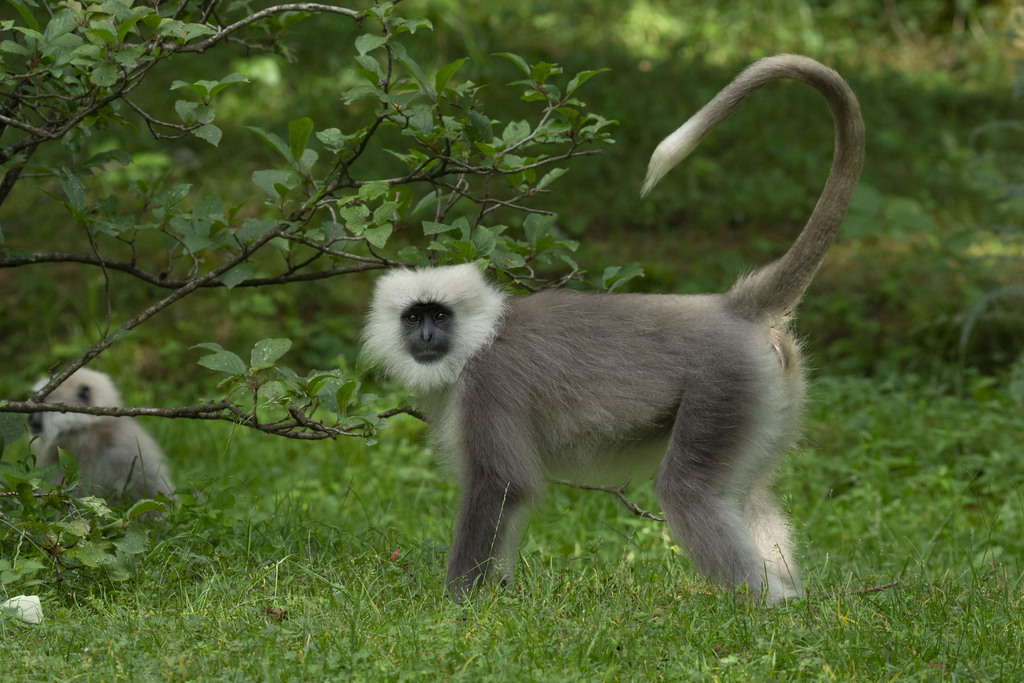
Chamba Sacred Langur
Semnopithecus ajax
The Kashmir gray langur (Semnopithecus ajax) is an Old World monkey, one of the langur species. It is a leaf-eating monkey.
It has been reported from Jammu and Kashmir and Himachal Pradesh in northwestern India but evidence indicates it only occurs in the Chamba Valley in Himachal Pradesh. Because of its restricted range, fragmented population and threats from human agriculture and development activities it is listed as Endangered in the IUCN Red List.
From the article Kashmir gray langur on Wikipedia (CC BY-SA), quoted section by section
What it does
It is arboreal and diurnal, and lives in temperate and alpine forests. It lives at the highest elevation of any non-human primate in the world and is found in forests at elevations ranging from 1,500 to 4,733 m (4,921 to 15,528 ft). The birthing season for the Kashmir gray langur runs from January through June, although almost half of all infants are born in March. The infants are weaned at a higher age than most Asian colobines. While most Asian colobines wean their young within the first year, Kashmir gray langurs wean their young on average at 25 months. This is apparently due to nutritional constraints, since monkeys in poorer sites wean their young at an older age. The interbirth interval for females is about 2.4 years. Alloparental care occurs in Kashmir gray langur for up to 5 months. Males are usually protective of infants, but infanticide occasionally occurs. Although most Asian colobine groups comprise only a single adult male and multiple females, multimale groups are known to occur within Semnopithecus species. In Kashmir gray langurs, multimale groups may include as many as five adult males. Females initiate copulation by soliciting a male, but not all solicitations result in copulation.
== References ==
Wikipedia: “Ecology and behaviour”
Listen
Looking for field recordings…
Where it lives
Recorded sightings
—
geo-referenced records in GBIF, from museums, herbaria and field observers.
Drag the globe to turn it. Dots are where records exist, not a range map; darker means more records.
In the stacks
Searching the stacks…
Every page naming Semnopithecus ajax in the Biodiversity Heritage Library →
This page is assembled live from iNaturalist, GBIF, Wikipedia, the Source Library and the Internet Archive. It is not yet part of the hand-edited codex. iNaturalist taxon 54868.