- Plants
- ›Vascular Plants
- ›flowering plants
- ›Dicots
- ›Sunflowers, Bellflowers, Fanflowers, and Allies
- ›Sunflowers, Daisies, Asters, and Allies
- ›chicories, dandelions, and allies
- ›Lettuce, Chicory, Dandelion and Salsify Tribe
- ›Hyoseridinae
- ›Sonchus
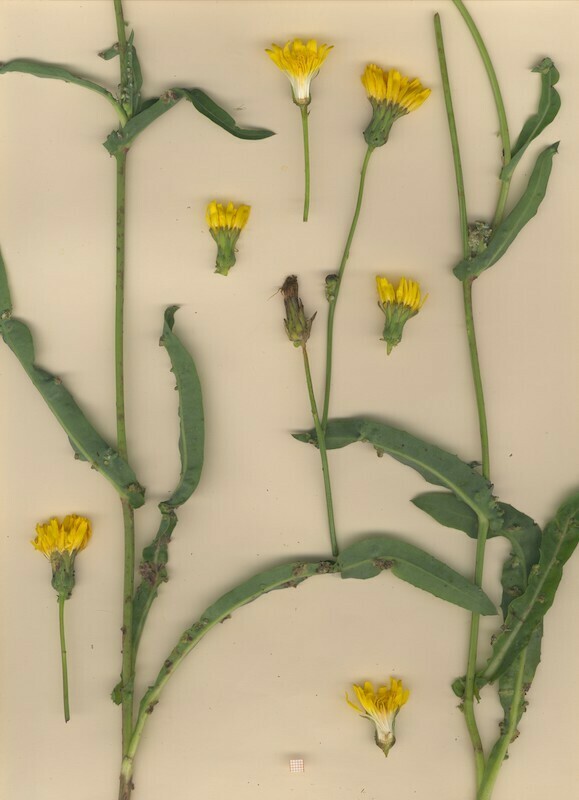
Sonchus maritimus
Sonchus is a genus of flowering plants in the tribe Cichorieae within the family Asteraceae and are commonly known as sow thistles (less commonly hare thistles or hare lettuces). Sowthistles are annual, biennial or perennial herbs, with or without rhizomes and a few are even woody (subgenus Dendrosonchus, restricted to the Canary Islands and Madeira).
From the article Sonchus on Wikipedia (CC BY-SA), quoted section by section
Description
The genus is named after the Ancient Greek for such plants, σόγχος. All are characterized by soft, somewhat irregularly lobed leaves that clasp the stem and, at least initially, form a basal rosette. The stem contains a milky latex. Flower heads are yellow and range in size from half to one inch in diameter; the florets are all of ray type. Sonchus fruits are single-seeded, dry and indehiscent. Sow thistles are common roadside plants, and while native to Eurasia and tropical Africa, they are found almost worldwide in temperate regions. Mature sow thistle stems can range from 30 cm to 2 m (1 to 6 ft) tall, depending upon species and growing conditions. Coloration ranges from green to purple in older plants. Sow thistles exude a milky latex when any part of the plant is cut or damaged, and it is from this fact that the plants obtained the common name, "sow thistle", as they were fed to lactating sows in the belief that milk production would increase. Sow thistles are known as "milk thistles" in some regions, although milk thistle more commonly refers to the genus Silybum.
Comparison with dandelions. They superficially resemble and are in the same family as dandelions, and even have pappus-like structures resembling dandelion seeds. …
At the table
Sow thistles are common host plants for aphids. Gardeners may consider this a benefit or a curse; aphids may spread from sow thistle to other plants, but alternatively the sow thistle can encourage the growth of beneficial predators such as hoverflies. In this regard sow thistles make excellent sacrificial plants. Sonchus species are used as food plants by the larvae of some Lepidoptera including Celypha rufana and the broad-barred white, grey chi, nutmeg, and shark moths. The fly Tephritis formosa is known to attack the capitula of this plant. Sow thistles have been used as fodder, particularly for rabbits, hence the other common names of "hare thistle" or "hare lettuce". They are also edible to humans as a leaf vegetable; old leaves and stalks can be bitter but young leaves have a flavour similar to lettuce. Going by the name pūhā or rareke (raraki) it is a traditional food eaten in New Zealand by Māori. When cooked the flavour is reminiscent of chard. The greens were also eaten by the indigenous people of North America. Edible raw when young, the older greens can also be eaten after cooking briefly.
Wikipedia: “Cultivation and use as food”
Where it lives
Recorded sightings
—
geo-referenced records in GBIF, from museums, herbaria and field observers.
Drag the globe to turn it. Dots are where records exist, not a range map; darker means more records.
In the stacks
Searching the stacks…
Every page naming Sonchus maritimus in the Biodiversity Heritage Library →
This page is assembled live from iNaturalist, GBIF, Wikipedia, the Source Library and the Internet Archive. It is not yet part of the hand-edited codex. iNaturalist taxon 546744.