- Animals
- ›Chordates
- ›Vertebrates
- ›Ray-finned Fishes
- ›Spiny-rayed fishes
- ›Pipefishes and Allies
- ›Syngnathoidei
- ›Pipefishes, Seahorses, and Seadragons
- ›Tail-brooding Pipefishes
- ›Hippocampus
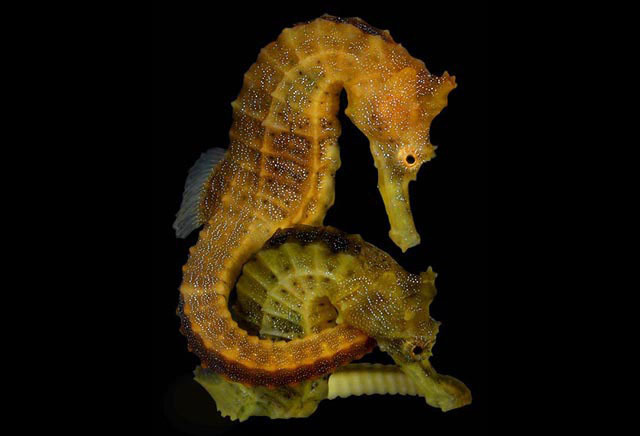
Northern Seahorse
Hippocampus erectus
The lined seahorse (Hippocampus erectus), northern seahorse or spotted seahorse, is a species of fish that belongs to the family Syngnathidae. H. erectus is a diurnal species with an approximate length of 15 cm (5.9 inches) and lifespan of one to four years. The H. erectus species can be found in myriad colors, from greys and blacks to reds, greens, and oranges. The lined seahorse lives in the western Atlantic Ocean as far north as Cape Cod and as far south as the Caribbean, Mexico, and Venezuela. It swims in an erect position and uses its dorsal and pectoral fins for guidance while swimming.
Lined seahorses feed mainly on minute crustaceans and brine shrimp, which they suck in through their snout. They are able to suck their prey by creating a current of water leading directly into its snout. Since seahorses are weak swimmers, they must ambush their prey by blending into their surroundings, which they do rather easily. The lined seahorse's eyes can move independently of one another, allowing it to effectively scan its surroundings. The species is sexually dimorphic and it is easy to distinguish between a male and female lined seahorse. The males are larger and also have longer tails. The lined seahorse is monogamous and performs ritual dances every morning to reestablish the bond with its mate. In addition, they create clicking sounds while embracing their partner. This action occurs when they initially find their mate.
From the article Lined seahorse on Wikipedia (CC BY-SA), quoted section by section
Description
The lined seahorse was first named Hippocampus Erectus by George Perry in 1810. "Hippocampus" translates into "horse or sea monster" in ancient Greek. The lined seahorse is a diurnal species that ranges in length from 12 cm to 17 cm; the maximum length reported for the species is 19 cm. The seahorse is sexually dimorphic, meaning there are distinct differences in appearances of males and females; most notably the brood pouch located on the male's abdomen which it utilized in reproduction. Males are also slightly larger in size and have longer prehensile tails than the females. In the wild, the lined seahorse has a lifespan of one to four years; however, in captivity their lifespan usually reaches the full four years. Four years is the maximum age reported for the species. They have a broad color spectrum, ranging from black, grey, brown, and green, to orange, red, and yellow. They tend to be paler on their front side. However, their colors change due to altercations in their environment, diet, anxiety or stress level, and/or mood. The lined seahorse is brawny and upright in appearance. They have an armor-like body composed of approximately fifty bony plates. Together these bony plates form the outer skeleton of the species. …
Range & habitat
The lined seahorse range spans from the waters to the south of Nova Scotia, to the southern area of Venezuela in South America. They can be found on the east coast of United States in Connecticut, Delaware, Florida, Georgia, Louisiana, Maryland, New Jersey, New York, Rhode Island, Virginia, and the Carolinas, as well as in the waters surrounding Mexico and the Caribbean. Species found in Brazil seem to be of a different species; however, more research is needed to determine this proposal. The lined seahorse is native to the following locations: United States, Bermuda, Cuba, Mexico (Veracruz, Yucatán), Haiti, Saint Kitts and Nevis, Belize, Honduras, Nicaragua, Costa Rica, Panama, Guatemala, and Venezuela. It has also been recorded from the Azores but it is not clear that a population has become established in the waters around that archipelago. Its habitats are marine intertidal and marine neritic.
The species is found in depths of water up to seventy-three meters. Adults can be found swimming freely in the water column or attached to a stationary object. Juveniles usually swim near the surface. The habitat of the lined seahorse consists of marine vegetation, such as suspended Sargassum, seagrass, sponges, and mangroves. …
Wikipedia: “Habitat and distribution”
What it does
The lined seahorse utilizes its elongated snout in order to consume its prey, consisting primarily of minute crustaceans, mollusks, and zooplankton. Unfortunately, some captive parental males have been known to cannibalize small number of its own fry, or juveniles, following its release into natural habitat. In order to ambush its prey, the seahorse employs color changes to camouflage itself with its surrounding environment, locates the prey, and then jerks its head upward, forcing the prey in the right position to be sucked in through its tubular snout. The lined seahorse is highly accurate, especially if its prey is within one inch from its snout. Overall, this process is quick and accurate. A growing lined seahorse may feed continuously for up to ten hours a day, engulfing approximately 3,600 baby brine shrimp.
Wikipedia: “Diet”
Where it lives
Recorded sightings
—
geo-referenced records in GBIF, from museums, herbaria and field observers.
Drag the globe to turn it. Dots are where records exist, not a range map; darker means more records.
In the stacks
Searching the stacks…
Every page naming Hippocampus erectus in the Biodiversity Heritage Library →
This page is assembled live from iNaturalist, GBIF, Wikipedia, the Source Library and the Internet Archive. It is not yet part of the hand-edited codex. iNaturalist taxon 54540.