- Animals
- ›Arthropods
- ›Hexapods
- ›Insects
- ›Winged and Once-winged Insects
- ›Ants, Bees, Wasps, and Sawflies
- ›Narrow-waisted Wasps, Ants, and Bees
- ›Ants, Bees, and Stinging Wasps
- ›Vespoid Wasps
- ›Hornets, Paper Wasps, Potter Wasps, and Allies
- ›Hornets and Yellowjackets
- ›Vespa
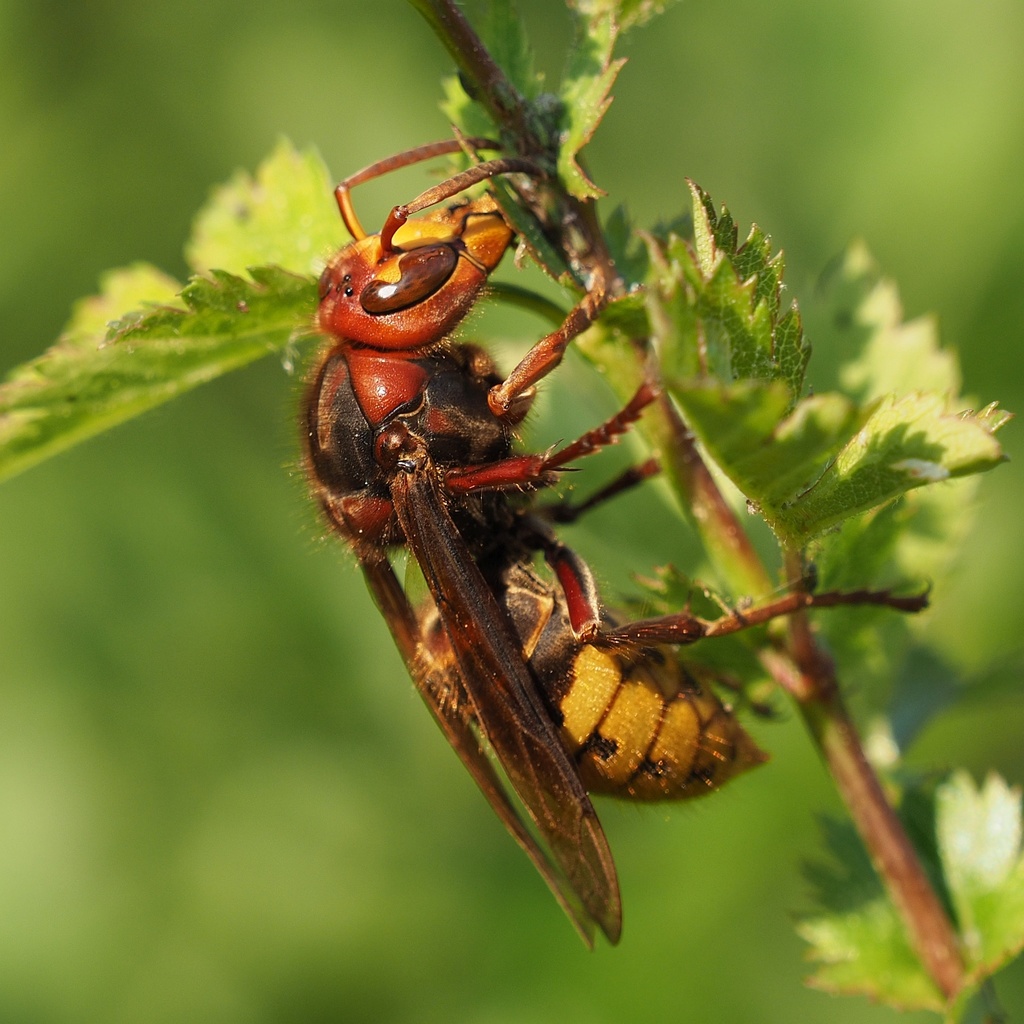
European Hornet
Vespa crabro
The European hornet (Vespa crabro) is the largest eusocial wasp native to Europe. It is also the only true hornet (genus Vespa) found in North America, having been introduced to the United States and Canada from Europe as early as 1840. Vespines, such as V. crabro, are known for making intricate paper-like nests out of surrounding plant materials and other fibers. Unlike most other vespines, reproductive suppression involves worker policing instead of queen pheromone control, as was previously thought.
This species stings in response to being stepped on or grabbed, but generally avoids conflict. It is also defensive of its nest and can be aggressive around food sources. Care should be taken when they are found in these circumstances, as they may sting without warning. European hornets are largely carnivorous and hunt large insects such as beetles, wasps, large moths, dragonflies, and mantises. They also feed on fallen fruit and other sources of sugary food. Mutual predation between medium-sized hornets and the Asilidae (robber flies) is often reported.
From the article European hornet on Wikipedia (CC BY-SA), quoted section by section
Description
The eyes of V. crabro are deeply indented and shaped like a "C". Its wings are reddish-orange, while the petiolate abdomen is striped with brown and yellow. It has hair on the thorax and abdomen, although the European hornet is not as hairy as most bees. Due to this coloration and abdomen pattern, V. crabro is often mistaken for the Asian giant hornet. Typical mass size for the European Hornet is 477.5±59.9 mg. Workers average around 25 mm (1.0 in) in length, while the larger queens can reach up to 35 mm (1+3⁄8 in). This is significantly larger than most common wasps (such as Vespula vulgaris), but smaller than the Asian giant hornet. Females are typically larger than males in both size and mass. However, male abdomens have seven segments, whereas female abdomens have six. There is a cerebral ganglion, two thoracic ganglia, and five abdominal ganglia. Only females possess a stinger, which is a modified egg laying device (ovipositor); males cannot sting. The antennae of males are slightly longer, with 13 segments, compared to 12 segments in females.
Range & habitat
The European hornet V. crabro originated in Eurasia. Nests historically ranged from Japan to the United Kingdom. However, Saussure reported that V. crabro was introduced to North America in the mid-19th century, where it is now well established. In 2010, they were found as far south as Guatemala. The few nests in Guatemala were thought to be recent, accidental introductions, as they were the first to be documented.
Wikipedia: “Distribution”
What it does
V. crabro prefers to build nests in dark places, usually hollow tree trunks. After the site has been chosen, the queen lays eggs in the combs inside the nest. The workers dispose of any eggs that are not laid by their queen; this behavior is called worker policing. Based on laboratory data, the average rate of egg-laying is 2.31 eggs per day. However, in this same nest, cell construction rate was only 1.63 cells per day. V. crabro colonies seasonally change strategies of obtaining food for both the larvae and adults. In April, when the queen normally lays her eggs, the workers actively go out and forage. Later, typically around the fall season, the foraging workers switch to scavengers. Instead of putting forth the effort to catch food sources, the workers try to take what is more easily available. For example, European hornets have been seen hovering around garbage cans and picnic areas in the fall.
Wikipedia: “Life cycle”
Toxicity
Unwarranted fear of V. crabro has often led to the destruction of nests. This has led to the decline of the species, which is often locally threatened or even endangered. European hornets benefit from legal protection in some countries, notably Germany, where killing a European hornet or destroying a nest has been illegal since January 1, 1987, with a fine up to €50,000. However, the highest reported fine levied in Germany for killing of wasps was €45, and experts report that fines are rarely imposed.
Wikipedia: “Endangered species and legal protection”
Listen
Looking for field recordings…
Where it lives
Recorded sightings
—
geo-referenced records in GBIF, from museums, herbaria and field observers.
Drag the globe to turn it. Dots are where records exist, not a range map; darker means more records.
In the stacks
Searching the stacks…
Every page naming Vespa crabro in the Biodiversity Heritage Library →
This page is assembled live from iNaturalist, GBIF, Wikipedia, the Source Library and the Internet Archive. It is not yet part of the hand-edited codex. iNaturalist taxon 54327.