- Animals
- ›Chordates
- ›Vertebrates
- ›Birds
- ›Hawks, Eagles, Kites, and Allies
- ›Hawks, Eagles, and Kites
- ›Honey-buzzards, Pernine Kites, and Allies
- ›Henicopernis
On eBird ↗
Long-tailed Honey-buzzard
Live sightings near you, the range map, bar charts of when it is seen, and Macaulay Library photos and recordings.
Long-tailed Honey-buzzard
Henicopernis longicauda
The long-tailed honey buzzard (Henicopernis longicauda) is a bird of prey in the family Accipitridae.
It is found in New Guinea and some neighboring island groups. Its natural habitats are subtropical or tropical moist lowland forest and subtropical or tropical moist montane forest.
From the article Long-tailed honey buzzard on Wikipedia (CC BY-SA), quoted section by section
Description
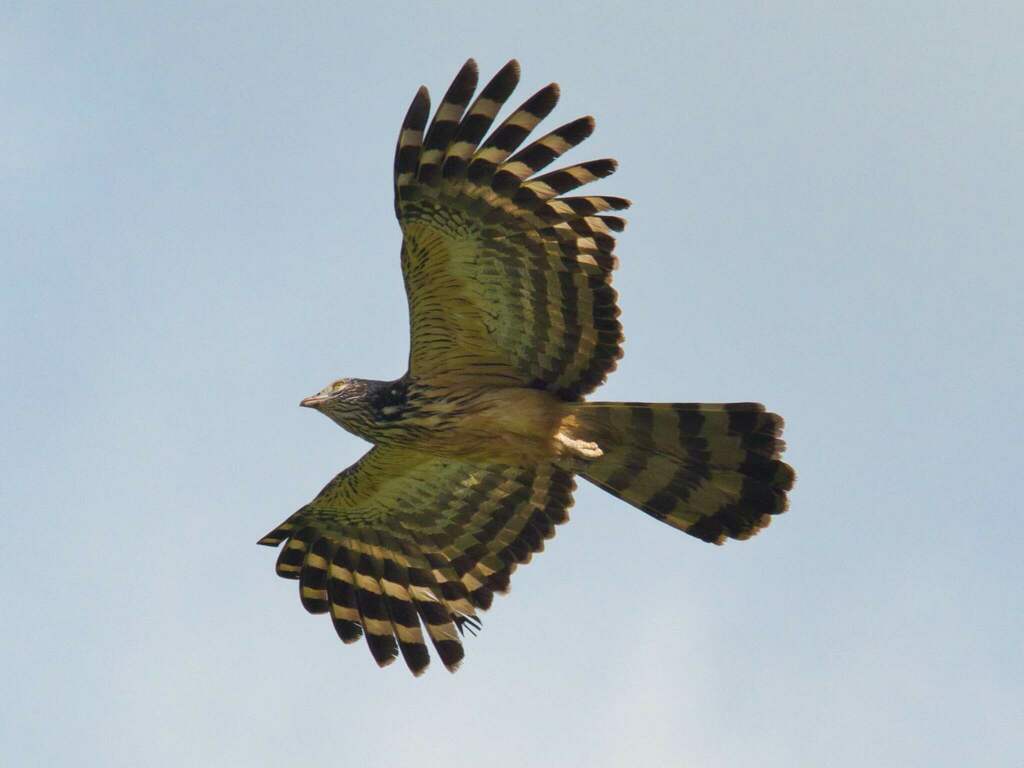
The Long-tailed honey buzzard is described as having a thin body, small head, long rounded tail and wide, round wings. They fly with their wrists forward while spreading their characteristically "fingered" primary feathers. The wing and tail feathers have dark black barring. The face and bill are pale and the iris is yellow. The head and breast feathers are lightly streaked. The total length, including the tail feathers, is reported to be from 50–61 cm (22 in). The wingspan ranges from 105–140 cm (48 in). The tail feather length ranges from 29–37 cm (13 in). The size of males as a proportion of the size of females was calculated to be 89%. The males weigh 447–630 grams and the larger females weigh 570–730 grams. Adults can be identified by their three visible boldly black bars on the body and wings, while the fourth bar is hidden. They have bluish-white feet. Juveniles can be identified by their much narrower bands, all four of which are visible.
Range & habitat
The Long-tailed honey buzzard is native to New Guinea and its surrounding islands. These include the Bay Islands of Japen and Biak, the Northwest Islands of Misool, Batanta, Salawati and Waigeo, the Aru Islands, the Southeast Islands of Fergusson and Normanby. On mainland New Guinea, they are reported to be found in the Trans-Fly savannah ecoregion on the southern end of the island, but also more broadly throughout New Guinea, except for the mountainous regions of the Western, Central and Eastern ranges. The Long-tailed honey buzzard is found typically in the regions’ lowland rainforests, hill forests and montane forests. It is a rainforest specialist and is restricted to New Guinea's rainforest habitats. It is found up to elevations of 3000 m. Long-tailed honey buzzards do not migrate and are considered endemic to New Guinea. There are estimated to be at most 100,000 individuals of this species.
Wikipedia: “Habitat and distribution”
What it does
The Long-tailed honey buzzard is described as the quintessential hawk seen flying overhead in the forests of the region. They are observed to prefer remaining alone or in pairs. They sail and circle slowly above the canopy cover of the forest, but also pass through open regions below the canopy where they perch to observe their surroundings. They are reported to not be shy and are easily spotted. They are diurnal (active during the day) and crepuscular (active around twilight).
Diet. The Long-tailed honey buzzard feeds primarily on insects such as ants, grasshoppers and especially adult wasps and wasp larvae. They follow wasps to their nests and pull out larvae with their feet. They also feed on bird and lizard eggs, tree-climbing lizards, small mammals and small birds. One sighting recounts seeing an individual catching land-bound prey in a grassland near a forest and carrying it back into the forest to consume.
Vocalizations. The only published information on Long-tailed honey buzzard vocalizations describes the series of calls they produce during display as “goshawk-like”. Typical goshawk display calls include many rapid notes in succession, called a chatter, or a single long call, referred to as a wail. Otherwise, they are described as being usually silent.
Reproduction. Long-tailed honey buzzards typically build stick nests in the crowns of tall trees. …
Wikipedia: “Behavior”
Listen
Looking for field recordings…
Where it lives
Recorded sightings
—
geo-referenced records in GBIF, from museums, herbaria and field observers.
Drag the globe to turn it. Dots are where records exist, not a range map; darker means more records.
In the stacks
Searching the stacks…
Every page naming Henicopernis longicauda in the Biodiversity Heritage Library →
This page is assembled live from iNaturalist, GBIF, Wikipedia, the Source Library and the Internet Archive. It is not yet part of the hand-edited codex. iNaturalist taxon 5403.