- Animals
- ›Chordates
- ›Vertebrates
- ›Reptiles
- ›Snakes and Lizards
- ›Lizards
- ›Skinks and allies
- ›Skinks
- ›Mabuyas
- ›Mabuya
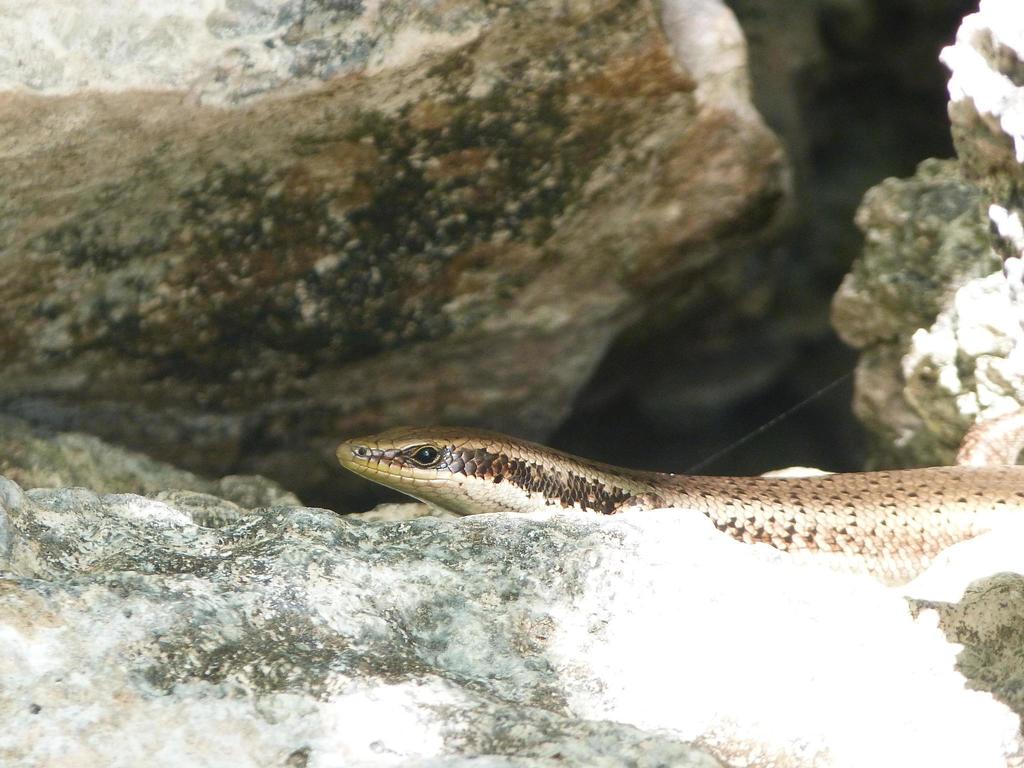
Petite Terre Skink
Mabuya parviterrae
Mabuya parviterrae, also known as the Petite Terre skink, is a species of lizard in the subfamily Lygosominae of the family Scincidae. It grows to snout–vent lengths of 101 mm (4.0 in) in males and 103 mm (4.1 in) in females. It is endemic to the island of Terre-de-Bas in the Îles de la Petite Terre, a small archipelago in Guadeloupe. It is largely restricted to a single rock wall on the island measuring around 460 m (1,500 ft) long, and may have the smallest range of any vertebrate. It is recommended that it be classified as being critically endangered.
From the article Mabuya parviterrae on Wikipedia (CC BY-SA), quoted section by section
Description
Petite Terre skinks grow to snout–vent lengths of 101 mm (4.0 in) in males and 103 mm (4.1 in) in females. The back is brown, maculated with numerous darker flecks, and slightly darker limbs. The sides have a dark brown band from the eyes to the back limbs, changing from a solid band to spots towards the middle and becoming more indistinct towards the posterior. There are two grey bands along the sides of the back. The underside is largely light beige and unmarked.
Range & habitat
The Petite Terre skink is endemic to the island of Terre-de-Bas in the Îles de la Petite Terre, a small archipelago that is part of the French overseas department of Guadeloupe in the Caribbean. The species was formerly more widespread, but now is mainly restricted to a single rock wall, around 460 m (1,500 ft) n length, found near the centre of the island. The island's native vegetation was mostly deforested centuries back, and the now-existing scrubland provides little food or cover for skinks. Besides the primary wall, where the population is estimated to number around 50 skinks, it is occasionally seen on other walls on the island. Its preference for walls may be due to the fact that they provide some ability to escape invasive black rats. The scientists describing the species recommended that it be classified as being critically endangered due to its exceedingly small distribution, which may be the smallest range of any vertebrate, degraded habitat, and ongoing predation from black rats.
== References ==
Wikipedia: “Distribution and conservation”
Where it lives
Recorded sightings
—
geo-referenced records in GBIF, from museums, herbaria and field observers.
Drag the globe to turn it. Dots are where records exist, not a range map; darker means more records.
In the stacks
Searching the stacks…
Every page naming Mabuya parviterrae in the Biodiversity Heritage Library →
This page is assembled live from iNaturalist, GBIF, Wikipedia, the Source Library and the Internet Archive. It is not yet part of the hand-edited codex. iNaturalist taxon 539947.