- Animals
- ›Arthropods
- ›Hexapods
- ›Insects
- ›Winged and Once-winged Insects
- ›Beetles
- ›Water, Rove, Scarab, Long-horned, Leaf, and Snout Beetles
- ›Staphyliniform Beetles
- ›Rove, Ant-like stone, and Carrion Beetles
- ›Rove Beetles
- ›Large Rove Beetles
- ›Staphylinini
- ›Staphylinina
- ›Ocypus
- ›Ocypus
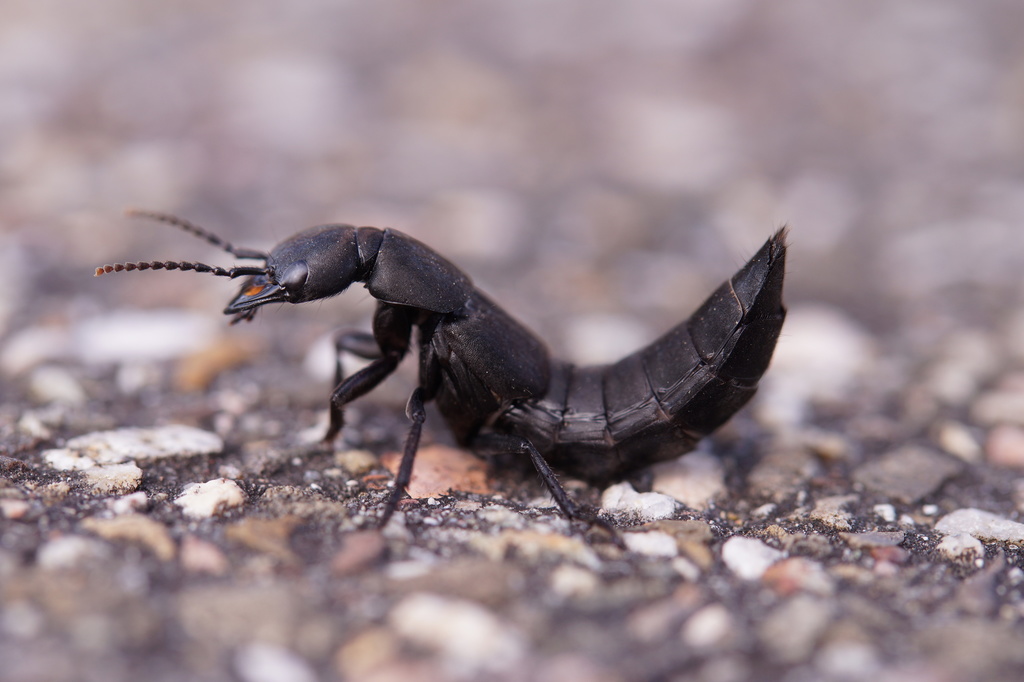
Devil's Coach Horse Beetle
Ocypus olens
The Devil's coach-horse beetle (Ocypus olens) is a species of beetle belonging to the large family of the rove beetles (Staphylinidae). It was originally included in the genus Staphylinus in 1764, and some authors and biologists still use this classification.
From the article Devil's coach horse beetle on Wikipedia (CC BY-SA), quoted section by section
Description
It is a long-bodied, black beetle. At about 20–32 mm (13⁄16–1+1⁄4 in), it is one of the larger European beetles. Its wing covers (elytra) are short, covering only its thorax, exposing the abdominal segments. The abdominal musculature is powerful and the abdominal segments are covered with sclerotized plates. It is capable of flight, but its wings are rarely used. It is covered with fine, black hairs. It is well known for its habit of raising its long and uncovered abdomen and opening its jaws, rather like a scorpion when threatened. Although it has no sting, it can give a painful bite with its strong, pincer-like jaws. It emits a foul-smelling odour, as a defensive secretion, from a pair of white glands at the end of its abdomen.
Range & habitat
These very common and widespread beetles are present in most of Europe and in North Africa. They have also been introduced to parts of the United States and Canada, specifically Oregon, Washington, California, and parts of British Columbia. They prefer areas with damp conditions and can be found from April to October in meadows, heath and moorland, woodlands, hedgerows, and parks and gardens. During the day, they commonly stay under logs, stones, or leaf litter.
Wikipedia: “Distribution and habitat”
What it does
It is a predator, hunting mainly by night, feeding on a range of invertebrates, including worms, slugs, spiders, and woodlice, as well as carrion. The prey is caught in the mandibles, which are also used to cut and together with the front legs to manipulate the food into a bolus. The bolus is repeatedly chewed and swallowed, emerging covered with a brown secretion from the foregut, until it is reduced to a liquid that is digested. Skin in the case of earthworms and hard materials from arthropods are left. The larvae are carnivorous with similar eating habits.
Wikipedia: “Biology and diet”
In human culture
The Latin species name olens, meaning "smelling", refers to the two white stinking glands on the abdomen. This beetle has been associated with the Devil since the Middle Ages, hence its common name, which has been used at least since 1840. Other names include devil's footman, devil's coachman, and devil's steed. It is sometimes also known as the cock-tail beetle for its habit of raising its abdomen. One dictionary suggested that the name developed in parallelism with ladybird and its Norse cognates. In Irish, the beetle is called dearga-daol or darbh-daol. The Irish also called it "the coffin cutter." British folklore has it that a beetle has eaten the core of Eve's apple, and that a person who crushes such a beetle is forgiven seven sins.
Wikipedia: “Etymology”
Listen
Looking for field recordings…
Where it lives
Recorded sightings
—
geo-referenced records in GBIF, from museums, herbaria and field observers.
Drag the globe to turn it. Dots are where records exist, not a range map; darker means more records.
In the stacks
Searching the stacks…
Every page naming Ocypus olens in the Biodiversity Heritage Library →
This page is assembled live from iNaturalist, GBIF, Wikipedia, the Source Library and the Internet Archive. It is not yet part of the hand-edited codex. iNaturalist taxon 53869.