- Plants
- ›Vascular Plants
- ›conifers
- ›conifers
- ›pine family
- ›pines, spruces, larches, and allies
- ›Pseudotsuga
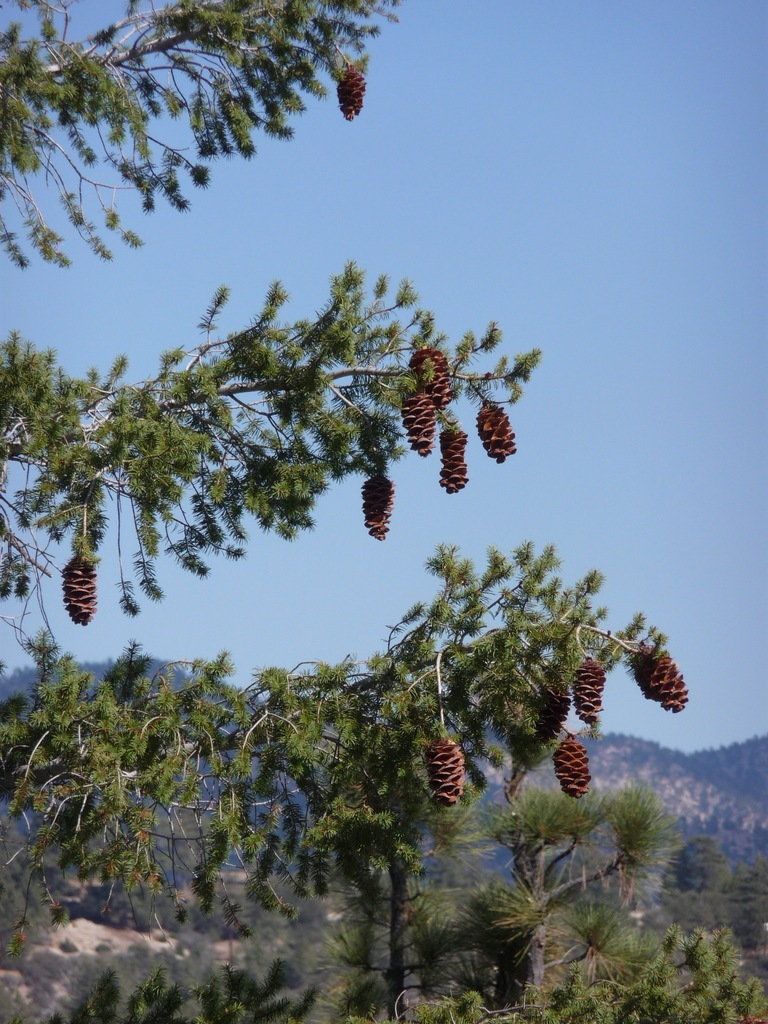
Bigcone Douglas-fir
Pseudotsuga macrocarpa
Pseudotsuga macrocarpa, commonly called the bigcone spruce or bigcone Douglas-fir, is a conifer in the pine family, Pinaceae, native to the mountains of southern California. It is notable for having the largest (by far) cones in the genus Pseudotsuga, hence the name.
The tree occurs from the San Rafael Mountains in central Santa Barbara County and the Tehachapi Mountains of southwestern Kern County, south through the Transverse Ranges, to the Cuyamaca Mountains in San Diego County. The tree is shade-tolerant and prefers to grow on slopes.
From the article Pseudotsuga macrocarpa on Wikipedia (CC BY-SA), quoted section by section
Description
Pseudotsuga macrocarpa typically grows from 15–30 m (49–98 ft) in height and 56–155 cm (1 ft 10 in – 5 ft 1 in) in trunk diameter. The growth form is straight, with a conical crown from 12–30 m (39–98 ft) broad, and a strong and spreading root system. The bark is deeply ridged, composed of thin, woodlike plates separating heavy layers of cork; bark of trees over 1 m (3.3 ft) in diameter is from 15–20 cm (5.9–7.9 in) thick. The main branches are long and spreading with pendulous side shoots. The leaves are needle-like, 2.5–4.5 cm (0.98–1.77 in) long, and are shed when about five years old. The female cones are from 11–17 cm (4.3–6.7 in) long, larger and with thicker scales than those of other douglas-firs, and with exserted tridentine bracts. The seeds are large and heavy, 10 mm long and 8 mm broad, with a short rounded wing 13 mm long; they may be bird or mammal dispersed as the wing is too small to be effective for wind dispersal. Trees start producing seeds at about 20 years of age. The largest known individual of this species is 53 m (174 ft) tall, 231 cm (91 in) in diameter, and is estimated to be from 600 to 700 years of age.
Range & habitat
Pseudotsuga macrocarpa is restricted to the California montane chaparral and woodlands and California coastal sage and chaparral ecoregions of California. It prefers a Mediterranean climate, characterized by hot dry summers and wet, mild winters. Annual rainfall during a 30-year period on a bigcone Douglas-fir site in the San Gabriel Mountains averaged 75 cm (30 in) and ranged from 25–125 cm (9.8–49.2 in). Bigcone Douglas-fir occurs between 300–2,700 m (980–8,860 ft). At low elevation, it occurs near streams in moist, shaded canyons and draws where aspects are mostly north and east. At elevations from 1,350–1,700 m (4,430–5,580 ft), aspects include south- and east-facing slopes. At these elevations, it also grows on sloping hillsides, ridges, and benches. At higher elevations, it occurs on south and west aspects on all types of terrain. The average angle of slope on which it grows is 35 degrees, ranging from level to 90 degrees, although these extremes are uncommon. Ranges the tree is found in, south to north, include:
Peninsular Ranges Cuyamaca Mountains Palomar Mountains Santa Ana Mountains San Jacinto Mountains Transverse Ranges San Bernardino Mountains San Gabriel Mountains Santa Susana Mountains San Emigdio Mountains Topatopa Mountains Santa Ynez Mountains San Rafael Mountains Sierra Madre Mountains
Wikipedia: “Distribution”
What it does
Pseudotsuga macrocarpa, has several features to tolerate and survive wildfire, notably the very thick bark, and the presence of numerous adventitious buds on the upper side of the branches; this enables the trees to survive even crown fires which burn off all the branchlets, the apparently dead trees becoming green again the following spring. Wildfire frequencies in the chaparral habitats in which it often grows typically range from 15 to 50 year intervals. Bigcone Douglas-fir is closely associated with canyon live oak (Quercus chrysolepis) and often establishes itself in its shade; after about 50 years, it emerges above the oak canopy.
The number of plant associates in bigcone Douglas-fir communities is usually small.
Common overstory associates include: bigleaf maple (Acer macrophyllum), California bay laurel (Umbellularia californica), gray pine (Pinus sabiniana), and white alder (Alnus rhombifolia). Shrub associates include bigpod ceanothus (Ceanothus megacarpus), red shank (Adenostoma sparsifolium), eastwood manzanita (Arctostaphylos glandulosa), toyon (Heteromoles arbutifolia), several species of sage (Salvia), and coastal sage scrub oak (Quercus dumosa). Ground cover associates are usually sparse, and may include California buckwheat (Eriogonum fasciculatum), wild onion (Allium spp.), scarlet keckiella (Keckiella ternata), giant chain fern (Woodwardia fimbriata), and …
Wikipedia: “Ecology”
Where it lives
Recorded sightings
—
geo-referenced records in GBIF, from museums, herbaria and field observers.
Drag the globe to turn it. Dots are where records exist, not a range map; darker means more records.
In the stacks
Searching the stacks…
Every page naming Pseudotsuga macrocarpa in the Biodiversity Heritage Library →
This page is assembled live from iNaturalist, GBIF, Wikipedia, the Source Library and the Internet Archive. It is not yet part of the hand-edited codex. iNaturalist taxon 53749.