- Animals
- ›Chordates
- ›Vertebrates
- ›Ray-finned Fishes
- ›Spiny-rayed fishes
- ›Swamp Eels
- ›Swamp Eels
- ›Swamp Eels
- ›Monopterus
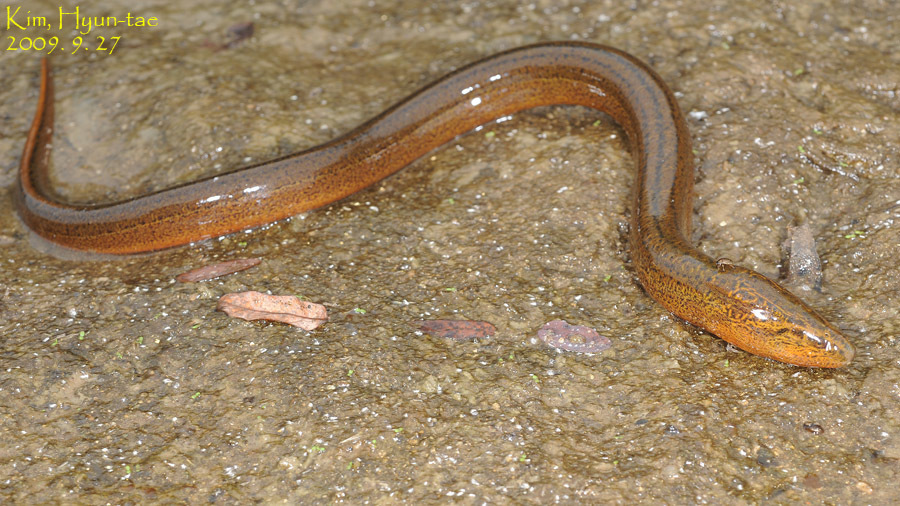
Asian Swamp Eel
Monopterus albus
The Asian swamp eel (Monopterus albus), also known as rice eel, ricefield eel, rice paddy eel, or white rice-field eel, is a commercially important, air-breathing species of fish in the family Synbranchidae. It occurs in East and Southeast Asia, where it is commonly sold and eaten throughout the region. It has been introduced to two areas near the Everglades in Florida and near Atlanta, Georgia.
From the article Asian swamp eel on Wikipedia (CC BY-SA), quoted section by section
Description
The Asian swamp eel has a scaleless, anguilliform body that grows to a meter or less, typically 25 to 40 cm as an adult. As a swamp eel, it has a tapering tail and blunt snout and lacks pectoral and pelvic fins. The dorsal, anal, and caudal fins are rudimentary, with the caudal fin often absent. These fins serve to protect the swamp eel against rolling and assist in sudden turns and stops. Its gill membranes are fused, but one V-shaped gill is located beneath the head. Such a shape prevents reverse flow. Their color is variable, but generally olive or brown, with irregular dark flecks. Individuals in Florida usually have a dark body and head, with dark olive or brown dorsal coloring and light orange ventral coloring. Individuals caught in Florida can be more colourful, indicating breeding for the pet trade. The mouth is large and protractile, and both upper and lower jaws have tiny teeth for eating fishes, worms, crustaceans, and other small, aquatic animals.
Similar species. M. cuchia, a related species also commonly eaten, has also been introduced to the USA. When it breaths, the throat expands on sides of head, as opposed to ventrally in M. albus. This species also has "suprapharyngeal air chambers", which M. albus does not, and a few scales, which are entirely absent in M. albus. M. cuchia has a single row of teeth, as opposed to two rows.
Range & habitat
It has a wide distribution. Monopterus albus is native to much of East and Southeast Asia, ranging west as far as India. M. albus is native to the tropical and subtropical areas of northern India and Burma to China, Japan, and Indo-Malayan Archipelago, possible populations in Far East Russia and northeastern Australia might belong to different cryptic species. It is a common fish in India, Southern China to Malaysia and Indonesia. The populations in most of Japan (Honshu and Kyushu) are likely introduced from China. The population in the Nara Basin was introduced from Korea in the beginning of the 20th century. Its distribution in Japan is discontinuous, which also indicates that it is introduced within the last millennium or so. The eels found in Taiwan appear to belong to two different species, a Japanese form was introduced in 1940, but a Southeast Asian form is also common and may have also been introduced or be native. The eels were first introduced to Oahu in the Hawaiian Islands around 1900, where they still occur. Earliest record of the fish in the Philippines is in 1918 from a collection by the Commercial Museum of Philadelphia where it has become an invasive species. Locations in the Southeastern United States were not colonized until the end of the 20th century. …
Wikipedia: “Distribution”
What it does
M. albus is a nocturnal animal. Its diet includes other fish, shrimp, crayfish, frogs, turtle eggs, aquatic invertebrates such as worms and insects, and occasionally detritus. An old document from 1958 claimed M. albus is capable of moving over dry land, but many years of study found no evidence for this.
Habitat. The preferred environment for the Asian swamp eel includes a wide variety of muddy, freshwater, shallow wetlands, such as rice paddies, ditches, ponds, marshes, streams, rivers, canals, lakes, and reservoirs. Depths less than 3 m are optimal. M. albus can live in a wide range of oxygen levels. This fish can obtain up to 25% oxygen from air transcutaneously if not using gills under water.
Lifecycle. The Asian swamp eel is sequentially hermaphroditic. All young are females. As juvenile fish begin to mature, some take on the masculine phenotype. Males are capable of changing sex, allowing them to replenish female populations when female densities are low. This change from one sex to another can take up to a year. Spawning can occur throughout the year. Some Japanese and Chinese forms of M. albus exhibit a great deal of parental care. Large males construct bubble nests at the mouth of burrows and guard the eggs and young. In some Japanese and Chinese forms, eggs are laid in bubble nests located in shallow waters. …
Wikipedia: “Ecology”
At the table
The fish is an important protein source for people in Thailand. It is cultured throughout Vietnam. In Indonesia, Cambodia, China, Laos, Myanmar, Thailand, Vietnam, and other Asian countries, swamp eels are farmed in polyculture rice fields and sold as a food product with the rice crop. In Balinese, the eels are known as lindung, they are sold dried in almost all village markets for use in Hindu offerings. In Japan, it is known as ta-unagi, from 田, pronounced "ta", meaning paddy and 鰻, pronounced "unagi", meaning eel, usually written in katakana as タウナギ, and not commonly eaten. In addition to being useful as a food, this species of eel is also often released into natural water resources in Thailand. According to the belief of the Thai people that it will help to end suffering and sorrow, or as a merit as releasing other fish or other aquatic animals such as climbing perch (Anabas testudineus), striped snakehead (Channa striata), Chinese edible frog (Hoplobatrachus rugulosus), pond snail (Filopaludina martensi), etc.
Wikipedia: “Uses”
Where it lives
Recorded sightings
—
geo-referenced records in GBIF, from museums, herbaria and field observers.
Drag the globe to turn it. Dots are where records exist, not a range map; darker means more records.
In the stacks
Searching the stacks…
Every page naming Monopterus albus in the Biodiversity Heritage Library →
This page is assembled live from iNaturalist, GBIF, Wikipedia, the Source Library and the Internet Archive. It is not yet part of the hand-edited codex. iNaturalist taxon 53511.