- Animals
- ›Chordates
- ›Vertebrates
- ›Birds
- ›Hawks, Eagles, Kites, and Allies
- ›Hawks, Eagles, and Kites
- ›Buteonine Hawks, Kites, and allies
- ›Rostrhamus
On eBird ↗
Snail Kite
Live sightings near you, the range map, bar charts of when it is seen, and Macaulay Library photos and recordings.
Snail Kite
Rostrhamus sociabilis
The snail kite (Rostrhamus sociabilis) is a bird of prey within the family Accipitridae, which also includes the eagles, falcons, hawks, and Old World vultures. Its relative, the slender-billed kite, is now again placed in Helicolestes, making the genus Rostrhamus monotypic. Usually, it is placed in the milvine kites, but the validity of that group is under investigation.
From the article Snail kite on Wikipedia (CC BY-SA), quoted section by section
Description
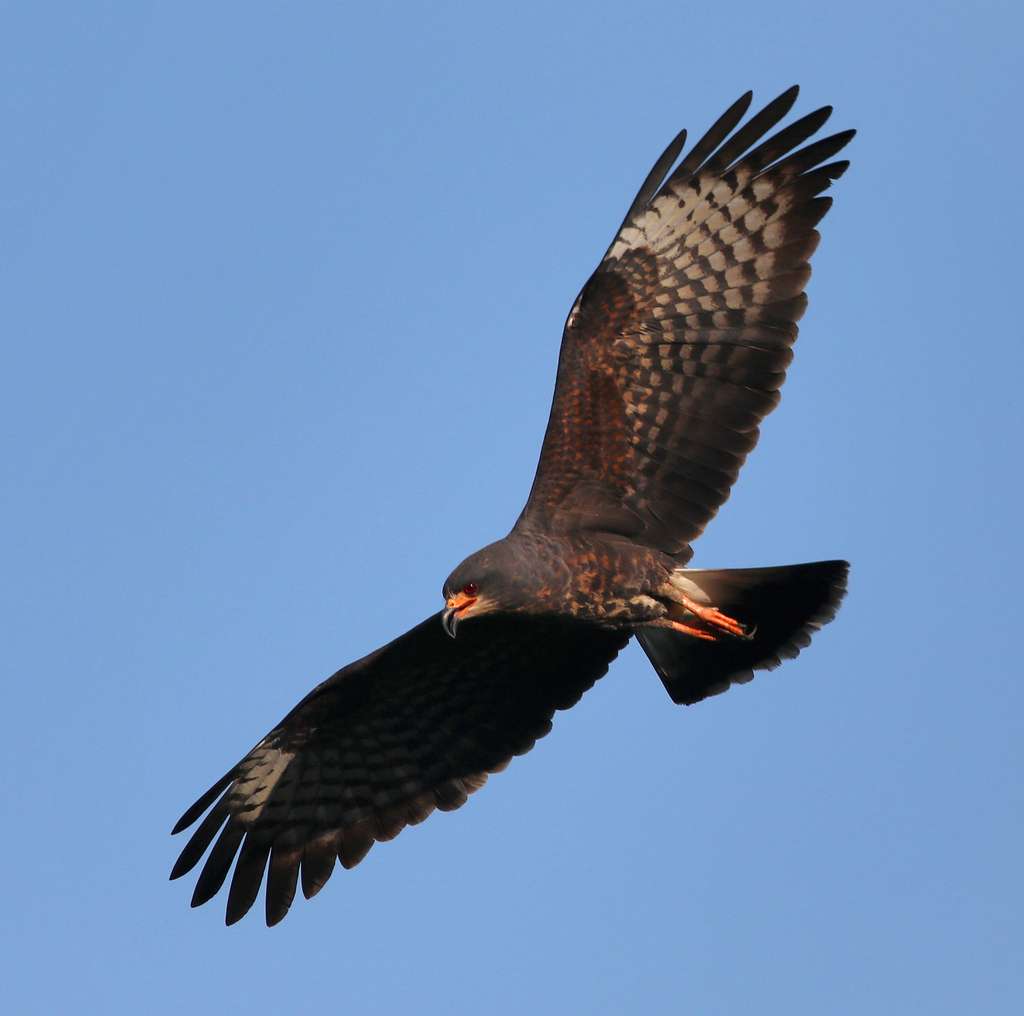
Snail kites are 36 to 48 cm (14 to 19 in) long with a 99–120 cm (39–47 in) wingspan. They weigh from 300 to 570 g (11 to 20 oz). There is very limited sexual dimorphism, with the female averaging only 3% larger than the male. They have long, broad, and rounded wings, which measure 29–33 cm (11–13 in) each. Its tail is long, at 16–21 cm (6.3–8.3 in), with a white rump and undertail coverts. The dark, deeply hooked beak, measuring 2.9–4 cm (1.1–1.6 in) is an adaptation to its diet. The tarsus is relatively long as well, measuring 3.6–5.7 cm (1.4–2.2 in). The adult male has dark blue-gray plumage with darker flight feathers. The legs and cere are red. The adult female has dark brown upperparts and heavily streaked pale underparts. She has a whitish face with darker areas behind and above the eye. The legs and cere are yellow or orange. The juvenile is similar to an adult female, but the crown is streaked. Adults have red or orangish-brown irises, while juveniles have dark brown irises. It flies slowly with its head facing downwards, looking for its main food, the large apple snails. For this reason, it is considered a molluscivore.
Range & habitat
The snail kite breeds in tropical South America, the Caribbean, and central and southern Florida in the United States. It is resident all-year round in most of its range, but the southernmost population migrates north in winter and the Caribbean birds disperse widely outside the breeding season.
Wikipedia: “Distribution”
What it does
This is a gregarious bird of freshwater wetlands, forming large winter roosts. Its diet consists almost exclusively of apple snails, especially the species Pomacea diffusa, P. maculata and P. paludosa in Florida, other species of Pomacea (P. doliodes) elsewhere in its range, and species of the genus Marisa (M. cornuarietis). Snail kites have been observed eating other prey items in Florida, including other freshwater snail species (such as the banded mystery snail), crayfish in the genus Procambarus, crabs in the genera Dilocarcinus and Poppiana (P. dentata), black crappie, ring-necked snakes, small turtles (including the common musk turtle, striped mud turtle, coastal plain cooter, Florida red-bellied cooter, Florida softshell turtle, and other unidentified species), rodents and carcasses (based only on a single reported case of a dead American coot). It is believed that snail kites turn to these alternatives only when apple snails become scarce, such as during drought, but further study is needed. On 14 May 2007, a birder photographed a snail kite feeding at a red swamp crayfish farm in Clarendon County, South Carolina. The presence of the large introduced Pomacea maculata in Florida has led the snail kites in North America to develop larger bodies and beaks to better eat the snail, a case of rapid evolution. …
Wikipedia: “Diet”
Listen
Looking for field recordings…
Where it lives
Recorded sightings
—
geo-referenced records in GBIF, from museums, herbaria and field observers.
Drag the globe to turn it. Dots are where records exist, not a range map; darker means more records.
In the stacks
Searching the stacks…
Every page naming Rostrhamus sociabilis in the Biodiversity Heritage Library →
This page is assembled live from iNaturalist, GBIF, Wikipedia, the Source Library and the Internet Archive. It is not yet part of the hand-edited codex. iNaturalist taxon 5349.