- Animals
- ›Chordates
- ›Vertebrates
- ›Birds
- ›Hawks, Eagles, Kites, and Allies
- ›Hawks, Eagles, and Kites
- ›Typical Eagles and Hawk-Eagles
- ›Lophaetus
On eBird ↗
Long-crested Eagle
Live sightings near you, the range map, bar charts of when it is seen, and Macaulay Library photos and recordings.
Long-crested Eagle
Lophaetus occipitalis
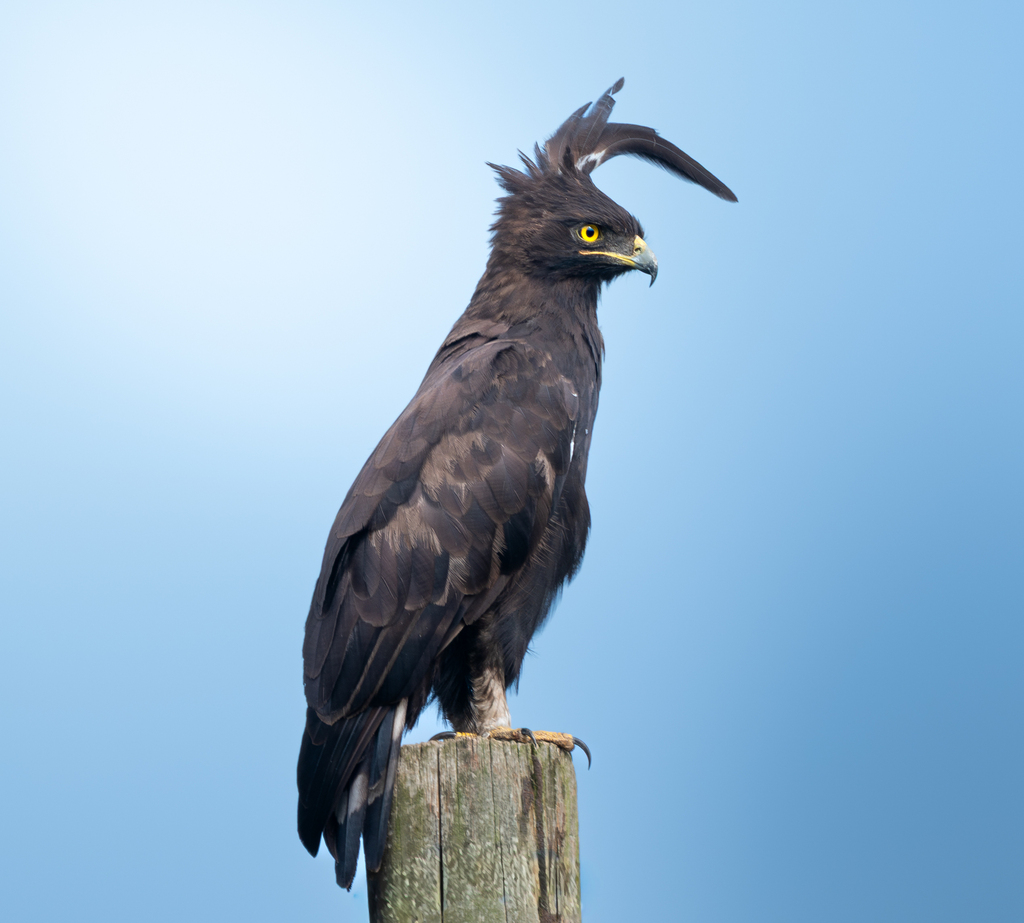
The long-crested eagle (Lophaetus occipitalis) is an African bird of prey characterised by its shaggy crest of feathers. In the family Accipitridae which includes all the eagles, it is currently placed in a monotypic genus Lophaetus. It is found throughout mid- and southern Africa, with differing home ranges due to food availability and suitable habitat area, but lives mainly on forest edges and near moist areas. Breeding may occur at any time of year, depending on food availability; it lays 1 or 2 eggs as is usual for raptors. It commonly eats smaller mammals, but will also eat other vertebrates and invertebrates.
From the article Long-crested eagle on Wikipedia (CC BY-SA), quoted section by section
Description
The long-crested eagle is a distinctive eagle when perched due to the long, shaggy crest and all dark plumage often called Kamusungu-sungu in Uganda. The adults are blackish-brown with long, thin feathers growing from the rear of the crown which are held erect to form a crest. The secondary feathers are black barred with light grey and with broad black tips, the primary feathers and median underwing coverts are white, forming a noticeable white patch on the upper and lower surfaces of the wing which is visible in flight. The tail is black, barred with pale grey. The eyes of adults are bright yellow but can be darker in females, and the cere and feet are yellow, paling to white in males. The juveniles are similar to the adults, but the plumage is lighter in colour and the crest is not developed and their eyes are grey. The body length is 53–58 cm (21–23 in) and the weight of the female is 1,300–1,500 g (46–53 oz), while the smaller male is 912–1,300 g (32.2–45.9 oz).
Range & habitat
The long-crested eagle occurs in sub-Saharan Africa from Senegal and Gambia eastwards to Ethiopia and south to the Eastern Cape, in South Africa, northern Namibia and northern Botswana. It is generally regarded as sedentary, but in arid areas may be nomadic depending on the rains.
Wikipedia: “Distribution”
At the table
Rodents are up to 98% of the long-crested eagle's diet. In southern Africa the rodents taken include greater cane rat (Thryonomys swinderianus), vlei rats Otomys spp., African marsh rat (Dasmys incomtus) and four-striped grass mouse (Rhabdomys pumilio). Birds, including owls and the young of other raptors, frogs and lizards, invertebrates and even fish and fruit are also recorded as forming part of its diet. The long-crested eagle is a "sit and wait" hunter which scans the ground from a perch and swoops on prey with a gliding flight.
Wikipedia: “Food”
Listen
Looking for field recordings…
Where it lives
Recorded sightings
—
geo-referenced records in GBIF, from museums, herbaria and field observers.
Drag the globe to turn it. Dots are where records exist, not a range map; darker means more records.
In the stacks
Searching the stacks…
Every page naming Lophaetus occipitalis in the Biodiversity Heritage Library →
This page is assembled live from iNaturalist, GBIF, Wikipedia, the Source Library and the Internet Archive. It is not yet part of the hand-edited codex. iNaturalist taxon 5335.