- Plants
- ›Vascular Plants
- ›flowering plants
- ›Dicots
- ›Mints, Plantains, Olives, and Allies
- ›Mint Family
- ›Nepetoideae
- ›Mentheae
- ›Melissas and sages
- ›Salvia
- ›Audibertia
- ›Audibertia
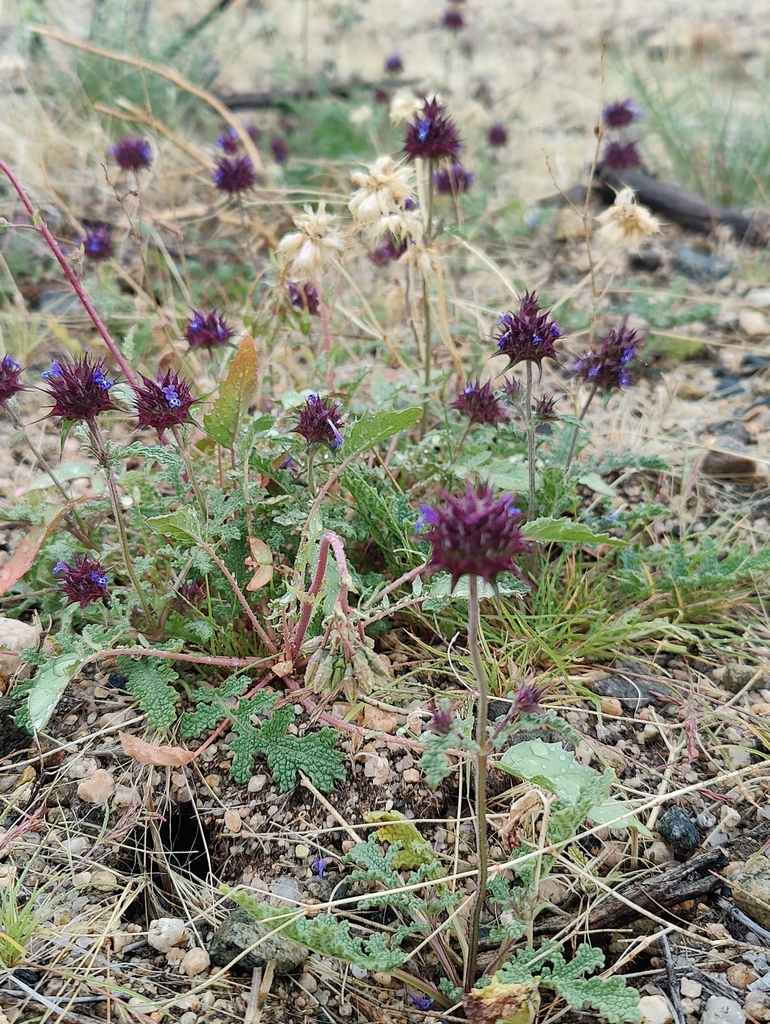
Chia
Salvia columbariae
Salvia columbariae is an annual plant that is commonly called chia, chia sage, golden chia, or desert chia, because its seeds are used in the same way as those of Salvia hispanica (chia). It grows in California, Nevada, Utah, Arizona, New Mexico, Sonora, and Baja California, and is an important food for Native Americans. Some native names include pashiiy from Tongva and it'epeš from Ventureño.
From the article Salvia columbariae on Wikipedia (CC BY-SA), quoted section by section
Description
Salvia columbariae grows 10 to 50 cm (3.9 to 19.7 in) tall. Its stem hairs are generally short and sparse in distribution. It has oblong-ovate basal leaves that are 2 to 10 cm (0.79 to 3.94 in) long. The leaves are pinnately dissected and the lobes are irregularly rounded. The inflorescence is more or less scapose, meaning it has a long peduncle that comes from the ground level that has bracts. The bracts are round and awn-tipped. There are usually 1 or 2 clusters of flowers within the inflorescence. The calyx is 8 to 10 mm (0.31 to 0.39 in) long and the upper lip is unlobed but has 2 (sometimes 3) awns. The lower lip is about twice the size of the upper lip. The flower color can be pale blue to blue and purple tipped. The stamens of the plant are slightly exserted. The fruit of S. columbariae is a nutlet that is tan to grey in color and 1.5 to 2 mm (0.059 to 0.079 in) long.
Range & habitat
Salvia columbariae can be found in dry undisturbed sites, chaparral, and coastal sage scrub. It generally grows at elevations lower than 2,500 m (8,200 ft). In cultivation, it prefers good drainage, sun, and dry weather.
Wikipedia: “Habitat”
At the table
The Cahuilla used the columbariae Benth. variety as a disinfectant by grinding the seeds to mush and applying it to infections as a poultice. The Cahuilla, Ohlone, Kawaiisu, and Mahuna used the gelatinous seeds to cleanse out foreign matter in the eyes. The seeds were placed in the eyes for infections and inflammation, and during sleep, they were tucked underneath the eyelids to remove sand particles. The Ohlone also used it to reduce fevers by consuming the seeds, and the Kumeyaay chewed the seeds on journeys by foot to give strength.
Wikipedia: “Medicinal uses”
Where it lives
Recorded sightings
—
geo-referenced records in GBIF, from museums, herbaria and field observers.
Drag the globe to turn it. Dots are where records exist, not a range map; darker means more records.
In the old herbals & bestiaries

Compendium of Materia Medica
李時珍 · 1596 · p.64

A Monograph of the Mycetozoa, being a descriptive catalogue of the species in the herbarium of the British Museum
Arthur Lister (1830-1908); plates by Gulielma Lister · 1894 · p.375

Hortus Eystettensis
Basilius Besler · 1640 · p.389

Introductio Generalis in Rem Herbariam
Augustus Quirinus Rivinus · 1690 · p.200

Latin Herbal
1484 · p.37

Latin Herbal
1484 · p.39

Latin Herbal with German Synonyms
1486 · p.38

Notable Commentaries on the History of Plants
Leonhart Fuchs · 1549 · p.523

Hortus Eystettensis
Basilius Besler · 1640 · p.212

Introductio Generalis in Rem Herbariam
Augustus Quirinus Rivinus · 1690 · p.201

Mark Catesby — Piscium, serpentum, insectorum (pt. 1) (1750)
Mark Catesby · 1750 · p.207

Herbal of Virtues
1499 · p.37
In the stacks
Searching the stacks…
Every page naming Salvia columbariae in the Biodiversity Heritage Library →
This page is assembled live from iNaturalist, GBIF, Wikipedia, the Source Library and the Internet Archive. It is not yet part of the hand-edited codex. iNaturalist taxon 53200.