- Plants
- ›Vascular Plants
- ›flowering plants
- ›Dicots
- ›Sunflowers, Bellflowers, Fanflowers, and Allies
- ›Sunflowers, Daisies, Asters, and Allies
- ›chicories, dandelions, and allies
- ›Lettuce, Chicory, Dandelion and Salsify Tribe
- ›Lettuce subtribe
- ›Lactuca
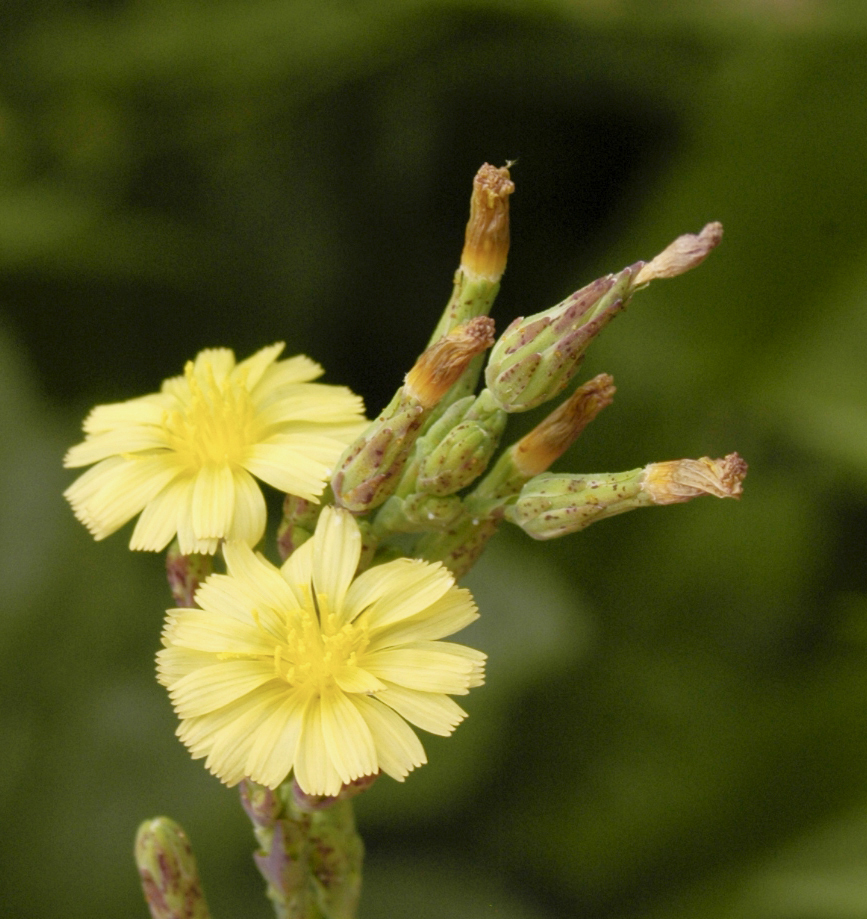
prickly lettuce
Lactuca serriola
Lactuca serriola, also called prickly lettuce, milk thistle (not to be confused with Silybum marianum, also called milk thistle), compass plant, and scarole, is an annual or biennial plant in the tribe Cichorieae within the family Asteraceae. It has a slightly fetid odor and is commonly considered a weed of orchards, roadsides and field crops. It is the closest wild relative of cultivated lettuce (Lactuca sativa L.).
Lactuca serriola is native to Eurasia and North Africa, and has become naturalized elsewhere.
From the article Lactuca serriola on Wikipedia (CC BY-SA), quoted section by section
Description
Lactuca serriola has a spineless reddish stem, containing a milky latex, growing up to 2 metres (6 ft 7 in). The leaves get progressively smaller as they reach its top. They are oblong or lanceolate, often pinnately lobed and (especially for the lower leaves), waxy grey green. Fine spines are present along the veins and leaf edges. The undersides have whitish veins. They emit latex when cut. The flower heads are 1–1.5 cm (1⁄2–1⁄2 in) wide, pale yellow, often tinged purple, with 12–20 ray flowers but no disc flowers. The bracts are also often tinged purple. It flowers from July until September in the northern hemisphere. The achenes are grey, tipped with bristles. The pappus is white with equal length hairs. Lactuca serriola is known as the compass plant because in the sun the upper leaves twist round to hold their margins upright, pointing roughly south or north from the stem. Similar to Mycelis muralis but showing more than 5 florets.
Range & habitat
Lactuca serriola is native to Europe, Asia, and North Africa, and has become naturalized elsewhere.
Wikipedia: “Distribution”
At the table
Lactuca serriola can be eaten as a salad, although it has something of a bitter taste. Young leaves can be eaten raw or cooked. Older leaves can be steamed. While unsubstantial, its roots have been used as a coffee substitute. Its presence in some ancient deposits has been linked more to its soporific properties which might suggest ritual use. The Ancient Greeks also believed its pungent juice to be a remedy against eye ulcers and Pythagoreans called the lettuce eunuch because it caused urination and relaxed sexual desire. Following its accidental introduction to North America, the Navajo began to use the plant as a ceremonial emetic. In the island of Crete in Greece the leaves and the tender shoots of a variety called maroula (μαρούλα) or agriomaroulo (αγριομάρουλο) are eaten boiled. It is used by a growing number of Jews and Samaritans as the Maror (bitter herb) on Passover (or Pesach in Hebrew). Lactuca serriola contains lactucarium, which is the milky sap (white latex) that flows through the stem of the plant. It is used as a medicinal herb when air-dried. Although the standard definition of lactucarium requires its production from Lactuca virosa, it was recognized that smaller quantities of lactucarium could be produced in a similar way from Lactuca sativa and Lactuca canadensis var. …
Wikipedia: “Uses”
In human culture
The Egyptian god Min is associated with this species of lettuce. Also, archaeobotanical evidence in Greek archaeological contexts is scanty, although uncarbonised seeds have been retrieved from a 7th-century BC deposit in a sanctuary of Hera on Samos. It is also described by Theophrastus. In mythology, Aphrodite is said to have laid Adonis in a lettuce bed, leading to the vegetable's association with food for the dead.
Wikipedia: “In culture”
Where it lives
Recorded sightings
—
geo-referenced records in GBIF, from museums, herbaria and field observers.
Drag the globe to turn it. Dots are where records exist, not a range map; darker means more records.
In the stacks
Searching the stacks…
Every page naming Lactuca serriola in the Biodiversity Heritage Library →
This page is assembled live from iNaturalist, GBIF, Wikipedia, the Source Library and the Internet Archive. It is not yet part of the hand-edited codex. iNaturalist taxon 53107.