- Animals
- ›Chordates
- ›Vertebrates
- ›Ray-finned Fishes
- ›Spiny-rayed fishes
- ›Pipefishes and Allies
- ›Syngnathoidei
- ›Pipefishes, Seahorses, and Seadragons
- ›Tail-brooding Pipefishes
- ›Phyllopteryx
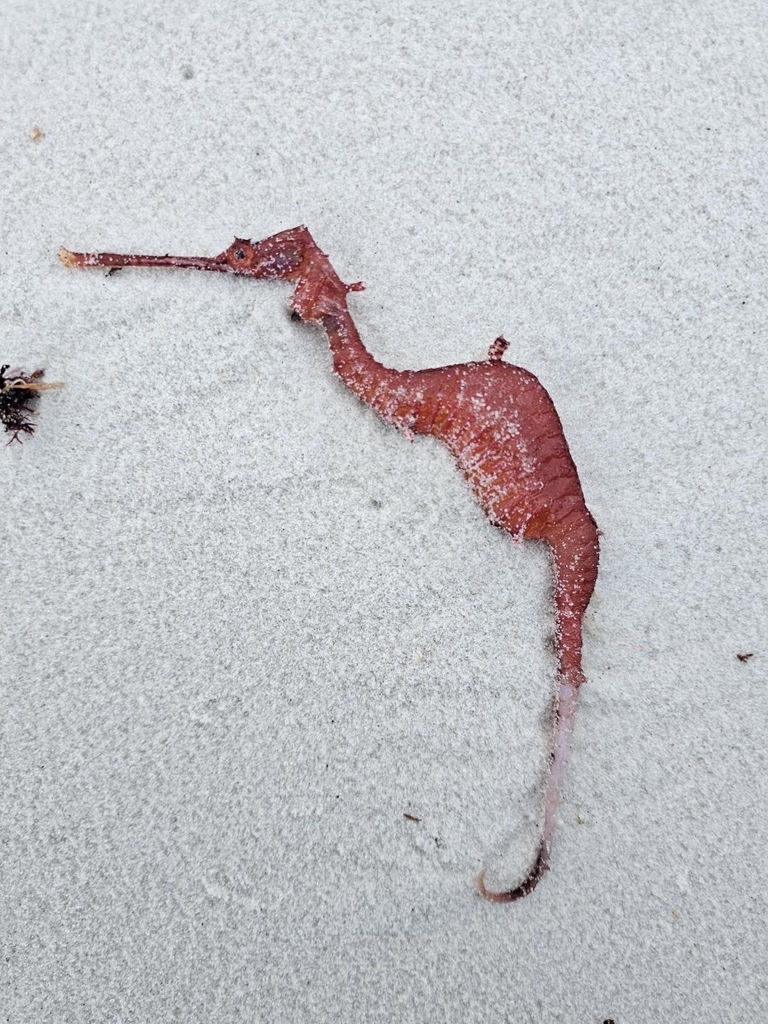
Ruby Seadragon
Phyllopteryx dewysea
The ruby seadragon (Phyllopteryx dewysea) is a marine fish in the family Syngnathidae, which includes seadragons, seahorses, and pipefishes. This is the third known species of seadragon, described in 2015, and the first to be discovered in 150 years. It has been sighted on the coast of Western Australia. As of 2025, there are significant knowledge gaps on this species, and only a few individuals have been observed in the wild.
The ruby seadragon is named to honor Mary 'Dewy' Lowe, a supporter of seadragon conservation and research.
From the article Ruby seadragon on Wikipedia (CC BY-SA), quoted section by section
Description
The ruby seadragon is characterized by a ruby red body with pink vertical bars that extend halfway up, meeting lateral trunk ridges. They have a slender, elongated body, like the common seadragon. Their body has 18 trunk segments with an enlarged pectoral area and spines. In contrast to the other two seadragon species, the ruby seadragon has a curved prehensile tail with a yellow tip. It also lacks dermal appendages (the leaf-like structures on other seadragon species) despite possessing the bony spines that these would attach to. It is possible that ruby seadragons exhibit sexual dimorphism. Of the two live ruby seadragon observations, one was potentially a female. This female had a deeper, circular body shape, with darker red coloration and obvious vertical bars.
The holotype (a single individual used to formally describe the species) of the ruby seadragon was a male carrying its brood. In addition to the above description, it had light snout markings; when preserved, its uniform coloration faded to brown. Five paratypes (additional specimen representing species variation) were identified following the discovery of the holotype. …
Range & habitat
As of 2025, there are no estimates of ruby seadragon population sizes. As of 2017, all of the 6 ruby seadragon specimens were collected in Western Australia. Three of the specimens were near Perth, one was in the Recherche Archipelago, one at Culver Cliffs, and the last near Esperance. It is likely that the ruby seadragon evaded prior identification because of their deep-water range, outside of the recreational scuba depth. The holotype was trawled in the Recherche Archipelago at a depth of 51–72 meters, indicating that ruby seadragon species may prefer deeper waters. This theory was confirmed in April 2016 during a survey of the Recherche Archipelago (at 50+ meters), resulting in the first live records of the ruby seadragon; these two sightings, in addition to the previous male with brood (2007), suggest a viable population in the Recherche Archipelago. Prior specimen locations may indicate a wider range in Western Australia, but this claim requires further evidence.
The Recherche Archipelago is the potential locality of the ruby seadragon. This area of Western Australia is a 230-kilometer chain of approximately 105 islands and 1500 islets. As of 2005, there was little research into the ocean currents of the area, but the region is described as storm-dominated with few periods of calm. …
Wikipedia: “Distribution & habitat”
What it does
Due to limited knowledge, researchers are uncertain about the behavior, ecology, and life cycle of the ruby seadragon, and of other seadragon species. The assumptions below are subject to change as further research is conducted. The holotype of the ruby seadragon was collected with brood, so the reproductive strategy of this species resembles other seadragons. In the common and leafy seadragon species, the female's eggs are transferred to the male's brood patch for incubation until the young hatch. The ruby seadragon diet is not known but its snout morphology suggests that it is adapted for predation, like other seadragon species. The common and leafy seadragons prey on small crustaceans and mysids. In observation, the ruby seadragons were seen striking at sandy substrate, potentially feeding on similar prey.
An interesting trait of the ruby seadragon is the lack of dermal appendages despite possessing bony spines for these structures. This is attributed to the sparse and turbulent habitat they are sighted in, as bulky appendages can add drag and resistance during strong surges. They would not serve the same camouflaging purpose as for the common and leafy seadragons. The red coloration of the ruby seadragon may be a camouflage strategy in the low-light depths that this species prefers. …
Wikipedia: “Biology & ecology”
Where it lives
Recorded sightings
—
geo-referenced records in GBIF, from museums, herbaria and field observers.
Drag the globe to turn it. Dots are where records exist, not a range map; darker means more records.
In the stacks
Searching the stacks…
Every page naming Phyllopteryx dewysea in the Biodiversity Heritage Library →
This page is assembled live from iNaturalist, GBIF, Wikipedia, the Source Library and the Internet Archive. It is not yet part of the hand-edited codex. iNaturalist taxon 531007.