- Animals
- ›Chordates
- ›Vertebrates
- ›Birds
- ›Hawks, Eagles, Kites, and Allies
- ›Hawks, Eagles, and Kites
- ›Buteonine Hawks, Kites, and allies
- ›Haliaeetus
On eBird ↗
Steller's Sea-Eagle
Live sightings near you, the range map, bar charts of when it is seen, and Macaulay Library photos and recordings.
Steller's Sea-Eagle
Haliaeetus pelagicus
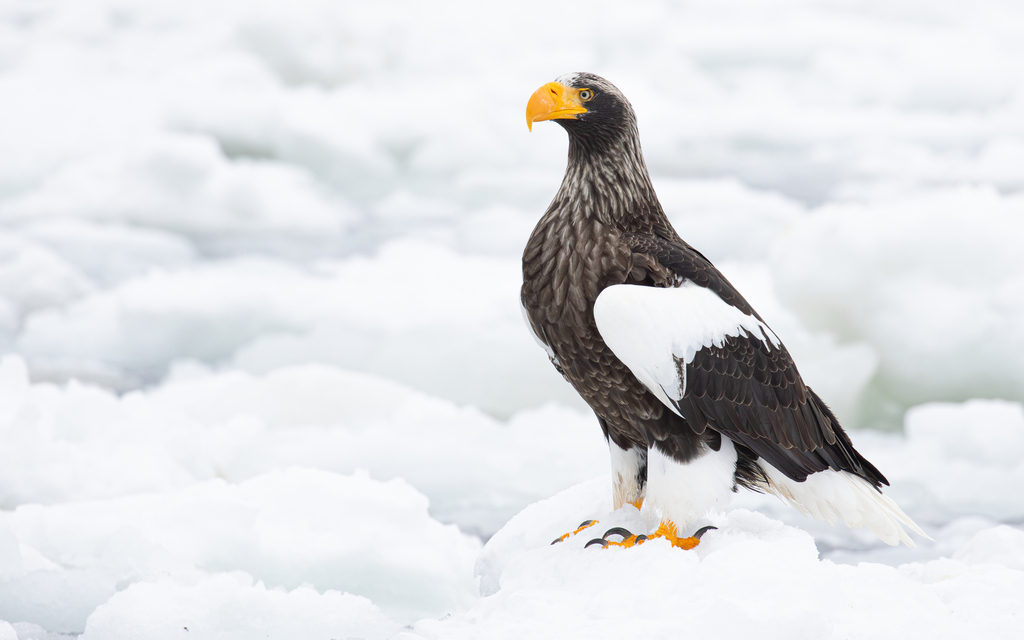
Steller's sea eagle (Haliaeetus pelagicus), also known as the Pacific sea eagle or white-shouldered eagle, is a very large diurnal bird of prey in the family Accipitridae. It was described first by Peter Simon Pallas in 1811. No subspecies are recognized. A sturdy eagle, it has dark brown plumage with white wings and tail, a yellow beak, and yellow talons. Typically, it is the heaviest eagle in the world, at about 5 to 10 kg (11 to 22 lb), but in some other standard measurements, may be smaller than the harpy eagle (Harpia harpyja) and the Philippine eagle (Pithecophaga jefferyi). Steller's sea eagle females are bigger than males, as in other raptors.
The Steller's sea eagle is endemic to coastal northeastern Asia, where it lives in Russia, Korea, Japan, and China. It mainly preys on fish and water birds. The Kamchatka Peninsula in Far Eastern Russia is known for its relatively large population of these birds; about 4,000 of these eagles live there. Steller's sea eagle is listed as vulnerable on the International Union for Conservation of Nature's Red List (IUCN Red List) of threatened species.
From the article Steller's sea eagle on Wikipedia (CC BY-SA), quoted section by section
Range & habitat
Steller's sea eagle breeds on the Kamchatka Peninsula, the coastal area around the Sea of Okhotsk, the lower reaches of the Amur River, and on northern Sakhalin and the Shantar Islands, Russia. Many eagles migrate from breeding grounds to Korea, Japan, and China in winter. Most birds winter south of their breeding range, in the southern Kuril Islands, Russia, and Hokkaidō, Japan. Steller's sea eagle is less prone to vagrancy than the white-tailed eagle, as it lacks the long-range dispersal typical of juveniles of that species, but vagrant eagles have been found in North America at locations including the Aleutian Islands, Pribilof Islands, and Kodiak Island, as well as a single individual seen in Texas, Nova Scotia, Massachusetts, Maine, and Newfoundland and Labrador, and inland in Asia to as far as Beijing in China and Yakutsk in Russia's Sakha Republic, and south to as far as Taiwan. The large body size (see also Bergmann's rule) and distribution of Steller's sea eagle suggests it is a glacial relict, meaning it evolved in a narrow subarctic zone of the northeasternmost Asian coasts, which shifted its latitude according to ice age cycles, and never occurred anywhere else. Their nests are built on large, rocky outcroppings or at the tops of large trees on the coast and alongside large rivers with mature trees. …
Wikipedia: “Distribution and habitat”
What it does
Steller's sea eagle mainly feed on fish and are apex predators of their environment. Their favored prey in river habitats are salmon and trout (of the Pacific salmon genus; Oncorhynchus spp.). Among these, pink salmon (O. gorbuscha) and chum salmon (O. keta) are reportedly favored, sometimes intensely supplemented by grayling (Thymallus sp.) and three-spined stickleback (Gasterosteus aculeatus). While pink and chum salmon average approximately 2.2 and 5 kg (4.9 and 11.0 lb) in mature mass, respectively, Steller's sea eagle not infrequently preys on fish up to 6 to 7 kg (13 to 15 lb). In coastal areas, nesting eagles may feed on Bering wolffish (Anarchichas orientalis), Hemitripterus villosus, smooth lumpfish (Aptocyclus ventricosus), and Myoxocephalus spp. Like most Haliaeetus eagles, they hunt fish almost exclusively in shallow water. Relatively large numbers of these normally solitary birds can be seen congregating on particularly productive spawning rivers in August through September due to an abundant food supply. On Kamchatka, aggregations of as many as 700 eagles have been reported, though much smaller groups are the norm. In summer, live fish, typically in the range of 20 to 30 cm (7.9 to 11.8 in) in length, are fed to the young at the nest. Normally, the parents catch about two or three fish for the young to eat each day. …
Wikipedia: “Diet”
Listen
Looking for field recordings…
Where it lives
Recorded sightings
—
geo-referenced records in GBIF, from museums, herbaria and field observers.
Drag the globe to turn it. Dots are where records exist, not a range map; darker means more records.
In the stacks
Searching the stacks…
Every page naming Haliaeetus pelagicus in the Biodiversity Heritage Library →
This page is assembled live from iNaturalist, GBIF, Wikipedia, the Source Library and the Internet Archive. It is not yet part of the hand-edited codex. iNaturalist taxon 5304.