- Plants
- ›Vascular Plants
- ›flowering plants
- ›Dicots
- ›Sunflowers, Bellflowers, Fanflowers, and Allies
- ›Sunflowers, Daisies, Asters, and Allies
- ›Asteroideae
- ›Chamomiles, yarrows, and allies
- ›Matricariinae
- ›Matricaria
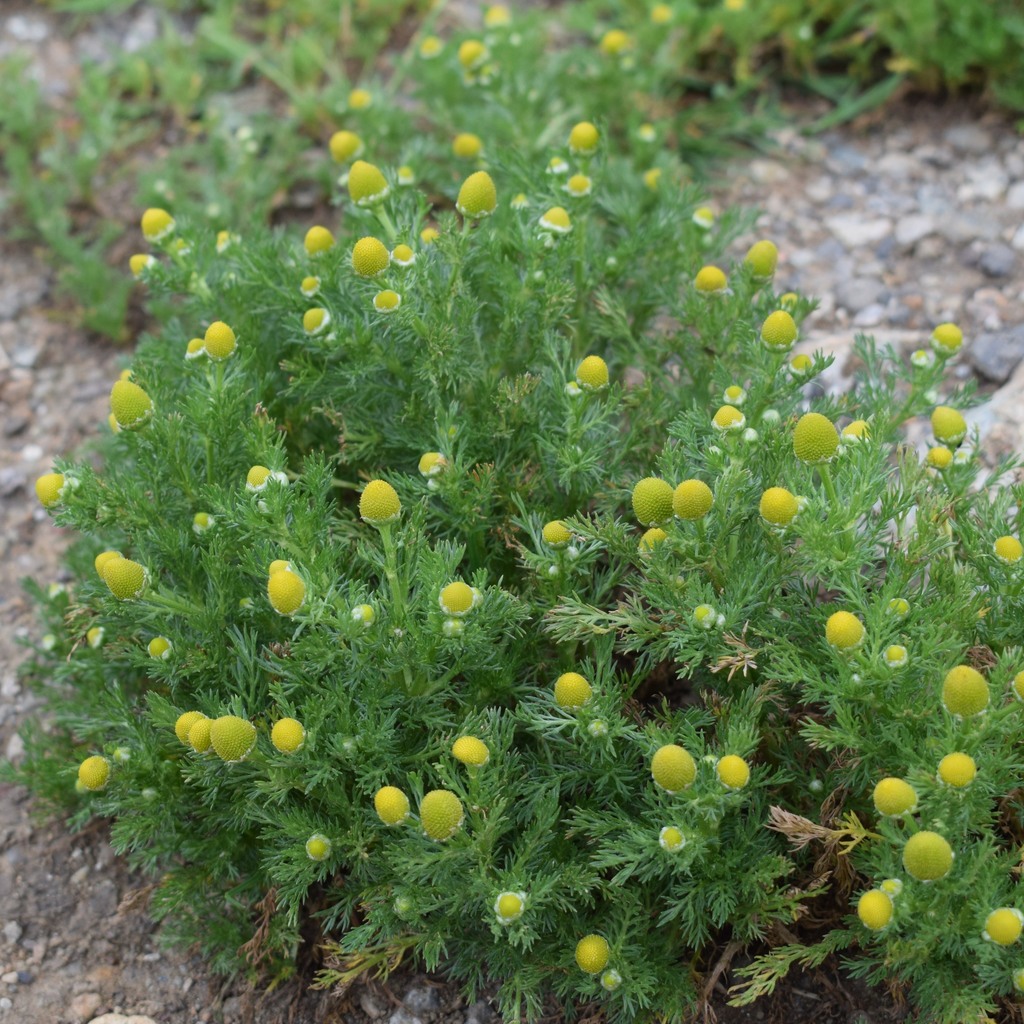
pineapple-weed
Matricaria discoidea
Matricaria discoidea, commonly known as pineappleweed, wild chamomile, and disc mayweed is an annual plant native to North America and Northeast Asia but which has become a cosmopolitan weed. It is in the family Asteraceae. The flowers exude a chamomile/pineapple aroma when crushed. They are edible and have been used in salads (although they may become bitter by the time the plant blooms) and to make herbal tea. Pineapple weed has been used for medicinal purposes,...
From the article Matricaria discoidea on Wikipedia (CC BY-SA), quoted section by section
Description
The flowers of M. discoidea, are small, dome-shaped capitula that resemble single flower heads but are composed of densely packed yellowish green corollas. Each plant typically carries at least five capitula, and each capitulum measures 5–15 mm across. The capitula lacks ray florets, giving the flowers their distinctive button-like appearance. The capitula are typically solitary or arranged in loose clusters, and they are supported by short peduncles about 5–10 mm in length. Papery bracts (small, leaf-like structures) surround the capitulum in three rows, with membranous margins and rounded tips. Like other members of the Asteraceae family, it produces florets with an inferior ovary. The hollow, conical receptacle contains numerous tubular, bisexual disc florets, each with five stamens and a pistil formed from two fused carpels. There are no scales between the disc florets. Matricaria species have flattened and penicillate style branches, aiding in pollen transfer. Flowerheads are commonly produced from March to September.
The leaves are pinnately divided one to three times, with blades measuring approximately 10–65 mm long and 2–20 mm wide. …
Range & habitat
The plant thrives in disturbed areas, especially those with poor, compacted soil. It often blooms along footpaths and roadsides in spring and early summer. It occurs across Canada and the United States, especially as a common weed in Alaska, the Yukon, and the Northwest Territories. However, there is disagreement over whether it originated in North America or in Siberia. This species has been introduced to Europe, Asia, Iceland, South America, and New Zealand and is now widespread and naturalized in Britain, where it has become one of the fastest-spreading plants of the 20th century.
Wikipedia: “Distribution and habitat”
What it does
M. discoidea reproduces solely through seed formation. The flower heads produce small, light brown, ribbed seeds measuring 1.3–1.6 mm in length by <0.7 mm in width and weighing 0.14 mg on average. Each seed is enveloped in a 19.6–22.8 μm-thick seed coat and packaged in a small, dry, indehiscent fruit achene. Flowering occurs rapidly under favorable conditions. In temperate environments such as England, M. discoidea may flower only 37–50 days after seedling emergence, depending on temperature and day length. Shorter photoperiods and later-season germination extend the time to flowering, often causing overwintering as a rosette before blooming the following spring. Individual flower heads produce 50–400 seeds. The main plant has been observed to produce up to six thousand seeds in the United Kingdom, while in Alaska the main plant usually contains 11–1000 seeds. Pineapple weed readily fertilizes itself, and the species typically produces seeds one or more times per year. Buried M. discoidea seeds have been found to quickly lose viability at an estimated rate of 15% per year over their first ten years, although they generally remain viable for a minimum of three years. Similarly, seeds experience a steep decline in dormancy in the initial years after burial. Successful germination requires light and open, disturbed soil, as seeds buried too deeply will not sprout.
Wikipedia: “Reproduction”
At the table
The greens can be washed and eaten, and both the flowers and the whole plant can be steeped to make tea, described as "excellent" by one field guide. They have also been used in salads (although they may become bitter by the time the plant blooms). Extracts from the flowers and other aerial parts of the plant have been shown to possess non-toxic, pain-relieving, and mildly sedative effects, reflecting the biological activity concentrated in the floral tissues.
Wikipedia: “Uses”
Where it lives
Recorded sightings
—
geo-referenced records in GBIF, from museums, herbaria and field observers.
Drag the globe to turn it. Dots are where records exist, not a range map; darker means more records.
In the stacks
Searching the stacks…
Every page naming Matricaria discoidea in the Biodiversity Heritage Library →
This page is assembled live from iNaturalist, GBIF, Wikipedia, the Source Library and the Internet Archive. It is not yet part of the hand-edited codex. iNaturalist taxon 52992.