- Animals
- ›Chordates
- ›Vertebrates
- ›Ray-finned Fishes
- ›Herrings
- ›Clupeoidei
- ›Double-armored freshwater herrings
- ›Hyperlophus
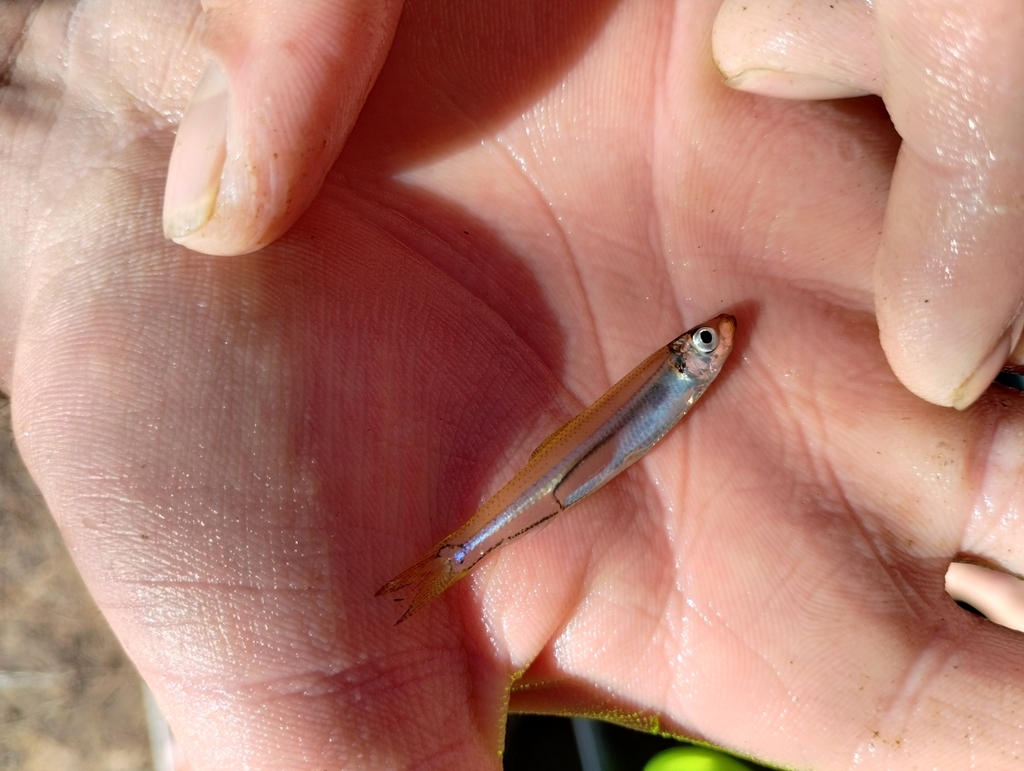
Glassy Sprat
Hyperlophus translucidus
The glassy sprat (Hyperlophus translucidus) is a type of sprat fish. The fish, when alive, is translucent, so it gets the second word in its scientific name from the Latin word translucidus, meaning transparent, diaphanous. In animal classification the glassy sprat belongs to Osteichthyes (some resources classified as Actinopterygii), Clupeiformes, Clupeidae, Hyperlophus. The glassy sprat is native to Australia and mainly found in Australia. It is marked as NE because it has not yet been evaluated by the World Animal Protection. It is mainly used as an economical aquatic product. In ecosystems, they are at the bottom end of the food chain, feeding mainly on plankton, which are less aggressive and very vulnerable to other fish. Glassy sprat are tiny in size and translucent with a silvery streak that extends from its tail to just behind its head. As early as a hundred years ago, Australians harvested the glassy sprat in large quantities and it featured on the table as food for a long time. Due to its poor appearance, it is not a very good ornamental fish.
From the article Glassy sprat on Wikipedia (CC BY-SA), quoted section by section
Range & habitat
This fish belongs to the Australian characteristics of fish species, mainly in two states, Queensland and New South Wales and they often live in brackish water area closer to the mainland. They are absent during the daytime, and many preflexion larvae are present during the night. Glassy sprats are pelagic and live inshore. They are found in shallow seagrasses, over sand adjacent to seagrasses, and in the shallow sandy parts of bays and estuaries. Glassy sprats are distributed across the Coral Sea, the Tasman Sea, and the South Pacific. According to the records, the location where the fish has been found is from Hervey Bay in Queensland through to the mid southern coast of NSW, including, Brisbane River, Mary River Heads, Caloundra, Moreton Bay, and Noosa River in Queensland; Port Stephens, Lake Illawarra, Lake Macquarie, Sans Souci (Botany Bay), in Sydney, Harbour and Jervis Bay in NSW. The fish assemblage of glassy sprat in seagrass beds close to the estuary mouth is significantly different from those in beds located far from the mouth of the estuary. The population of glassy sprat in seagrass beds is higher at night than during the day. One reason for the difference is that fish can avoid the netting more efficiently during the day than they do at night. They may also go deeper to avoid bird predators during low tide during the day. …
Wikipedia: “Distribution”
What it does
Glassy sprat reproduces through sexual propagation, ovipara, and in vitro fertilization. Each female glassy sprat can lay tens of thousands of eggs and they scatter them freely in the sea. Male fish discharge a lot of semen after the female lays eggs, which causes the water to turn a different colour. Glassy sprat roe have mucus on the surface of their egg membrane and can be stuck to rocks, moss, and water grass. While their hatching success rate is low, the number of new offsprings born each year is a lot. The hatching time of fish eggs is variable, ranging from 1 to 5 days. The eggs of sprats are translucency, extremely buoyancy, and delicacy. Their ova are 1.016 mm in diameter and spherical. The capsule is fragile, yet the transparent, colourless yolk that almost entirely fills the capsule has delicate lines or reticulations, as if the yolk were not separated into spheres The anal opening is a four-fifths distance along the underside of the body and the basal portion of the tail. The eggs and larvae of the glassy sprat are plentiful in the sub-tropical waters of southern Queensland during late winter and early spring (June–October), when the average monthly sea surface temperature ranges from 21 to 23 °C (70 to 73 °F). The females spawn an average of one per week. The hatching time of fish eggs is variable, ranging from 1 to 5 days. …
Wikipedia: “Reproduction”
In human culture
The glassy sprat is a marine and estuary species that occurs mainly in nearshore zones, seagrass areas, and shallow estuaries. It is often captured as a by-product of fisheries. Although it is easy to catch such fish because of its number, it has never been a commercial fish. Although the fish is often found in by-products of fisheries, catches like this only represent a very small fraction of the total population and do not have any negative impact on their population's survival. This species represents a small amount of by-catch in the New South Wales ocean hauling fishery, and has also been recorded as by-catch in the Moreton Bay prawn trawl fishery (Robins-Troeger, 1994). Due to its high number, humble size, and since it doesn't have an influence on its sea, it has been marked as Least Concern by IUCN.
Wikipedia: “History”
Where it lives
Recorded sightings
—
geo-referenced records in GBIF, from museums, herbaria and field observers.
Drag the globe to turn it. Dots are where records exist, not a range map; darker means more records.
In the stacks
Searching the stacks…
Every page naming Hyperlophus translucidus in the Biodiversity Heritage Library →
This page is assembled live from iNaturalist, GBIF, Wikipedia, the Source Library and the Internet Archive. It is not yet part of the hand-edited codex. iNaturalist taxon 529798.