- Animals
- ›Chordates
- ›Vertebrates
- ›Ray-finned Fishes
- ›Spiny-rayed fishes
- ›Jacks, Flounders, Barracudas, and Allies
- ›Jacks, Remoras, and Allies
- ›Jacks
- ›Caranginae
- ›Caranx
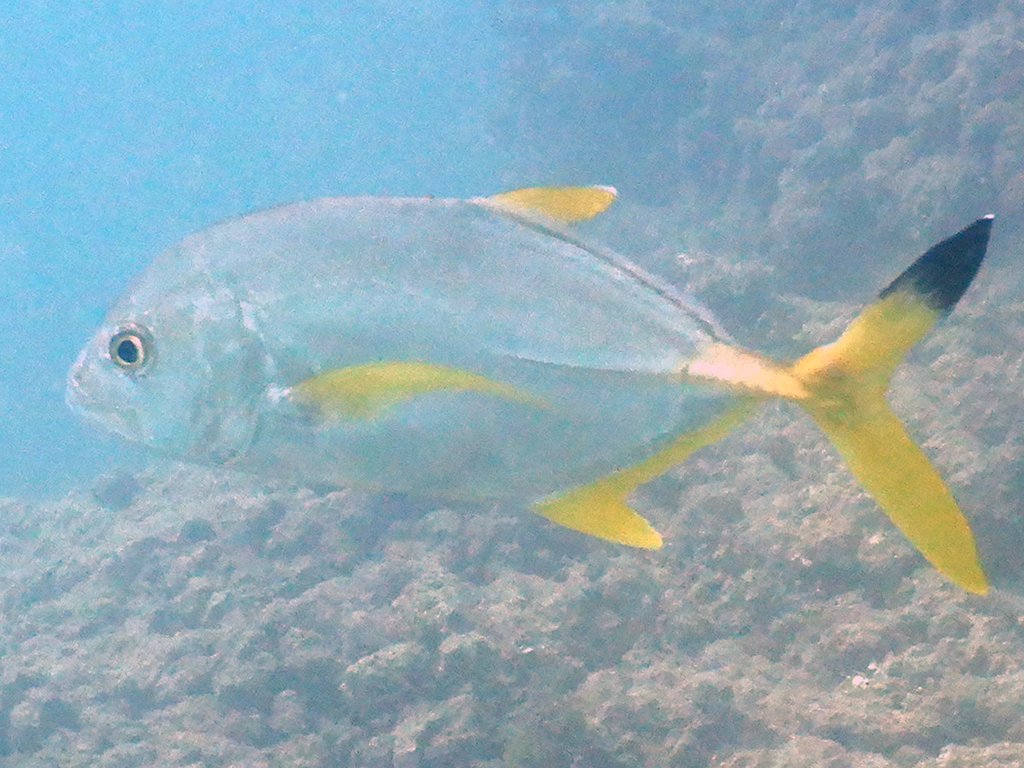
Blacktip Trevally
Caranx heberi
The blacktip trevally (Caranx heberi), also known as the blacktip kingfish or yellowtail kingfish, is a species of large marine fish classified in the jack family Carangidae. The blacktip trevally is distributed throughout the tropical to subtropical Indian and West Pacific Oceans, ranging from South Africa in the west to Fiji, Japan and northern Australia in the east. It inhabits coastal waters throughout its range, preferring moderately deep clear waters over rocky and coral reefs. The blacktip trevally is easily distinguished by its yellow fins and a dark upper caudal fin lobe which gives the species its common name, as well as a host of other anatomical features. The species is known to reach a maximum size of 1 m. It is a benthopelagic predator, commonly forming small shoals where it takes a variety of fishes, cephalopods and crustaceans as prey. Little is known of reproduction in the species, and spawning is assumed to take place in more tropical regions of its range, with juveniles known to inhabit bays and large estuaries. Blacktip trevally are often caught using hook and line and various nets in commercial fisheries although don't make up a large part of the market. They are also popular with anglers due to their fighting ability and decent table qualities.
From the article Blacktip trevally on Wikipedia (CC BY-SA), quoted section by section
Description
The blacktip trevally is a large fish, growing to a maximum recorded size of 1 m in length and 12.5 kg in weight. It is similar to most other jacks in having a compressed, oblong body, with the dorsal profile much more convex than the ventral profile, particularly anteriorly. The dorsal fin is in two distinct sections; the first consisting of 8 spine and the second of 1 spine and 19 to 21 soft rays. The anal fin consists of 2 anteriorly detached spines followed by 1 spine and 15 to 17 soft rays. The ventral fin consists of 1 spine and 5 soft rays, while the caudal fin is strongly forked. The species lateral line is moderately arched anteriorly, with 50 to 60 scales in this section, while the straight section contains 0 to 4 scales and 30 to 40 strong scutes. The pattern of breast scales is variable, ranging from fully scaled to naked ventrally. The species has moderately well developed adipose eyelids, while its dentition consists of an outer row of widely spaced canines and an inner band of villiform teeth in the upper jaw and a row of widely spaced conical teeth on the lower jaw. The blacktip trevally has 24 to 27 gill rakers and 24 vertebrae. The blacktip trevally's colouration is distinctive, with the upper body being dark bronze to yellow green while the lower body fades to silvery white below. …
Range & habitat
The blacktip trevally is distributed throughout the tropical and subtropical waters of the Indian and West Pacific Oceans. In the western part of its range, the species ranges from South Africa and Madagascar north along the east African coast up to the Persian Gulf and Red Sea. Its distribution continues eastward through India, South East Asia and the Indonesian Archipelago. Its range extends south to northern Australia, north to Japan, and to Fiji in the east. The blacktip trevally is predominantly an inshore species, frequenting clean open coastal waters as an adult, with juveniles also found in large bays and estuaries. Adults are often found over moderately deep rocky reefs and pinnacles as well as open sandy areas.
Wikipedia: “Distribution and habitat”
What it does
The blacktip trevally travels in both small shoals and individually throughout its habitat, with juveniles more commonly found in shoals. They appear to be migratory, with South Africa recording influxes of the species in summer, while in India they arrive after the monsoons and continue their inhabitance through the cold months. The species is a benthopelagic predator, taking its prey from the sea floor and higher in the water column. Prey items include a variety of fish, cephalopods, and crustaceans including shrimps, mantis shrimps, crabs and crayfish. Reproduction in the species is poorly understood, although observations indicate it spawns in the more tropical regions of its range, with sexual maturity reached at 50 cm.
Wikipedia: “Habitat and behavior”
Where it lives
Recorded sightings
—
geo-referenced records in GBIF, from museums, herbaria and field observers.
Drag the globe to turn it. Dots are where records exist, not a range map; darker means more records.
In the stacks
Searching the stacks…
Every page naming Caranx heberi in the Biodiversity Heritage Library →
This page is assembled live from iNaturalist, GBIF, Wikipedia, the Source Library and the Internet Archive. It is not yet part of the hand-edited codex. iNaturalist taxon 529700.