- Animals
- ›Chordates
- ›Vertebrates
- ›Birds
- ›Hawks, Eagles, Kites, and Allies
- ›Hawks, Eagles, and Kites
- ›Typical Eagles and Hawk-Eagles
- ›Spizaetus
On eBird ↗
Ornate Hawk-Eagle
Live sightings near you, the range map, bar charts of when it is seen, and Macaulay Library photos and recordings.
Ornate Hawk-Eagle
Spizaetus ornatus
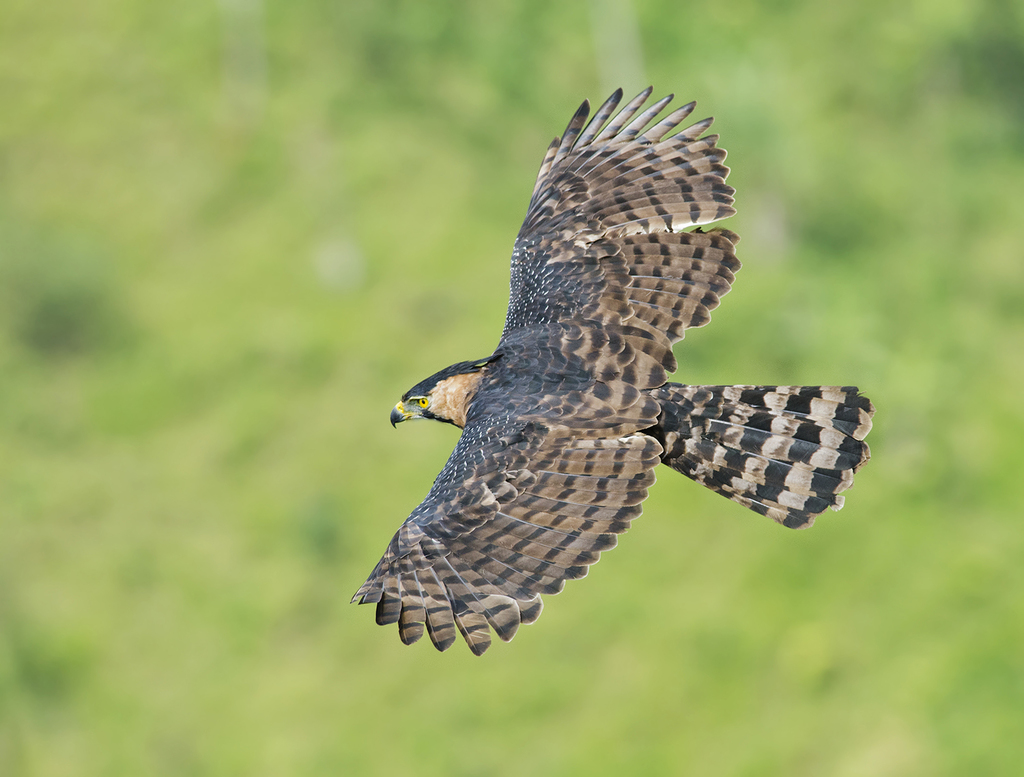
The ornate hawk-eagle (Spizaetus ornatus) is a bird of prey from the tropical Americas. Formerly, some authorities referred to this species as the crested hawk-eagle, a name that may cause some confusion as it is more commonly used for an Asian eagle species. Like all eagles, it is in the family Accipitridae. This species has a feathered tarsus that marks it as a member of the Aquilinae or booted eagle subfamily. This species is notable for the vivid colors and bold markings of adults, which differ considerably from the far more whitish plumage of the juvenile bird. The ornate hawk-eagle ranges from central Mexico south through much of Central America and in a somewhat spotty but broad overall range into South America, including in the west apart from the Andes and broadly on the Atlantic side especially Brazil down to as far as Southeast Brazil and northern Argentina. This species is found largely in primary forests with tall trees, although can be found in many forest types.
The ornate hawk-eagle female lays almost always a single egg and the species has a fairly prolonged breeding cycle like many tropical raptors, especially due to a lengthy post-fledging stage on which juveniles are dependent on their parents. It is a diversified and exceptionally powerful predator which takes a range of prey, usually various medium-to-large-sized birds and small-to-medium-sized mammals as well as occasional reptiles. Like many forest-dependent raptors, especially those in the tropical and subtropical regions, this species is likely under the pressing threat of deforestation.
From the article Ornate hawk-eagle on Wikipedia (CC BY-SA), quoted section by section
Description
This is a medium to large-sized species of raptor, but small for an eagle. In the ornate hawk-eagle, the sexes are similar in appearance and overlap in size, but like most birds of prey, do show reverse sexual dimorphism, in which females outsize males to the contrary of most nonraptorial birds. The biggest female ornate hawk-eagles are 13% larger than the biggest males, with an average of about 8% greater in nominate race. In Central America, in extreme cases, the largest females are as much as 50% heavier than the smallest males. The species is slightly smaller than the largest members of widespread raptor genera such as the largest Buteo and Falco species, but is usually larger than other forest raptors in its range apart from vultures and other eagle species. The total length of full-grown ornate hawk-eagle is 56.0 to 68.5 cm (22.0 to 27.0 in). Average total length is estimated at 60 cm (24 in) for males and 63 cm (25 in) for females. The wingspan may range from 117 to 142 cm (3 ft 10 in to 4 ft 8 in). Body mass can vary in males from 835 to 1,215 g (1.841 to 2.679 lb) and in females from 950 to 1,760 g (2.09 to 3.88 lb). The average weight of five adult males was 1,009 g (2.224 lb) while another five males averaged 1,035 g (2.282 lb). The average weight of four adult females was 1,421 g (3.133 lb), while a sample of 11 averaged 1,452 g (3.201 lb). …
Range & habitat
The ornate hawk-eagle has the largest distribution of the nine species of eagle endemic to the neotropics, ranging over an estimated 20.2 million square kilometers in total. This is a largely sedentary species, but some local dispersal is known to occur and individuals wander into drier forest and higher altitudes than normal. The species ranges as far north as southeastern Mexico, where it is found on the Caribbean slope from southern Tamaulipas, on Pacific more infrequently in Jalisco and east Oaxaca. In their Mexican range, their status is uncertain in Colima, where it may be extirpated. Reportage of the species is known in the Mexican states of Guerrero and Nayarit but these could pertain to wandering individuals. Nesting remains unconfirmed throughout west Mexico and since most birds seen are juveniles, these could refer to post-dispersal wanderers. The species is found almost continuously through Central America in Belize, Guatemala, El Salvador, Honduras and Nicaragua into Costa Rica and Panama (including the isle of Coiba). In Panama, it is much more numerous on the more humid Caribbean side than the drier slopes of the Pacific, being especially scarce in the Panama Canal Zone and Azuero Peninsula, but can occur in more humid parts of the Pacific side. A similar distributional favoring of the more humid Caribbean coast has been noted elsewhere in Central America as well. …
Wikipedia: “Range and habitat”
What it does
The ornate hawk-eagle is a powerful predator that readily varies its prey selection among two main prey groups. Largely the most significant prey for the species are medium to large sized birds. The other main prey type are a variety of small to medium-sized mammals. On occasion, reptiles may form a seldom part of the diet. This species largely forages inside forests, often perch-hunting. This entails short flights from tree to tree at mid-story heights while foraging or still-hunting from inconspicuous vantage points near the center of a dense canopy. Upon prey detection, they swoop to grasp the prey on the ground or in trees or engage in tail chases among trees. The agility imparted by its relative small and broad wings and longish tail and talent for tail-chases in enclosed woods and thickets are why this and similar eagles are referred to as "hawk-eagles", in reference to similar hunting styles in the "true hawks" (i.e., the members of the Accipiter and Astur genera). In size, tail length and hunting style, the ornate hawk-eagle in particular is quite similar to the largest races of the larger Astur species (formerly Accipiter), the Eurasian goshawk (Astur gentilis). Most witnessed tail-chases by this species have involved chasing various gamebirds, with about equal accounts of successful and unsuccessful pursuits. …
Wikipedia: “Dietary habits”
Listen
Looking for field recordings…
Where it lives
Recorded sightings
—
geo-referenced records in GBIF, from museums, herbaria and field observers.
Drag the globe to turn it. Dots are where records exist, not a range map; darker means more records.
In the stacks
Searching the stacks…
Every page naming Spizaetus ornatus in the Biodiversity Heritage Library →
This page is assembled live from iNaturalist, GBIF, Wikipedia, the Source Library and the Internet Archive. It is not yet part of the hand-edited codex. iNaturalist taxon 5294.